




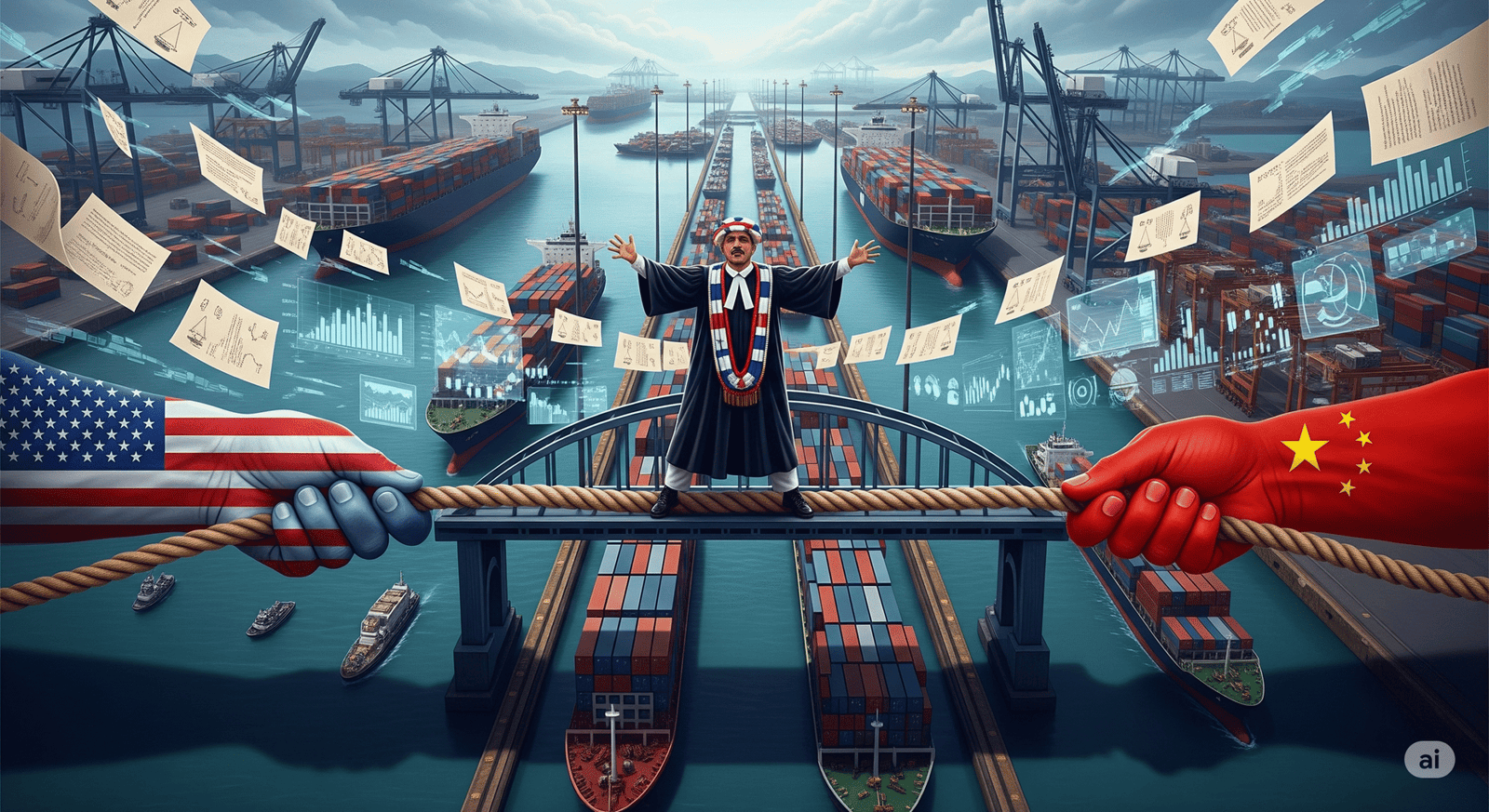
In the strategic heart of Central America, a new and highly significant front has opened in the global geopolitical struggle between the United States and China. On Friday, July 31, 2025, Panama’s Comptroller General, Anel Flores, announced the filing of two lawsuits with the country’s supreme court against the owners of two critical ports at either end of the Panama Canal. This legal action, ostensibly focused on the financial and legal terms of a decades-old contract, is widely viewed as a pivotal moment in a high-stakes battle for influence over one of the world’s most vital maritime chokepoints.
The lawsuits target the Panama Ports Company (PPC), a local subsidiary of the Hong Kong-based firm CK Hutchison. This company has operated the ports of Balboa on the Pacific side and Cristobal on the Atlantic since 1997. The action comes on the heels of a failed attempt by a U.S.-backed consortium—led by the American investment fund BlackRock and Swiss shipping giant MSC—to acquire a majority stake in these ports as part of a larger global portfolio sale. The deal’s collapse was a direct result of Chinese government pressure, which reportedly insisted on a state-owned Chinese shipping company, Cosco, being included as a veto-holding member of the consortium. For Washington, this was an unacceptable display of Beijing’s ability to leverage its economic power to influence critical global infrastructure, and it set the stage for Panama’s latest move.
The Panamanian government’s stated rationale for the lawsuits is rooted in a detailed audit and the public interest. The comptroller general has been highly critical of the existing contract, which was extended for 25 years in 2023. He has labeled it “unfair” and “abusive,” claiming that the company has failed to pay the Panamanian state sufficient royalties. One lawsuit seeks to nullify the contract entirely, while the other aims to declare its extension unconstitutional. In a press conference, Flores emphasized that the future of these vital national assets should be determined by Panamanians, not by foreign powers negotiating their fate in other parts of the world. This sentiment, though framed in terms of national sovereignty, aligns perfectly with Washington’s strategic interests and has been publicly supported by Panama’s president, José Raúl Mulino.
The timing of this legal offensive is, therefore, no coincidence. The Panama Canal, which handles a significant portion of global maritime trade, has been a key area of focus for the United States, particularly under the Trump administration, which has repeatedly voiced concerns about Chinese influence. In his inauguration speech, President Trump vowed to “take back” the canal from what he perceives as growing Chinese control. Following this, an audit was initiated by the Panamanian government, and the country later withdrew from China’s Belt and Road Initiative, signaling a clear shift in its diplomatic and economic alignment. The lawsuits against PPC are the most aggressive step yet in this realignment.
If the Panamanian court finds in favor of the government, the contracts for the ports would be re-tendered. This would give Panama the opportunity to redesign the terms to be more favorable to the state and, more importantly, to ensure that the winning bidder is aligned with its new geopolitical leanings. Given the recent diplomatic shift and the pressure from Washington, it is highly likely that a U.S. or allied firm would be the successful bidder. This outcome would be a significant win for the United States and a major setback for China’s expanding global port network.
However, the situation is not without risks for Panama. The company, CK Hutchison, has responded by appealing for legal protection for businesses, warning that such actions could create an environment of uncertainty for foreign investors. The company has also highlighted its positive contributions to the Panamanian economy, including the creation of thousands of jobs and billions in revenue. This is a subtle but clear warning that a politically motivated expropriation could expose Panama to international litigation and damage its reputation as a safe place for foreign investment.
Ultimately, the lawsuits filed by Panama are more than just a local legal dispute. They represent a critical moment in the battle for influence over a crucial piece of global infrastructure. With the U.S. and China locked in a strategic competition, the fate of these ports will have far-reaching implications, not only for the Panamanian economy but for the future of global trade and the balance of power in the Western Hemisphere. The world will be watching to see whether Panama’s bold legal move is a step towards economic sovereignty or a miscalculation in a game of great-power politics.
Based on the latest reports from Friday, July 31, 2025, here are 21 bullet points on Panama’s recent legal action against a port owner.
- Date: July 31, 2025
- Action: The Panamanian Comptroller General, Anel Flores, filed two lawsuits against the owners of ports at both ends of the Panama Canal.
- Lawsuit Target: The lawsuits are against Panama Ports Company, a subsidiary of the Hong Kong-based firm CK Hutchison.
- Geopolitical Context: The legal action is seen as a development in the ongoing struggle for influence between the U.S. and China over strategic infrastructure.
- US Influence: The move is being viewed as a potential victory for the U.S., specifically for the efforts of President Donald Trump to limit Chinese influence in the region.
- Ports’ History: The ports at the center of the dispute were originally awarded to CK Hutchison in 1997.
- Failed Sale: The lawsuits follow a failed attempt to sell the ports to a consortium led by the U.S. investment fund BlackRock and the Swiss shipping firm MSC.
- Chinese Interference: The sale reportedly failed after China threatened to block the deal unless its state-owned shipping giant, Cosco, was included in the consortium.
- Allegations: The Panamanian government claims the contract with Panama Ports Company is “unfair” and “abusive.”
- Financial Claims: The comptroller general has alleged that the company has not paid sufficient royalties to the Panamanian government.
- Contract Extension: A 25-year contract extension, signed in 2023, is also being challenged as it was allegedly made without the necessary authorizations.
- Legal Objectives: One lawsuit seeks to nullify the contract, while the other aims to declare it unconstitutional.
- President’s Stance: Panama’s president, José Raúl Mulino, has publicly supported the comptroller general’s decision.
- Strategic Timing: The timing of the lawsuits is seen as advantageous for the US-backed consortium.
- Potential Outcome: If the lawsuits are successful, the contracts for the ports would have to be re-tendered.
- Panama’s Shifting Stance: Panama previously exited China’s Belt and Road Initiative in April, signaling a shift away from Beijing.
- Future Bidding: A successful re-tendering process would likely favor a U.S. firm or an ally country.
- Panama’s Goals: Nullifying the contract would allow Panama to redesign the terms to be more beneficial to the state.
- Legal Risks: Panama could face litigation from CK Hutchison, which might argue the lawsuits are a politically motivated expropriation.
- Company’s Response: Panama Ports Company has appealed for legal protection for businesses, stating that respect for the rule of law is essential for investors.
- Job Impact: The company claims its operations have created over 25,000 direct and indirect jobs and contributed billions to the Panamanian economy.
When, Where, Why, and Who
- When: The lawsuits were officially filed on Wednesday, July 30, 2025, and were publicly announced on Thursday, July 31, 2025.
- Where: The legal action is taking place in Panama, specifically regarding two ports at either end of the Panama Canal. The port owner is a Hong Kong-based company.
- Why: The lawsuits were filed because the Panamanian government claims the contract with the port operator is “unfair” and “abusive,” alleging insufficient royalty payments and an improperly authorized contract extension. This legal move is also occurring within the broader context of a geopolitical struggle between the U.S. and China for influence over key global infrastructure.
- Who: The legal action was initiated by Panama’s Comptroller General, Anel Flores, with the support of President José Raúl Mulino. The target of the lawsuits is the Panama Ports Company, a subsidiary of the Hong Kong-based CK Hutchison. The situation also involves the U.S. and China, who are vying for influence, and the U.S.-backed consortium of BlackRock and MSC, which had a failed attempt to acquire the ports.