



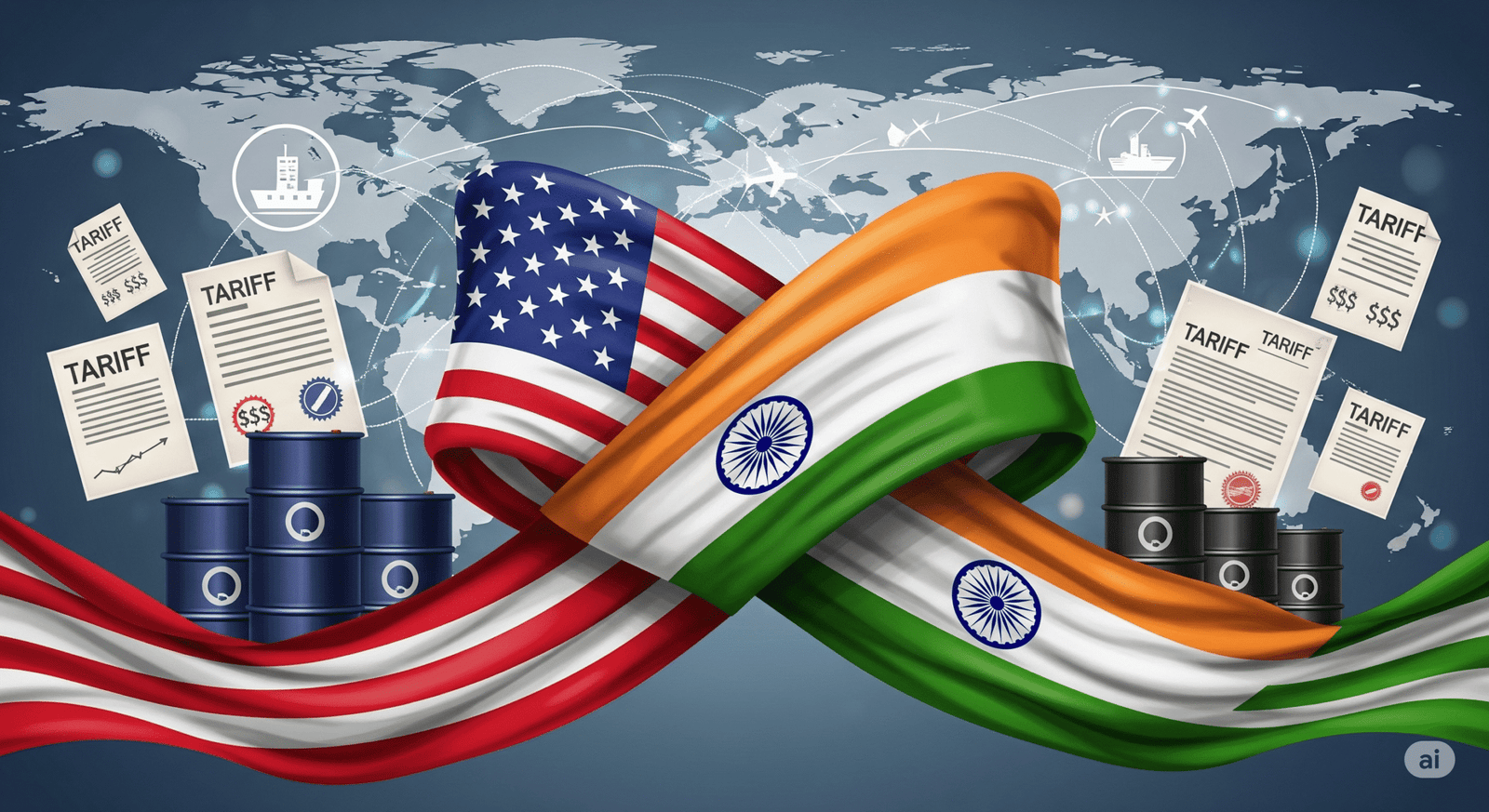
The global trade landscape is undergoing a seismic shift, driven by geopolitical tensions and protectionist policies. In a move that has sent shockwaves across international markets, the U.S. government has levied a substantial 50% reciprocal tariff on imports from India and Brazil. This is not just a standard trade dispute; it’s a stark reflection of how international diplomacy and economic policy are now inextricably linked. At the heart of this conflict lies the continued purchase of Russian oil by these nations, a practice the U.S. views as a direct challenge to its efforts to isolate Moscow.
This tariff hike, which doubles the previous 25% rate, places India and Brazil at a significant disadvantage in the U.S. market. The new, additional 25% tariff is set to take effect on August 27, 2025, following the initial 25% levy that began on August 7, 2025. The rationale provided by the Trump administration is clear: by continuing to buy Russian crude, these countries are “fueling the war machine” in Ukraine. This punitive measure is designed to force India and Brazil to reconsider their trade relationships with Russia.
The immediate fallout for India is expected to be severe. The U.S. is India’s largest export destination, and a 50% tariff effectively makes many Indian goods uncompetitive. The most vulnerable sectors are those that are labor-intensive and operate on thin margins, such as textiles, footwear, gems, and jewelry. Analysts predict that these tariffs could reduce India’s exports to the U.S. by as much as 40-50%, a staggering blow that could wipe out a full percentage point from the nation’s GDP growth. The economic pain will be felt by countless small and medium-sized enterprises (SMEs) that rely on the U.S. market. For these businesses, absorbing such a massive cost increase is simply not viable, and many could be forced to close, leading to job losses and economic instability.
India has reacted strongly, with its Ministry of External Affairs calling the tariffs “unjustified and unreasonable.” New Delhi argues that its decision to purchase Russian oil is based on commercial viability and the critical need to secure energy for its massive population of 1.4 billion people. India also points out the hypocrisy of the U.S. and its European allies, which continue to engage in trade with Russia in other sectors. This is a classic example of the delicate balancing act India is trying to perform—maintaining its long-standing strategic relationship with Russia while also fostering economic ties with the U.S. and Europe.
The situation is further complicated by the geopolitical dynamics at play. While the U.S. is targeting India and Brazil, it has not imposed similar tariffs on China, which is the world’s largest buyer of Russian crude. This selective application of pressure raises questions about the true motivations behind the tariffs. Is it solely about pressuring Russia, or is it also a tactic to reshape global trade alliances and assert U.S. dominance? Some experts believe this move could inadvertently push India closer to Russia and China, creating a new, more solidified bloc in opposition to U.S. policy. The recent phone call between Indian Prime Minister Modi and Brazilian President Lula, where they discussed the tariffs and the need to defend multilateralism, underscores this potential realignment.
From a trade perspective, a reciprocal tariff is a tax imposed by one country on another in response to a similar action. The theory is that by matching tariffs, a country can pressure its trading partner into lowering its barriers and creating a more balanced trade environment. However, when these tariffs are used as a tool for geopolitical leverage rather than purely economic reasons, they can spiral into a full-blown trade war, harming economies and straining diplomatic relations.
The long-term consequences of these tariffs are still uncertain. India may be forced to diversify its trade partners and seek new markets for its goods, which could be a challenging and lengthy process. The move also risks unraveling the burgeoning U.S.-India strategic partnership that has been a focus for both countries in recent years. The tariffs, while aimed at Russia, are inflicting significant collateral damage on a key U.S. partner, and the ripple effects will be felt far beyond the balance sheets of Indian exporters. The coming months will be a crucial test of diplomatic resolve and economic resilience as India navigates this complex and challenging new reality.
Trump Doubles Tariffs on India to 50% | ISH News
U.S. Tariffs on India and Other Countries
The U.S. government, under President Donald Trump, has imposed significant new tariffs on countries, including India and Brazil. The move is a response to their continued purchase of Russian oil, which the U.S. says is funding Russia’s war in Ukraine. The tariffs on Indian goods are now as high as 50%, with the new additional tariff taking effect on August 27, 2025. This action is expected to heighten global trade tensions and have a notable economic impact on India.
21 Bullet Points on the Latest News (Date: August 8, 2025)
- The U.S. government has imposed additional tariffs on imports from India.
- The tariffs are a direct response to India’s continued purchase of Russian crude oil.
- The new tariffs are a “punishment” for what the U.S. views as India “fueling the war machine.”
- An additional 25% tariff was announced, bringing the total tariff rate on many Indian goods to 50%.
- The first 25% tariff became effective on August 7, 2025.
- The additional 25% tariff will take effect 21 days later, on August 27, 2025.
- The tariff rate of 50% on India is the highest rate imposed by the U.S. on any country, on par with Brazil.
- Brazil also faces a 50% tariff for similar reasons.
- The tariffs are expected to significantly impact India’s export sectors, particularly those that are labor-intensive.
- Industries most affected include textiles, leather, footwear, gems, and jewelry.
- Some products, such as pharmaceuticals, energy resources (including crude oil), and certain electronics, are currently exempt from the elevated tariffs.
- Analysts predict the tariffs could reduce India’s exports to the U.S. by 40-50%.
- The economic fallout could shave up to 1% off India’s GDP growth.
- India’s Ministry of External Affairs has called the tariffs “unjustified and unreasonable.”
- India states its oil purchases are based on market factors to ensure its energy security.
- India’s exports to the U.S. were approximately $87 billion in 2024.
- The financial savings for India from purchasing discounted Russian oil were around $3.8 billion in the last fiscal year.
- The U.S. move is seen as a way to pressure Russia by targeting its trading partners.
- Critics note that China, the largest buyer of Russian crude, has not faced similar tariffs.
- The tariffs may push India to seek new trading partners and re-evaluate its global alliances.
- Indian Prime Minister Narendra Modi and Brazilian President Luiz Inácio Lula da Silva have spoken, reaffirming their commitment to multilateralism and defending against unilateral tariffs.
When, Where, Why, and Who
When: The U.S. government announced an additional 25% tariff on Indian imports on August 6, 2025, which will become effective on August 27, 2025. This comes after a separate 25% tariff became effective on August 7, 2025.
Where: The tariffs are being imposed by the United States government on imports from India and Brazil. The economic and political impacts will be felt in these countries and across the global trade landscape.
Why: The tariffs were imposed by the U.S. government in response to India and Brazil’s ongoing purchases of Russian oil. The U.S. views these purchases as providing financial support to Russia, which is engaged in a war with Ukraine. The action is intended to pressure Russia by targeting its economic lifelines.
Who: The tariffs were implemented by U.S. President Donald Trump via an executive order. The tariffs target the governments and economies of India and Brazil, and will directly affect exporters, businesses, and consumers in these countries.