



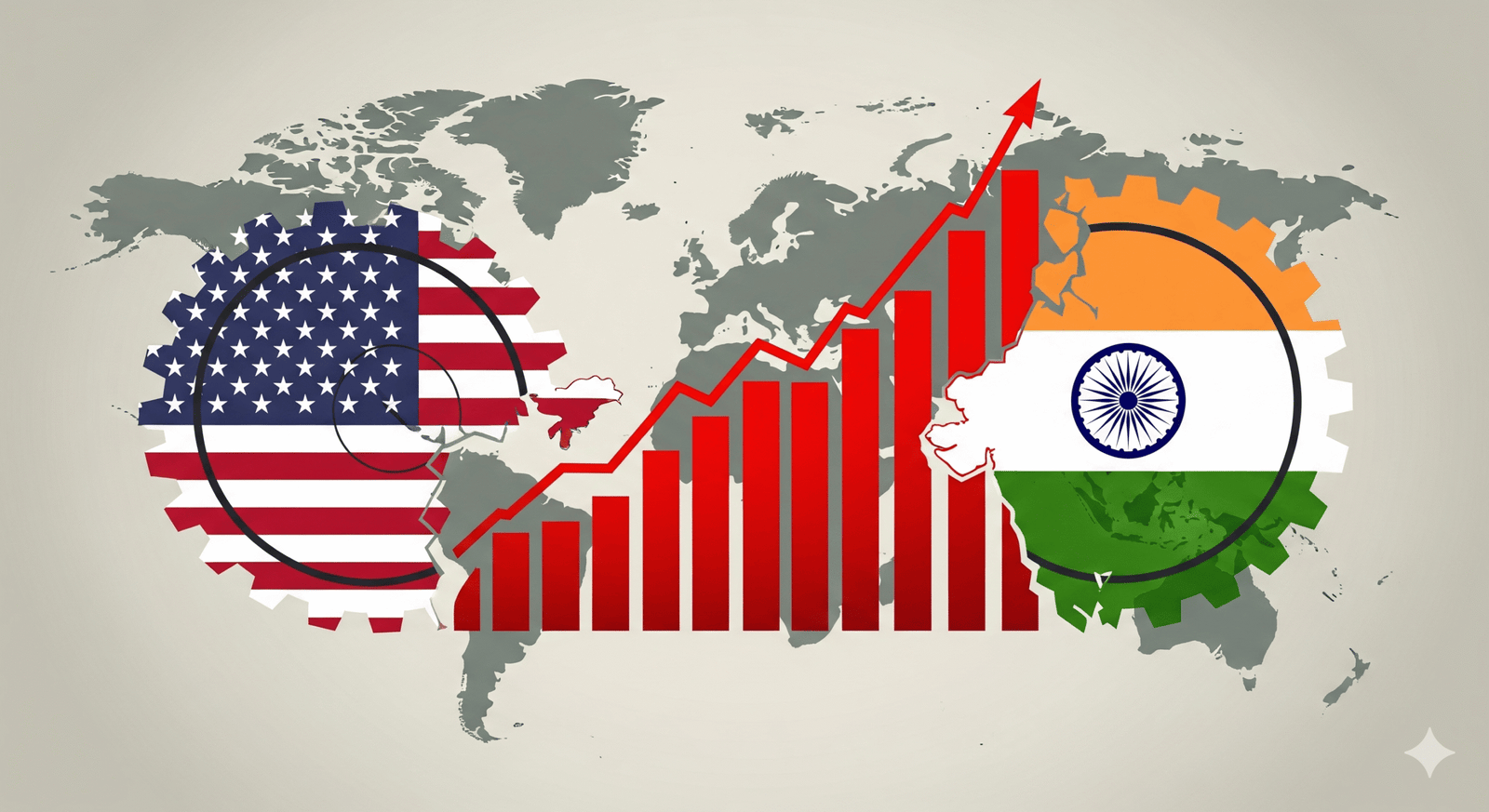
Loni Kalbhor, Maharashtra, India – In a significant and widely-anticipated move, the Donald Trump administration has officially imposed a staggering 50% tariff on a wide range of Indian goods, a decision that has sent shockwaves through India’s export-dependent sectors and raised concerns about the country’s economic trajectory.1 The new tariffs, which came into effect on August 27, 2025, are not a simple trade measure but a powerful political and economic statement, forcing India to re-evaluate its trade strategy and seek new avenues for growth.2 For a nation like India, with its complex web of global trade and a focus on becoming a major manufacturing hub, the repercussions of this policy are far-reaching.3
The 50% tariff is an amalgamation of a previously imposed 25% “reciprocal” tariff and an additional 25% duty levied as a punitive measure for India’s continued imports of Russian crude oil.4 This has created a “strategic shock” for India, affecting a significant portion of its exports to its largest trading partner, the United States.5 According to an analysis by the Global Trade Research Initiative (GTRI), the tariffs will directly impact over $60 billion worth of Indian exports, which is approximately two-thirds of India’s total exports to the US.6
The hardest-hit sectors are India’s labor-intensive industries, which are crucial for employment and economic stability.7 Textiles, gems and jewelry, shrimp, and furniture are among the most vulnerable, with experts predicting a potential 70% reduction in export volumes from these sectors.8 For millions of workers in hubs like Tiruppur, Surat, and Noida, this translates to an immediate threat to their livelihoods.9 The new duties will make Indian goods significantly more expensive for American consumers, giving competitors from countries like China, Vietnam, and Bangladesh a considerable price advantage.10 Analysts have warned that a simple shirt made in India could cost over 30% more than a similar one from Bangladesh, effectively pricing Indian goods out of the US market.11
While the headline figures paint a grim picture, not all of India’s exports are affected equally.12 Sectors like pharmaceuticals, electronics, and petroleum products have been granted exemptions and will remain duty-free for now.13 This is a crucial detail, as it highlights a potential strategic carve-out for goods that are vital to the US economy. However, the exemptions are not guaranteed, and analysts have warned that further tariffs on these sectors, particularly in areas like semiconductors, could be on the horizon.
India’s response has been one of calculated resilience rather than immediate retaliation. The government is actively pursuing a multi-pronged strategy to mitigate the damage.14 This includes launching dedicated outreach programs in over 40 new markets, including the UK, Japan, and South Korea, to diversify its export base.15 Officials are also considering domestic policy reforms, such as GST adjustments and a new Export Promotion Mission, to boost internal demand and support affected industries.16 Prime Minister Narendra Modi’s government has maintained a firm stance, emphasizing that India’s foreign policy and trade decisions are guided by its national interests and not external pressure.17 The government is signaling that this trade shock could be a catalyst for long-overdue economic reforms and a push towards a more self-reliant economy.18 While the short-term pain is undeniable, the government’s strategic response aims to turn this crisis into an opportunity for long-term economic restructuring.19
Key Points on US Tariffs on India
- Date of Effect: The 50% tariffs came into effect on August 27, 2025.20
- Perpetrator: The Trump administration.
- Amount of Tariffs: A total of 50%, combining a 25% “reciprocal” tariff and a new 25% punitive tariff.21
- Official Rationale: The new tariff is a penalty for India’s continued purchase of Russian crude oil.22
- Economic Impact: A single analysis suggests a potential impact of 0.9% on India’s GDP.23
- Affected Goods Value: Approximately $60.2 billion of Indian exports will be hit by the 50% tariff.24
- Affected Sectors: Labor-intensive industries like textiles, gems and jewelry, shrimp, and furniture.25
- Projected Export Reduction: Affected sectors could see a 70% plunge in export volumes to the US.26
- Competitors to Benefit: Countries like China, Vietnam, and Bangladesh are expected to gain market share.
- Exempt Sectors: Pharmaceuticals, electronics, and petroleum products are currently exempt.27
- Indian Government Response: A multi-pronged strategy to counter the tariffs.28
- Domestic Measures: Consideration of GST adjustments to boost internal demand.29
- New Trade Strategy: Diversifying exports by focusing on 40 new markets.30
- Strategic Initiatives: Launching an Export Promotion Mission.31
- Official Stance: India will not bow to pressure and will act in its national interest.32
- Job Impact: The tariffs threaten hundreds of thousands of jobs in India’s export hubs.33
- Source of Analysis: The Global Trade Research Initiative (GTRI).
- Political Context: The tariffs are seen as a tool of the “America First” policy.34
- Impact on Bilateral Relations: The tariffs have strained the India-US relationship.
- Alternative Supply Chains: The tariffs may force Indian companies to diversify their supply chains.
- Potential for Reforms: The government sees the crisis as a catalyst for economic reforms.35
US Tariffs on India: When, Where, Why, and Who
When:
- The 50% tariffs officially came into effect on Wednesday, August 27, 2025.36
Where:
- The tariffs are being applied to goods imported into the United States from India.37 The economic impact is being felt across various sectors in India, particularly in export hubs for textiles, gems, and seafood.38
Why:
- The tariffs are a direct result of the Trump administration’s “America First” trade policy. The explicit reason given for the latest 25% increase, which brought the total to 50%, is to penalize India for its continued purchase of Russian crude oil, a move the US views as undermining its foreign policy and sanctions against Russia.39 The broader motivation is to reduce the US trade deficit with India and protect American industries.
Who:
- Proponent: The Trump administration, specifically President Donald Trump and his Department of Homeland Security.40
- Affected Party: The nation of India, its government, exporters, and millions of workers in labor-intensive industries.41
- Beneficiaries: Competing nations like China, Vietnam, and Bangladesh, who are expected to gain market share in the US.42
- Analysts: Organizations like the Global Trade Research Initiative (GTRI), which have provided expert analysis on the economic impact.43