





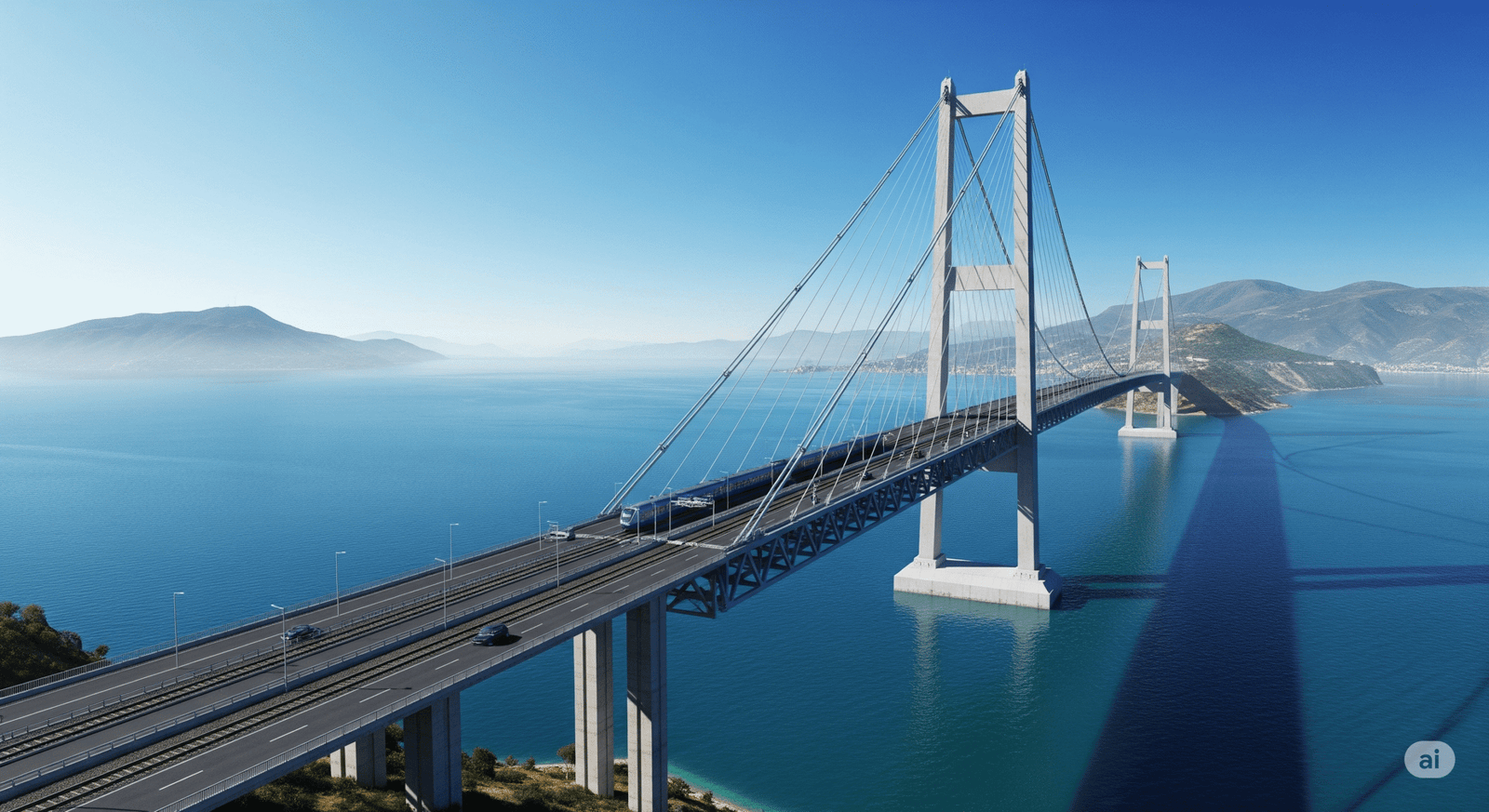
In a monumental decision that has captured the imagination of a nation and reignited a debate spanning centuries, Italy has given the final green light for the construction of the world’s longest suspension bridge. The project, which will connect the island of Sicily to the mainland region of Calabria across the Strait of Messina, is more than just a feat of engineering; it is a high-stakes political and economic gamble aimed at revitalizing Italy’s long-neglected south, while also serving a new strategic purpose in an increasingly tense geopolitical landscape.
The ambitious plan, championed by Transport Minister Matteo Salvini and a priority for the government of Prime Minister Giorgia Meloni, is projected to cost a staggering €13.5 billion. Proponents argue that this colossal investment is the key to unlocking the economic potential of Sicily and Calabria. By dramatically cutting the ferry crossing time—from over an hour to just 10 minutes by car—the bridge is expected to facilitate trade, boost tourism, and, most importantly, create up to 120,000 jobs annually during its construction phase. Salvini has hailed it as “the biggest infrastructure project in the West,” a bold claim that reflects the government’s belief in its transformative power.
However, this is a project fraught with challenges, both historical and modern. The idea of bridging the strait has existed since ancient Roman times, but it has been repeatedly shelved due to a litany of concerns. One of the most prominent is seismic risk; the Strait of Messina lies on a major fault line responsible for a catastrophic earthquake in 1908. While the consortium leading the project, Webuild, has assured the public that the suspension bridge design is built to withstand such seismic forces—citing similar structures in Japan and Turkey—the memory of past tragedies remains a powerful deterrent for many.
Environmental concerns also loom large. Activist groups have lodged formal complaints with the European Union, arguing that the massive project poses a significant threat to migratory bird species that use the strait as a critical flyway. They claim that the government has failed to provide sufficient evidence that the project is a public imperative that outweighs the potential for irreversible ecological damage.
Perhaps the most uniquely Italian challenge is the ever-present specter of organized crime. In a country where major public works projects have historically been a target for mafia infiltration, the government has been forced to provide special assurances. Salvini has publicly pledged that the bridge will be subject to the same stringent anti-mafia protocols used for major international events, vowing that keeping organized crime out of the project is their “top priority.” The success or failure of these measures will be a crucial test of the government’s ability to manage a project of this scale transparently and lawfully.
In a surprising twist, the project has also been framed as a matter of national security. The government has indicated its intent to classify the bridge as a “security-enhancing infrastructure,” a move that would help Italy meet NATO’s defense spending targets. By creating a strategic corridor for the rapid deployment of troops and equipment to NATO’s southern flanks, the bridge could serve a dual-use purpose, blending economic development with military readiness. This unexpected rationale adds another layer of complexity to a project that is already a web of competing interests and ambitious goals.
As preliminary work is set to begin in the coming weeks, Italy stands at a crossroads. The Messina Bridge could be a symbol of a nation finally overcoming its historical divisions and infrastructural deficits, or it could be a testament to a project that was too large, too costly, and too complicated to ever truly succeed. The next decade will reveal whether this historic gamble will pay off, ushering in a new era of prosperity for southern Italy, or if it will become another footnote in the long, troubled history of a bridge to nowhere.
Note: The following is a news summary based on the latest available information as of Friday, August 8, 2025.
Here are 21 key points regarding Italy’s approval of the Messina Bridge project:
- Italy has officially approved the construction of the world’s longest suspension bridge.
- The bridge will connect the island of Sicily to the mainland region of Calabria.
- The project received final approval from a strategic interministerial committee on Wednesday, August 6, 2025.
- The total cost of the project is estimated at €13.5 billion, or approximately $15.5 billion.
- The bridge’s suspended span will be 3.3 kilometers (more than 2 miles) long.
- This length will surpass Turkey’s Canakkale Bridge, currently the world’s longest, by over 1,200 meters.
- The project has been a long-standing proposal, dating back to ancient Roman times.
- The current right-wing government of Prime Minister Giorgia Meloni revived the plan in 2023.
- Transport Minister Matteo Salvini has been a key proponent, calling it “the biggest infrastructure project in the West.”
- The bridge is designed to carry both road and rail traffic.
- It will have three car lanes in each direction and a double-track railway line.
- The project is expected to create up to 120,000 jobs annually during its construction phase.
- It is aimed at boosting the economy of southern Italy, a region that has lagged behind the north.
- Preliminary work, including archaeological and geological surveys, is expected to begin between late September and early October.
- Construction is scheduled to start in 2026.
- The bridge is projected to be completed between 2032 and 2033.
- The project has faced significant opposition and concerns.
- These concerns include seismic risks, as the Strait of Messina is an active fault line.
- Environmental groups have also lodged complaints, citing potential harm to migratory bird species.
- The government has indicated that the project will be subject to strict anti-mafia legislation to prevent criminal infiltration.
- The government may also classify the bridge as a “security-enhancing infrastructure” to help meet NATO defense spending targets, as it could facilitate troop and equipment movement.
When, Where, Why, and Who
- When: The final approval for the project was given on Wednesday, August 6, 2025. Preliminary work is expected to start as soon as late September or early October, with a projected completion date between 2032 and 2033.
- Where: The bridge will be built across the Strait of Messina, connecting the Italian mainland region of Calabria to the island of Sicily.
- Why: The primary reason is to stimulate the economy of southern Italy and improve connectivity between the mainland and Sicily. The bridge is expected to drastically reduce travel time, create a significant number of jobs, and facilitate the movement of goods and people. The government has also linked the project to national security, citing its potential use for rapid troop movements in support of NATO.
- Who: The project was approved by the Italian government, led by Prime Minister Giorgia Meloni. Key figures involved include Transport Minister Matteo Salvini, a major backer of the plan. The construction will be carried out by a consortium led by the Italian infrastructure group Webuild. The project has been opposed by various environmental groups and local anti-mafia organizations, but it is supported by many citizens and businesses in southern Italy.