
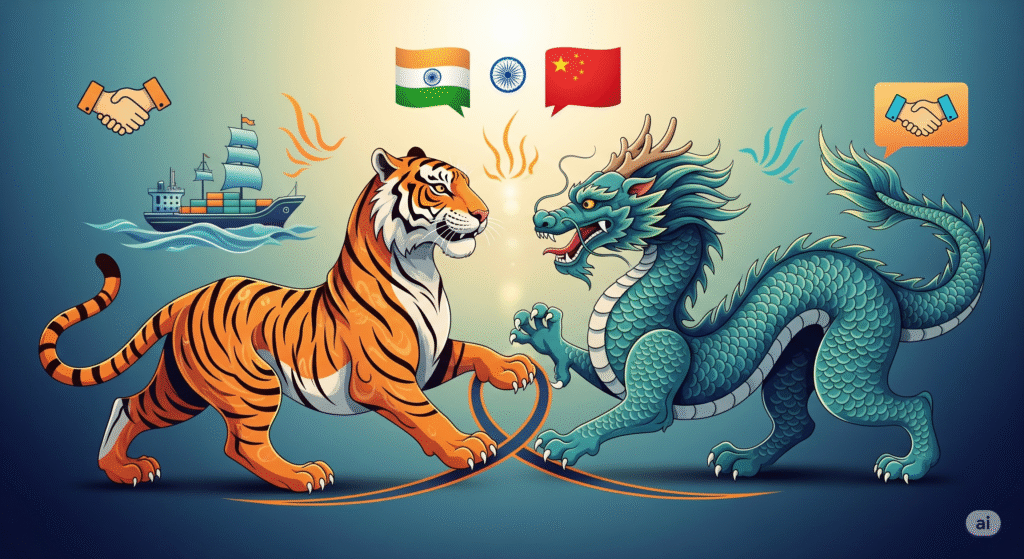
In a significant diplomatic move, China’s Foreign Minister Wang Yi has concluded a visit to India, holding high-level talks with top officials including National Security Advisor Ajit Doval and External Affairs Minister S. Jaishankar.1 The visit, which culminated in a meeting with Prime Minister Narendra Modi, signals a cautious but tangible warming of ties between the two Asian giants after years of strained relations stemming from the deadly 2020 border clash in the Galwan Valley.2 The key takeaway from the talks is a renewed commitment to resume trade relations and work toward resolving their long-standing border dispute.3
The bilateral relationship, which had been frozen since the military standoff, has seen a series of recent confidence-building measures.4 Both sides have agreed to reopen border trade through three key passes: Lipulekh Pass, Shipki La, and Nathu La.5 This decision is a crucial step towards de-escalation and restoring economic connectivity that was severed in the wake of the border tensions.6 Furthermore, the two nations have agreed to resume direct flight connectivity and ease visa processes for tourists, businesspersons, and media, a move aimed at revitalizing people-to-people contact.7
A major breakthrough on the economic front is China’s decision to lift curbs on the export of essential commodities to India.8 These include fertilizers, rare earth minerals and magnets, and tunnel-boring machines—items that are critical for India’s agricultural, technological, and infrastructure sectors.9 India had been grappling with a supply crunch of these goods, and China’s move to address this concern signals a pragmatic approach to re-engaging with New Delhi.10 This step is particularly noteworthy as it comes at a time when global supply chains are under immense pressure and highlights a mutual interest in ensuring economic stability.11
On the more sensitive issue of the border dispute, the talks have yielded a new consensus.12 While a final settlement remains a distant goal, both sides have agreed to a “piecemeal” approach to resolve the less contentious areas of the border first.13 They will set up a new Expert Group under the Working Mechanism for Consultation and Coordination on India-China Border Affairs (WMCC) to explore “early harvest” agreements on boundary delimitation.14 This is a shift from India’s previous position of seeking a comprehensive, all-sector settlement and indicates a new willingness to find a path forward. Additionally, new General Level Mechanisms will be established in the eastern and middle sectors of the border to enhance communication and maintain peace and tranquility, similar to the existing mechanism in the western sector.15
This renewed diplomatic engagement is not taking place in a vacuum. It is widely seen as occurring against the backdrop of a volatile global environment, particularly the recent imposition of tariffs on India by the US under the Trump administration.16 The friction in US-India relations has, in a way, provided a strategic impetus for New Delhi and Beijing to recalibrate their own ties.17 Both countries, as major economic and military powers, recognize the importance of stability and cooperation to navigate the complexities of a multipolar world.18 The upcoming Shanghai Cooperation Organization (SCO) summit in Tianjin, which Prime Minister Modi is expected to attend, will provide a key platform for further high-level engagement and a chance to solidify the progress made during Wang Yi’s visit.19
21 Key Points on the India-China Diplomatic Reset
- Date: August 20, 2025.20
- China’s Foreign Minister Wang Yi visited India for official talks from August 18-19.21
- The visit was focused on resuming diplomatic and economic ties.22
- Both nations have hailed the talks as “positive and constructive.”23
- They have agreed to resume border trade through three key passes: Lipulekh Pass, Shipki La, and Nathu La.24
- The decision aims to strengthen bilateral ties and restore economic connectivity.
- Both sides agreed to resume direct flights between the two countries.25
- They will also facilitate visas for tourists, businesspersons, and media.26
- A major breakthrough is China lifting export curbs on fertilizers, rare earths, and tunnel boring machines to India.27
- This move addresses India’s supply chain concerns for critical materials.28
- The talks resulted in a new consensus on the border dispute.29
- Both sides will pursue a “piecemeal” or “early harvest” approach to boundary delimitation.30
- This is a departure from India’s previous stance of seeking a comprehensive settlement.
- An Expert Group will be established under the WMCC to work on the “early harvest” plan.31
- New General Level Mechanisms will be set up in the eastern and middle sectors of the border.32
- The goal is to maintain peace and tranquility on the border.33
- The talks also covered supporting each other’s upcoming BRICS summits (India in 2026, China in 2027).34
- The diplomatic thaw comes amid a backdrop of rising US-India trade tensions.35
- Both countries recognize that a stable, cooperative relationship is in their mutual interest.36
- The visit sets the stage for Prime Minister Narendra Modi’s attendance at the upcoming SCO summit in Tianjin, his first visit to China in seven years.37
- The talks signal a pragmatic recalibration of relations to navigate a changing global geopolitical landscape.38
The News Explained: When, Where, Why, and Who
When
- The visit and talks took place on August 18 and 19, 2025.39
- The new agreements on trade, flights, and border mechanisms were announced following the conclusion of these meetings.40
Where
- The talks were held in New Delhi, India.41
- The agreements primarily concern the India-China border regions, specifically the three border passes that are being reopened for trade.42
Why
- The main purpose of the talks was to de-escalate tensions and restore normalcy in the relationship, which had been severely impacted by the 2020 Galwan Valley clash.
- The visit was aimed at rebuilding trust and finding practical ways to manage the border dispute while also enhancing economic and people-to-people exchanges.43
- A contributing factor to the timing of this diplomatic reset is the perceived friction in India’s relationship with the US, which may be encouraging a strategic re-evaluation by both New Delhi and Beijing.44
Who
- The primary figures involved are China’s Foreign Minister Wang Yi, India’s National Security Advisor Ajit Doval, and India’s External Affairs Minister S. Jaishankar.45
- Prime Minister Narendra Modi also met with Wang Yi, highlighting the significance of the talks.46
- Other key stakeholders include the military and diplomatic establishments of both countries, as well as the businesses and citizens who will benefit from the resumption of trade and travel.