





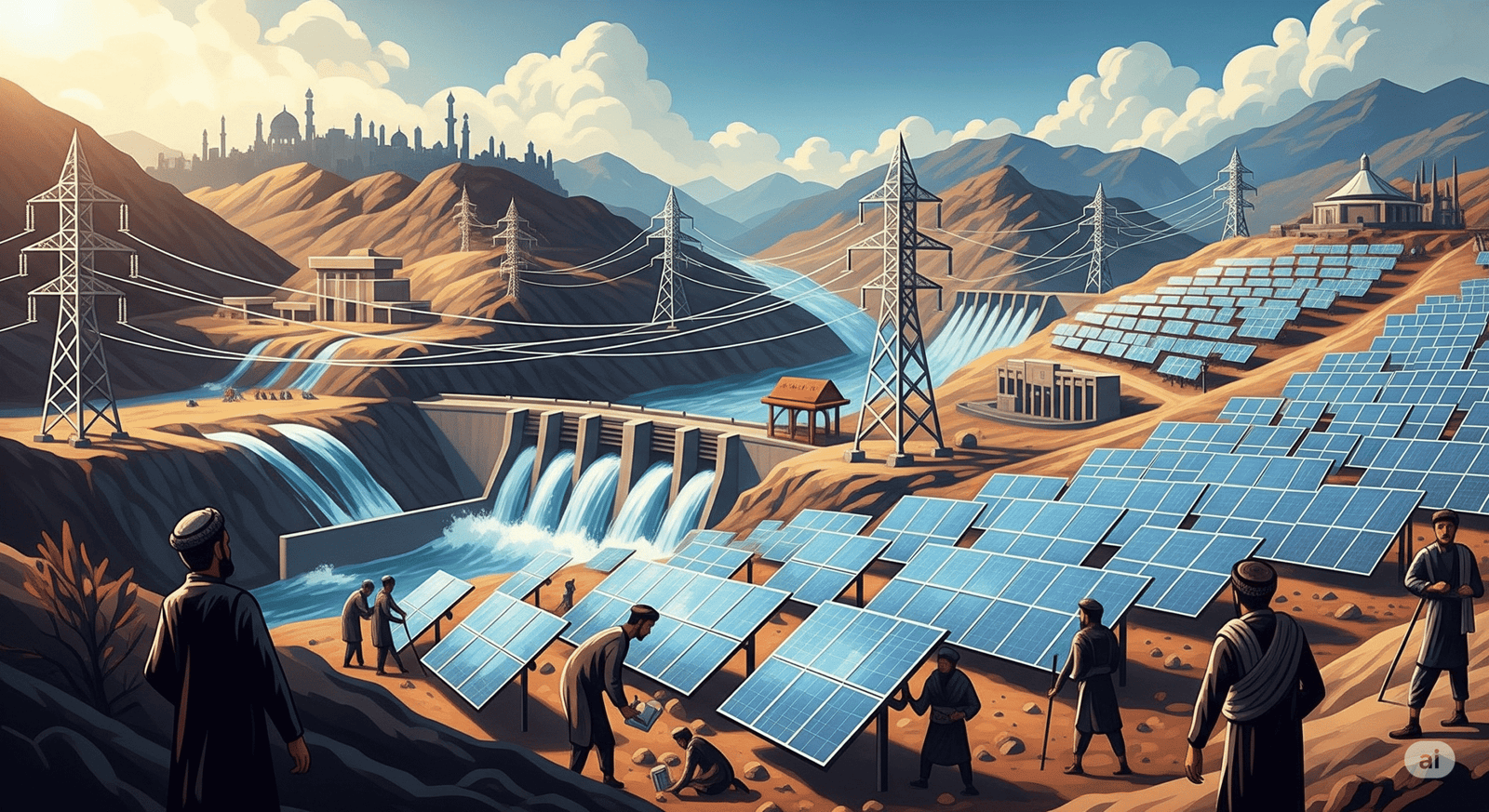
In a country long defined by conflict and humanitarian crisis, a new and ambitious economic initiative has emerged, offering a glimmer of hope for a different future. On Sunday, August 3, 2025, the acting Minister of Energy and Water for the Taliban government, Mullah Abdul Latif Mansour, announced a colossal $10 billion deal to generate 10,000 MW of power across Afghanistan. This project, which Mansour hailed as a “vital step for economic progress,” is a bold move to tackle the nation’s chronic power shortages and to lay the groundwork for a more self-sufficient and stable economy.
For decades, Afghanistan has been plagued by a crippling lack of electricity. The country’s power grid is underdeveloped and fragile, leaving much of the population and industry in the dark. As a result, Afghanistan relies heavily on electricity imported from its neighbors, including Uzbekistan, Tajikistan, Turkmenistan, and Iran. While these imports keep the lights on for some, they come at a significant financial cost, draining precious national resources. This new deal, which will involve the construction of hydro, solar, and thermal power plants, aims to fundamentally change this reality. The goal is to not only meet the country’s domestic and industrial needs but also to eliminate its dependence on expensive foreign power sources.
The deal, struck with a Turkish company whose identity has yet to be publicly revealed, is a clear signal of the Taliban government’s economic priorities. Since their return to power, the Taliban have sought to project an image of a government focused on governance, economic stability, and infrastructure development. This massive investment in the energy sector is the most significant and tangible example of this new focus. It suggests that the new leadership is acutely aware that true stability cannot be achieved without a functional and robust national infrastructure.
Furthermore, the project is a crucial component of a broader strategy to address the country’s dire humanitarian and economic crisis. A $10 billion investment in infrastructure development is not just about power generation; it’s about job creation on a massive scale. The minister’s announcement was clear that the project is expected to create thousands of jobs, a much-needed lifeline in a country with soaring unemployment rates and widespread poverty. In a country where many struggle to find work, such a project could provide a vital boost to local economies and offer a sense of purpose and stability to communities.
The partnership with a Turkish company is also noteworthy. It highlights the shifting landscape of international relations in the region. As many Western nations remain diplomatically distant from the Taliban government, countries like Turkey are stepping in to fill the economic and political void. This deal strengthens economic ties and suggests a growing level of trust and cooperation between the two nations, which may have broader diplomatic implications in the future.
However, the path to success for this ambitious project is fraught with challenges. Afghanistan remains a country with significant security risks, and large-scale infrastructure projects are often vulnerable to attacks and sabotage. The new government also faces a lack of technical expertise and a banking system that is still struggling to regain international trust. For a project of this magnitude to succeed, the Taliban government will need to demonstrate its ability to provide a secure and stable environment for foreign investors and to manage the technical and financial complexities of such a massive undertaking.
Despite these hurdles, the $10 billion energy deal represents a significant moment for Afghanistan. It is a bold statement of intent—a promise to move beyond a history of conflict and into a future of reconstruction and economic progress. If successful, it could be the spark that finally ignites Afghanistan’s potential, bringing light to its homes, power to its industries, and hope to its people.
Based on the latest reports from August 3, 2025, here are 21 bullet points on Afghanistan’s new energy deal.
- Date: August 3, 2025
- Announcement: The acting Minister of Energy and Water, Mullah Abdul Latif Mansour, announced a new energy deal.
- Investment Value: The deal is valued at $10 billion.
- Power Generation Goal: The agreement aims to generate 10,000 MW of power.
- Scope: The projects will be implemented across the entire country of Afghanistan.
- Project Types: The minister stated that the projects will include hydro, solar, and thermal power plants.
- Investor Country: The deal was struck with a company from Turkey.
- Company Name: The specific name of the Turkish company has not been publicly disclosed.
- Economic Significance: The minister called the deal a “vital step for economic progress.”
- Addressing Power Shortages: The project aims to address Afghanistan’s chronic power shortages.
- Current Situation: Afghanistan currently imports a large percentage of its electricity from neighboring countries.
- Power Imports: The country relies on power from Uzbekistan, Tajikistan, Turkmenistan, and Iran.
- Cost Savings: The new projects are expected to significantly reduce the country’s reliance on costly power imports.
- Domestic Needs: The new power generation is intended to meet both domestic and industrial needs.
- Infrastructure Development: The deal is a major step in the Taliban government’s efforts to develop Afghanistan’s infrastructure.
- Taliban’s Economic Focus: The Taliban have prioritized economic self-sufficiency and infrastructure projects.
- International Relations: The deal with a Turkish company highlights the strengthening economic ties between the two countries.
- Broader Context: The announcement comes amidst a dire humanitarian and economic crisis in Afghanistan.
- Job Creation: The projects are expected to create thousands of jobs, providing a much-needed boost to employment.
- Timeline: The minister stated that the power projects would be implemented in several phases over the next five years.
- Challenges: Observers note that significant challenges remain, including security risks, a lack of technical expertise, and an unstable banking system.
When, Where, Why, and Who
- When: The announcement of the deal was made on Sunday, August 3, 2025.
- Where: The projects are planned to be implemented across various regions of Afghanistan. The deal was struck with a Turkish company.
- Why: Afghanistan suffers from severe power shortages and is heavily reliant on costly electricity imports. The new $10 billion deal is a strategic move to achieve energy self-sufficiency, boost economic progress by providing power for domestic and industrial use, and create thousands of jobs.
- Who: The announcement was made by Mullah Abdul Latif Mansour, the acting Minister of Energy and Water for the Taliban government. The deal was made with a Turkish company, whose name has not been released.