





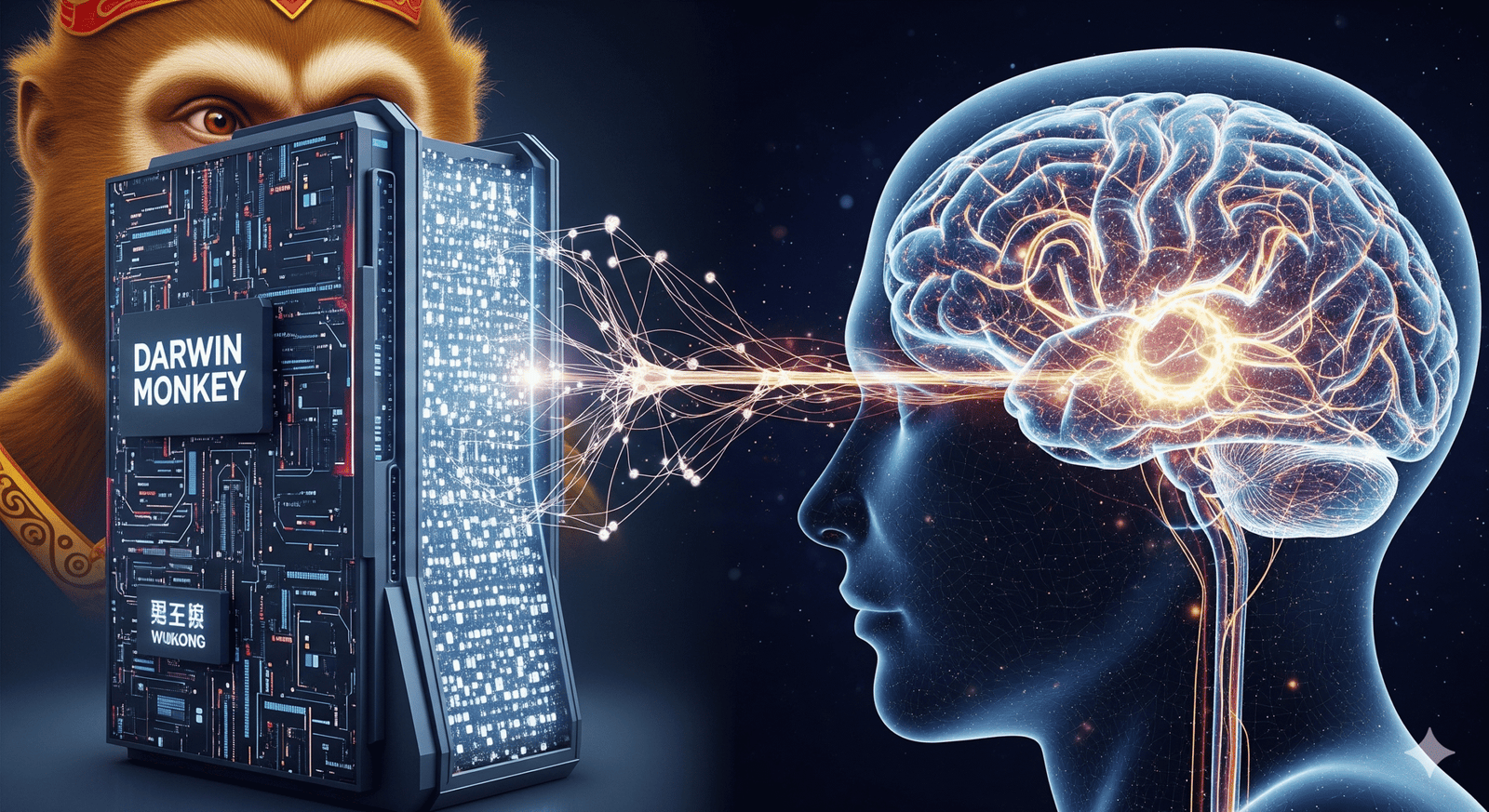
The race for artificial general intelligence (AGI) has just taken a monumental leap forward with China’s unveiling of “Darwin Monkey,” or “Wukong” (悟空), a groundbreaking supercomputer boasting an astonishing 2 billion artificial neurons. Modeled directly on the intricate architecture of the human brain, this development is not just another step in computing power; it represents a significant stride towards creating machines that can think, learn, and adapt in ways previously confined to science fiction. This innovation, emerging from the heart of China’s burgeoning AI sector, signals a new era in the global AI landscape and ignites fresh debates about the future of artificial intelligence.
The sheer scale of “Darwin Monkey” is mind-boggling. With 2 billion artificial neurons and 120 trillion synapses, it mirrors the approximate number of neurons in a human brain’s cerebral cortex. This neuromorphic approach fundamentally differs from traditional supercomputers, which rely on sequential processing. Instead, “Darwin Monkey” emulates the parallel, interconnected processing of biological brains, allowing for more efficient handling of complex, unstructured data and learning. This architecture is particularly adept at tasks requiring pattern recognition, continuous learning, and decision-making under uncertainty – capabilities that are crucial for achieving human-like intelligence. The ambition behind Wukong is to move beyond specialized AI, which excels at single tasks like playing chess or recognizing faces, towards AGI that can perform any intellectual task a human being can.
The implications of such a powerful neuromorphic supercomputer are vast and transformative. In the realm of scientific research, “Darwin Monkey” could revolutionize drug discovery by simulating molecular interactions with unprecedented accuracy, or accelerate materials science by predicting properties of new compounds. Its ability to process massive datasets in real-time could be deployed in complex logistical operations, optimizing everything from urban traffic flow to global supply chains. For healthcare, it could lead to more personalized medicine, faster disease diagnosis, and the development of sophisticated prosthetics that seamlessly integrate with the human nervous system. Furthermore, its brain-like learning capabilities open doors for advanced robotics, enabling robots to learn new skills and adapt to dynamic environments with greater autonomy and flexibility.
However, the unveiling of “Darwin Monkey” also brings into sharper focus the ethical and societal considerations surrounding advanced AI. The development of AGI raises questions about job displacement, the potential for misuse, and the very definition of intelligence and consciousness. As these machines become more capable of independent thought and decision-making, establishing robust ethical frameworks and regulatory guidelines becomes paramount. China’s rapid advancements in AI, often driven by significant government investment and access to vast datasets, highlight a global competition in AI development. The “Wukong” project is not just a technological achievement; it is a geopolitical statement, signaling China’s intent to be a leader in the next generation of artificial intelligence, potentially reshaping economic, military, and social paradigms worldwide.
In conclusion, “Darwin Monkey” represents a significant milestone in the quest for artificial intelligence. Its brain-inspired architecture and immense computational power promise to unlock new frontiers in scientific discovery and technological innovation. While the full impact of such a system is yet to be realized, its arrival undoubtedly accelerates the conversation about the future of AI and challenges humanity to thoughtfully navigate the profound opportunities and responsibilities that come with creating truly intelligent machines.
21 Bullet Points on “Darwin Monkey” Supercomputer
Date: August 29, 2025
- China has officially unveiled a new supercomputer named “Darwin Monkey.”
- It is also referred to as “Wukong” (悟空), after the mythical Monkey King.
- “Darwin Monkey” boasts over 2 billion artificial neurons.
- It features 120 trillion synapses, mimicking the human brain’s complexity.
- The supercomputer is specifically modeled on the architecture of the human brain.
- This is a significant advancement in neuromorphic computing.
- Neuromorphic systems aim to replicate the parallel processing of biological brains.
- It moves beyond traditional supercomputing’s sequential processing.
- The system is designed for tasks requiring pattern recognition and continuous learning.
- Its goal is to achieve Artificial General Intelligence (AGI).
- AGI aims for AI that can perform any intellectual task a human can.
- The supercomputer is expected to revolutionize scientific research.
- Potential applications include advanced drug discovery and materials science simulations.
- It could optimize complex logistical operations, such as traffic control and supply chains.
- In healthcare, it could lead to personalized medicine and improved diagnostics.
- “Darwin Monkey” could also enhance capabilities in advanced robotics.
- The project underscores China’s ambition to lead in global AI development.
- The development raises ethical considerations regarding job displacement and misuse of AI.
- It highlights the need for robust ethical frameworks for advanced AI.
- This unveiling accelerates the global competition in artificial intelligence.
- “Wukong” represents a major leap towards human-level artificial intelligence.
Separate Answer: When, Where, Why, and Who
When: “Darwin Monkey” (Wukong) was officially unveiled by China in August 2025.
Where: The supercomputer was developed and unveiled in China. Specific details about its physical location for operation were not immediately specified, but it represents a national achievement in AI development.
Why: China developed “Darwin Monkey” with the primary goal of achieving Artificial General Intelligence (AGI). By mimicking the human brain’s architecture, the supercomputer is designed to overcome limitations of traditional AI, enabling more adaptive learning, complex problem-solving, and ultimately, a leap forward in scientific discovery, technological innovation, and potentially global leadership in AI.
Who: “Darwin Monkey” was developed by Chinese researchers and scientists, likely supported by significant government funding and national AI initiatives. The project is a testament to China’s concerted efforts to become a dominant force in artificial intelligence.