





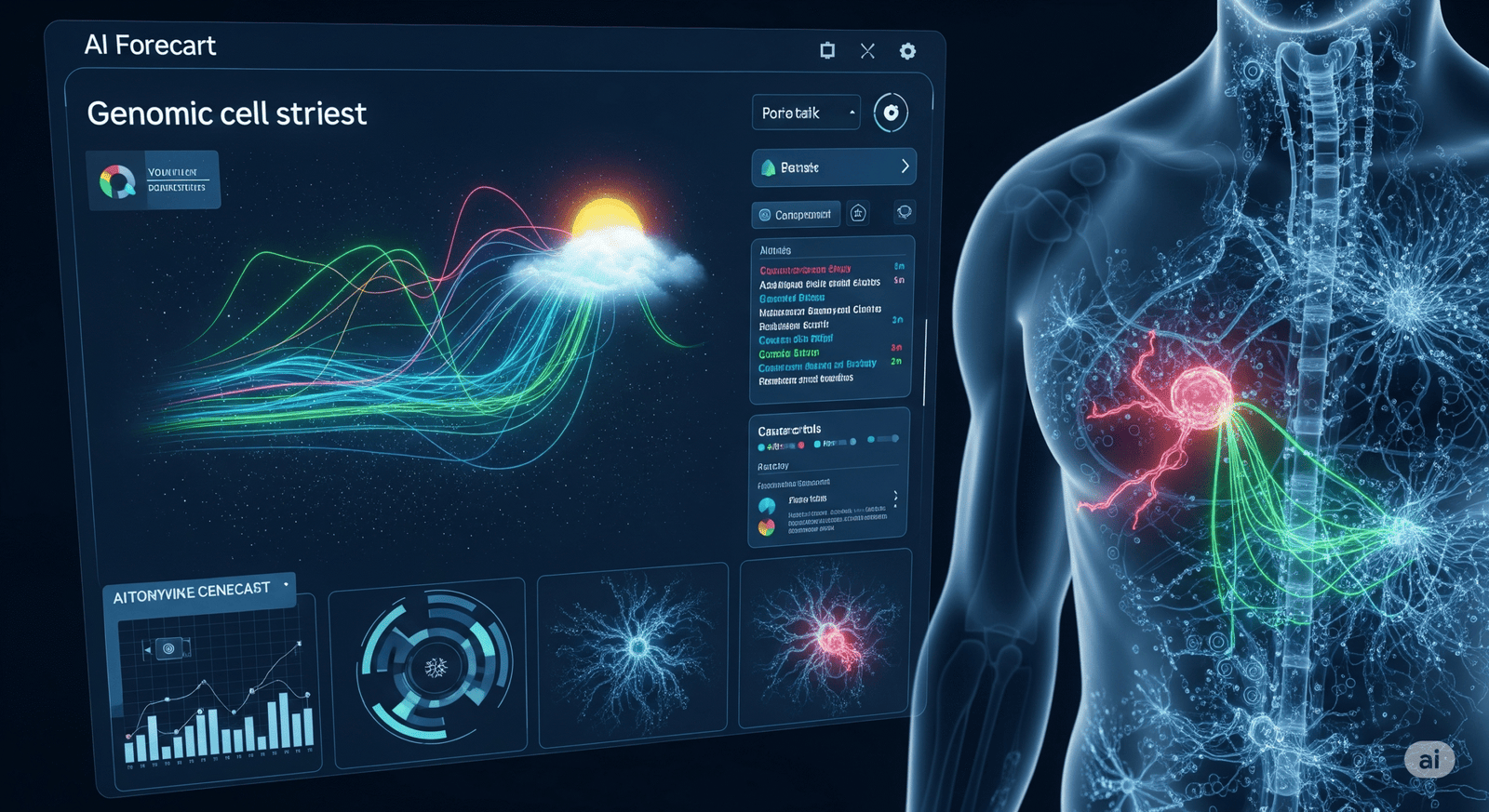
Forecasting Life: How a New AI Model is Revolutionizing Cancer Prediction Through Cellular “Weather”
In a monumental leap for medical science and artificial intelligence, researchers have unveiled a groundbreaking AI model on Friday, July 25, 2025, that promises to revolutionize our understanding and prediction of cellular behavior, particularly in the context of cancer. Described as akin to “weather forecasting” for cells, this novel approach utilizes patient genomics to model and predict how cells will behave over time, offering unprecedented insights into disease progression and treatment response. This development, published in the esteemed journal Cell, marks a pivotal moment in the quest for truly personalized medicine.
The core ingenuity of this new AI model lies in its ability to move beyond static snapshots of cellular states. Traditional genomic analysis provides a wealth of information about a cell at a given moment, but understanding the dynamic interplay and evolution of cells – how they communicate, respond to stimuli, and potentially turn cancerous – has remained a significant challenge. This is where the “weather forecasting” analogy comes into play. Just as meteorological models use vast amounts of atmospheric data to predict future weather patterns, this AI model leverages complex patient genomics data to anticipate future cellular activities, essentially creating a digital forecast of biological processes.
A key innovation underpinning this model is what the scientists call a “hypothesis grammar.” This is a plain-language system that allows biologists to input their understanding of cellular rules – for instance, “this cell increases division as oxygen concentration increases” – directly into the AI. The program then automatically translates these biological concepts into the complex mathematical equations required for computational modeling. This ingenious simplification, embodied in the new “PhysiCell” software, democratizes access to advanced agent-based computer modeling, enabling biologists without extensive programming expertise to run sophisticated simulations and test their hypotheses.
The implications for cancer research are profound. By creating “digital twins” of human and animal tissues, researchers can virtually simulate the emergence of tumors, observe their growth, and predict their interactions with various therapeutic interventions and the immune system. The model has already demonstrated its power by accurately simulating how immune cells (macrophages) invade breast tumors in one validation experiment. Furthermore, in a compelling application to personalized medicine, the model successfully predicted varied responses to immunotherapy in virtual pancreatic cancer patients, highlighting the critical importance of individual cellular ecosystems in determining treatment efficacy. This capability opens the door to “virtual clinical trials,” a revolutionary concept that could allow researchers to test countless drug combinations and therapeutic strategies in a digital sandbox, significantly reducing the cost, time, and ethical considerations associated with traditional trials.
Beyond its immediate applications in oncology, the versatility of this AI model extends to other complex biological processes. Researchers envision using it to simulate intricate phenomena such as brain development, observing how brain cells organize themselves to lay the foundation for neural circuits. This broader applicability underscores the model’s potential to deepen our fundamental understanding of life itself, moving biology from a purely descriptive science to one capable of accurate prediction.
The development of this AI model is a testament to the power of collaborative science, involving leading investigators from institutions like Indiana University, Johns Hopkins Medicine, the University of Maryland School of Medicine, and Oregon Health & Science University. Their work was supported by crucial funding from organizations such as the Jayne Koskinas Ted Giovanis Foundation and the National Institutes of Health, alongside contributions from the Lustgarten Foundation and the National Foundation for Cancer Research, leveraging existing data and knowledge.
In an era where personalized medicine is the holy grail of healthcare, this new AI model represents a monumental stride forward. By transforming genomic data into dynamic, predictive insights, it promises to accelerate the discovery of new therapeutic targets, optimize existing treatments, and ultimately, bring us closer to a future where diseases like cancer can be predicted, understood, and treated with unprecedented precision. As the scientific community continues to unravel the complexities of cellular behavior, this “cellular weather forecasting” model stands poised to illuminate paths to health and healing previously obscured by the sheer complexity of biological systems.
This is truly groundbreaking news in the field of medicine and artificial intelligence. The development of an AI model that can “forecast” cell behavior using patient genomics, much like meteorologists predict weather, holds immense promise for personalized cancer treatment and prevention.
Here are 21 bullet points on this new AI model :
- July 25, 2025: Scientists announced the development of a novel AI model capable of simulating and predicting cell behavior.
- July 25, 2025: The model draws parallels to weather forecasting, using complex data to predict future cellular states.
- July 25, 2025: A key innovation is the use of a “hypothesis grammar,” a plain-language system for inputting biological rules.
- July 25, 2025: This grammar translates biological concepts into mathematical equations for the AI to process.
- July 25, 2025: The new software, named “PhysiCell,” makes agent-based computer modeling more accessible to biologists without extensive programming knowledge.
- July 25, 2025: It allows for the creation of digital models, or “digital twins,” of human and animal tissues and diseases.
- July 25, 2025: By tracking cells following assigned rules, scientists can virtually observe phenomena like tumor emergence and interaction with therapies.
- July 25, 2025: The model can predict cellular responses to various factors, including drugs and environmental changes.
- July 25, 2025: This technology is expected to support faster and cheaper biomedical research, potentially replacing some costly lab experiments.
- July 25, 2025: A primary application demonstrated is the simulation of cancer progression and response to treatments.
- July 25, 2025: The models were initially validated using data from human pancreatic tumors and laboratory experiments in mice.
- July 25, 2025: In one validation experiment, the model accurately simulated how immune cells (macrophages) invaded breast tumors.
- July 25, 2025: It successfully predicted varied responses to immunotherapy in virtual pancreatic cancer patients, highlighting the importance of cellular ecosystems for precision oncology.
- July 25, 2025: The research integrates patient genomics data, providing a dynamic “snapshot” of cellular activity over time rather than a static one.
- July 25, 2025: The new framework is envisioned to enable “virtual clinical trials,” offering a sandbox for investigating hypotheses without risk to patients.
- July 25, 2025: Beyond cancer, the model can also simulate other complex biological processes, such as brain development and how brain cells organize into circuits.
- July 25, 2025: The research emphasizes the transition from merely describing biological processes to accurately predicting them.
- July 25, 2025: Funding for this groundbreaking work came from organizations like the Jayne Koskinas Ted Giovanis Foundation and the National Institutes of Health.
- July 25, 2025: The study and examples of cell simulations were described online in the prestigious journal Cell.
- July 25, 2025: This AI development represents a significant step towards truly personalized medicine and a deeper understanding of disease mechanisms.
- July 25, 2025: It holds the potential to accelerate the discovery of new therapeutic targets and optimize existing treatments.
When, Where, Why, and Who
- When: The new AI model was publicly announced and its findings published in the journal Cell on Friday, July 25, 2025.
- Where: This groundbreaking research was a collaborative effort led by investigators from several prominent institutions:
- Indiana University
- Johns Hopkins Medicine
- University of Maryland School of Medicine (specifically its Institute for Genome Sciences)
- Oregon Health & Science UniversityThe cancer cell behavior models were initially based on data from human pancreatic tumors at Johns Hopkins and laboratory experiments in mice.
- Why: The primary motivations behind developing this new AI model are:
- To Predict Cell Behavior Dynamically: Traditional genomic research provides snapshots of cellular states. This AI model aims to predict how cells behave and evolve over time, offering a dynamic view of biological processes akin to weather forecasting.
- To Advance Precision Oncology: By modeling individual patient genomics and simulating how cells (including cancer cells and immune cells) interact and respond to therapies, the model can help predict treatment efficacy for individual patients. This moves closer to personalized medicine, allowing for tailored treatments.
- To Accelerate and De-risk Research: The ability to run “virtual clinical trials” and simulate biological processes can significantly reduce the time, cost, and ethical complexities associated with traditional lab experiments and clinical trials. Researchers can test hypotheses in a digital “sandbox” before moving to costly physical experiments.
- To Bridge Biology and Computation: The innovative “hypothesis grammar” makes complex computational modeling accessible to biologists who may not have extensive programming skills, fostering interdisciplinary research and accelerating discovery.
- To Deepen Understanding of Disease: By simulating disease progression, such as tumor emergence and interaction with the immune system, scientists can gain profound insights into the underlying mechanisms of diseases like cancer.
- Who:
- Lead Investigators/Institutions: Scientists from Indiana University, Johns Hopkins Medicine, the University of Maryland School of Medicine, and Oregon Health & Science University led this collaborative research.
- Key Researchers (Co-first authors/leads mentioned in background research):
- Daniel Bergman, Ph.D. (Assistant Professor at University of Maryland School of Medicine’s Institute for Genome Sciences)
- Jeanette Johnson, Ph.D. (Postdoctoral Fellow at the Institute for Genome Sciences, Johns Hopkins)
- Elana Fertig, Ph.D. (Professor and Director of the Institute for Genome Sciences at the University of Maryland School of Medicine)
- Mark T. Gladwin, MD (Vice President for Medical Affairs at the University of Maryland School of Medicine)
- Funding Organizations: The Jayne Koskinas Ted Giovanis Foundation, the National Institutes of Health, the Lustgarten Foundation, and the National Foundation for Cancer Research provided primary funding and leveraged prior data.
- Patients/Patient Data: Genomics data from human pancreatic tumors and other biological samples were crucial for training and validating the model.
- The Scientific Community: The development of the “PhysiCell” software aims to empower a broader range of biologists to utilize sophisticated computational modeling.