




A Flashpoint Rekindled: The Dangerous Escalation on the Thailand-Cambodia Border
July 25, 2025 – The usually peaceful terrains characteristic of Southeast Asia are presently scarred by the harsh truth of armed confrontation, as the protracted border disagreement between Thailand and Cambodia has intensified into its most lethal encounters in more than ten years.1 What began as a landmine incident has rapidly escalated into a full-blown military confrontation, claiming lives, displacing thousands, and casting a shadow of instability over the region.2
The roots of this volatile situation run deep, intertwining historical grievances with modern political tensions.3 At the heart of the dispute lies the ambiguity of colonial-era maps drawn in the early 20th century, particularly the 1907 Franco-Siamese treaty.4 These cartographic documents, intended to demarcate the boundary between what was then Siam (Thailand) and French Indochina (encompassing Cambodia), have been prone to divergent readings, resulting in numerous land segments, including zones around historic Khmer shrines, being in an ongoing state of dispute.5
The Preah Vihear Temple, a UNESCO World Heritage site, serves as a poignant symbol of this enduring friction.6 Even though the International Court of Justice (ICJ) determined in 1962 and reiterated in 2013 that the temple edifice itself is Cambodian territory, the precise delineation of the adjacent terrain continues to be a source of intense contention.7 Beyond Preah Vihear, other historical sites like the Ta Muen Thom temple have also become flashpoints, each a testament to a shared yet contested heritage.8
The current crisis, however, was ignited by a more immediate trigger. On July 23, 2025, five Thai soldiers were wounded by a landmine explosion near the border.9 Thailand swiftly accused Cambodia of freshly planting these mines, a charge vehemently denied by Phnom Penh, which countered that the blast likely resulted from existing unexploded ordnance.10 This incident, following a skirmish in May that killed a Cambodian soldier, served as the spark that ignited the present inferno.
Diplomatic relations, already strained, quickly crumbled. Thailand retaliated by expelling Cambodia’s ambassador and recalling its own envoy, prompting Cambodia to downgrade diplomatic ties to their “lowest level” and evacuate its embassy in Bangkok.11 The rhetoric on both sides hardened, with accusations of aggression and violations of sovereignty flying freely.12
By Thursday, July 24, 2025, the situation had deteriorated into full-scale armed conflict.13Accounts from the frontier zones indicate a frightening intensification: cannon bombardment, missile apparatus (such as BM-21 Grads), and even aerial assaults.14 Thailand’s air force reportedly deployed F-16 fighter jets, conducting bombing runs on Cambodian positions, while Cambodia is alleged to have used truck-mounted rocket launchers to target civilian areas within Thailand.15
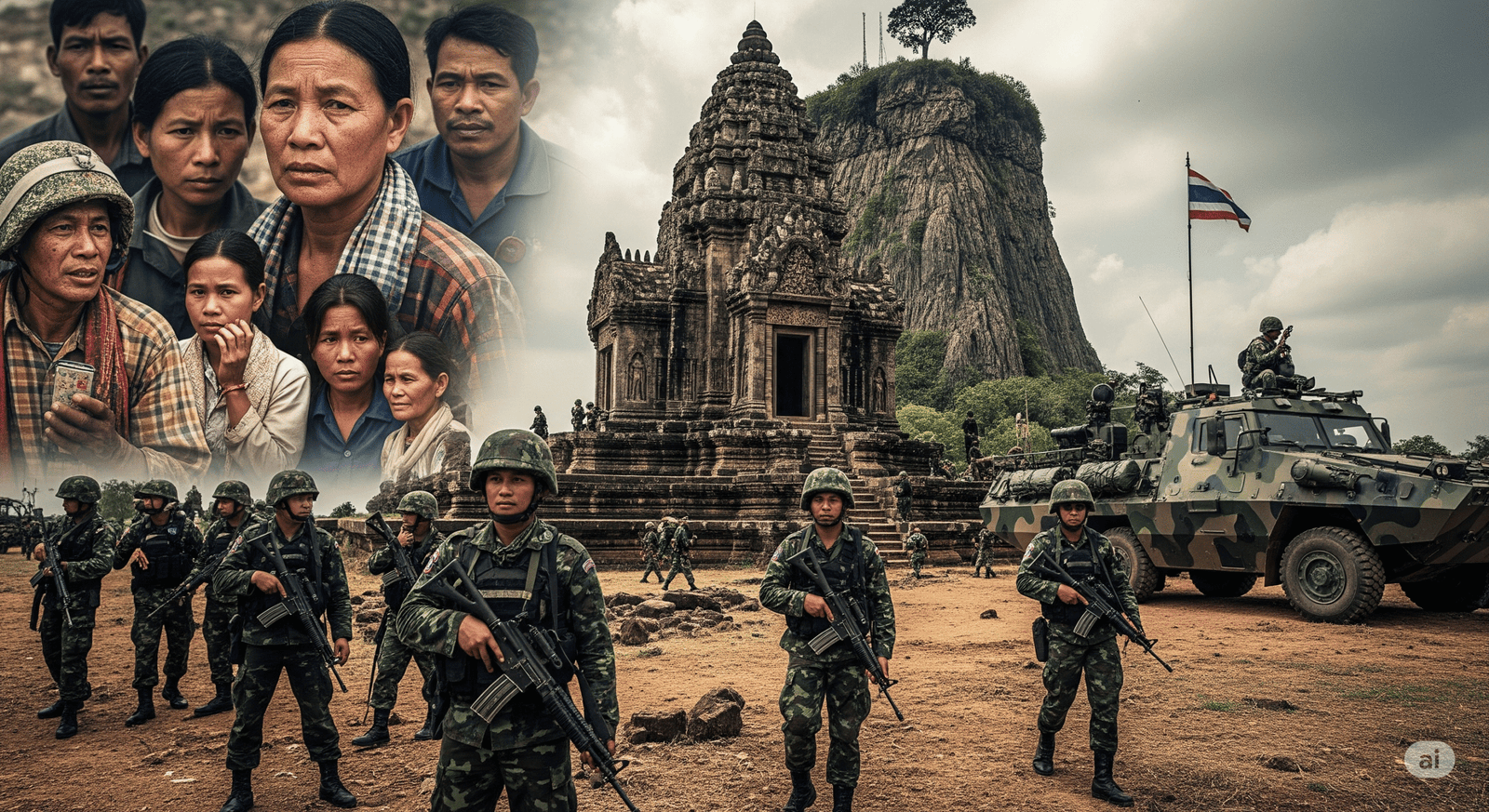
The human cost has been devastating. A minimum of fourteen individuals, primarily non-combatants, have been verified as deceased on the Thai front, alongside scores of wounded. Casualties have also been reported in Cambodia, though official figures are still emerging amid the ongoing fighting. The violence has triggered a mass exodus, displacing over 100,000 people from their homes on both sides of the border.16 These individuals now seek refuge in makeshift shelters, facing an uncertain future and a desperate need for humanitarian aid.17 Heart-wrenching images of families fleeing with scant belongings on homemade tractors underscore the profound impact on ordinary lives.
Adding to the gravity of the situation, a hospital in Thailand’s Surin province was reportedly hit by shelling, an act that Thai officials have condemned as a potential “war crime.”18 Such an overt dismissal of humanitarian principles significantly exacerbates the gravity of the ongoing conflict.
Thailand has firmly rejected calls for third-party mediation, insisting that a resolution must come through bilateral talks, but only after Cambodian forces cease hostilities.19 Meanwhile, Cambodian Prime Minister Hun Manet has appealed directly to the United Nations Security Council, urging an emergency meeting to address what he terms “Thailand’s aggression.”20 The UNSC is indeed scheduled to hold a closed-door session today, July 25, 2025, to discuss the crisis, reflecting growing international concern.21 Regional bodies like ASEAN, along with major global players like the United States and China, have also called for an immediate de-escalation and a return to dialogue.22
The current conflict is a stark reminder of how unresolved historical disputes, when coupled with heightened nationalism and domestic political pressures, can rapidly spiral into deadly confrontations. For the people living along this long-contested border, the immediate future is one of fear and uncertainty. The international community watches with bated breath, hoping that diplomatic efforts can somehow pull Thailand and Cambodia back from the brink of a wider, more catastrophic conflict. The path to lasting peace will undoubtedly be long and arduous, requiring genuine commitment from both nations to find a common ground beyond the shadows of their shared, tumultuous past.
Here are 21 bullet points on the latest news regarding the Thailand-Cambodia border clashes, dated July 25, 2025:
- July 25, 2025: Deadly fighting continues for a second day along the disputed Thailand-Cambodia border.
- July 25, 2025: Reports confirm the use of heavy artillery, rocket systems (including BM-21 Grad), airstrikes, and landmine blasts.
- July 25, 2025: Thailand reports at least 14 deaths, including one soldier and 13 civilians.
- July 25, 2025: Over two dozen people, including 15 soldiers and 32 civilians, have been injured in Thailand.
- July 25, 2025: Cambodia has reported at least one death and four civilian injuries, though official casualty figures are still emerging.
- July 25, 2025: The fighting has displaced over 100,000 people on both sides of the border.
- July 25, 2025: More than 100,000 Thais have fled from four border provinces and are in nearly 300 temporary shelters.
- July 25, 2025: Approximately 20,000 Cambodian residents have evacuated from their northern border areas.
- July 25, 2025: Thailand has explicitly rejected third-party mediation to resolve the conflict.
- July 25, 2025: Thailand insists on bilateral talks, stating that Cambodia must cease violence first.
- July 25, 2025: Cambodia’s Premier, Hun Manet, has formally requested an urgent session with the United Nations Security Council.
- July 25, 2025: The United Nations Security Council is slated to convene a private session to deliberate on the unfolding crisis.
- July 25, 2025: The current clashes are described as the deadliest military confrontation between the two nations in over a decade.
- July 25, 2025: Thailand’s acting Prime Minister, Phumtham Wechayachai, warned that the situation could escalate into a “state of war.”
- July 25, 2025: The fighting has widened, now taking place in at least 12 locations along the disputed border.
- July 25, 2025: One of the deadliest incidents was a Cambodian rocket attack on a petrol station in Sisaket province, Thailand, resulting in multiple civilian casualties.
- July 25, 2025: Cambodian forces also reportedly attacked Phanom Dong Rak Hospital, causing damage and injuries.
- July 25, 2025: Thailand has launched “Operation Yuttha Bodin” as a land and air offensive in response to what it calls “invading Cambodian forces.”
- July 25, 2025: Thailand has sealed off all terrestrial routes connecting with Cambodia.
- July 25, 2025: Both countries blame each other for initiating the latest escalation.
- July 25, 2025: The U.S., China, and Malaysia (in its capacity as ASEAN’s current chair) have extended offers to mediate discussions, yet Thailand favors a direct, two-party resolution.
When, Where, Why, and Who of the Thailand-Cambodia Border Clashes:
When:
The latest escalation in the long-standing border dispute began on Thursday, July 24, 2025, with fighting intensifying significantly through Friday, July 25, 2025. Tensions had been simmering for months, with a notable skirmish in May 2025 where a Cambodian soldier was killed, and a recent incident on July 23, 2025, where Thai soldiers were injured by landmines, leading to diplomatic downgrades.
Where:
The clashes are occurring along the disputed border between Thailand and Cambodia. Key flashpoints mentioned include:
- Regions adjacent to the Prasat Ta Muen Thom temple situated in Thailand’s Surin Province and Cambodia’s Oddar Meanchey province.
- Near the Preah Vihear Temple, an ancient Hindu shrine that is a focal point of significant dispute.
- Multiple locations along a 209-kilometer stretch of the border, including in Thai provinces such as Surin, Sisaket, Buriram, Sa Kaeo, Ubon Ratchathani, Chanthaburi, and Trat.
- The conflict also involves areas near the Emerald Triangle (Chong Bok), a tripoint where the borders of Thailand, Cambodia, and Laos converge.
Why:
The current escalation is rooted in a complex mix of historical border disputes and recent triggers:
- Colonial-era border demarcation: The dispute largely stems from ambiguous 1907 maps drawn under French colonial rule, which both countries interpret differently.
- Sovereignty over ancient temples: Control over historically significant sites like the Preah Vihear and Ta Moan Thom temples is a major point of contention. The International Court of Justice (ICJ) ruled in 1962 and reaffirmed in 2013 that Preah Vihear belongs to Cambodia, but Thailand continues to dispute parts of these rulings.
- Recent Landmine Incident: A direct trigger for the current escalation was a landmine explosion earlier this week (July 23, 2025) that injured Thai soldiers. Thailand accused Cambodia of newly planting the mines, a charge Cambodia denies.
- Diplomatic Downgrade: Following the landmine incident, Thailand expelled Cambodia’s ambassador and recalled its own, with Cambodia retaliating by downgrading diplomatic ties and imposing trade restrictions.
- Political Tensions: The conflict has also been exacerbated by domestic political issues in Thailand, including a controversy surrounding former Thai Prime Minister Paetongtarn Shinawatra’s leaked call with Cambodia’s former leader Hun Sen, which led to her suspension. This has created a power vacuum and potentially given more authority to an “aggrieved” Thai military.
Who:
The primary actors involved are:
- Thailand (Royal Thai Armed Forces and Government): Led by Acting Prime Minister Phumtham Wechayachai and the Royal Thai Army. Thailand insists on bilateral negotiations and has rejected third-party mediation.
- Cambodia (Royal Cambodian Armed Forces and Government): Led by Prime Minister Hun Manet (son of former strongman Hun Sen). Cambodia has actively pursued international involvement, making a direct plea to the United Nations Security Council.
- Civilians on both sides: Tens of thousands have been displaced and have suffered casualties.
- International Bodies/Countries (attempting mediation/monitoring):
- United Nations Security Council (UNSC): Urged by Cambodia to hold an urgent deliberation.
- ASEAN (Association of Southeast Asian Nations): Malaysia, as the current chair, has offered to facilitate dialogue.
- The U.S. and China: Have additionally pressed for a reduction in tensions and a renewed emphasis on talks.