
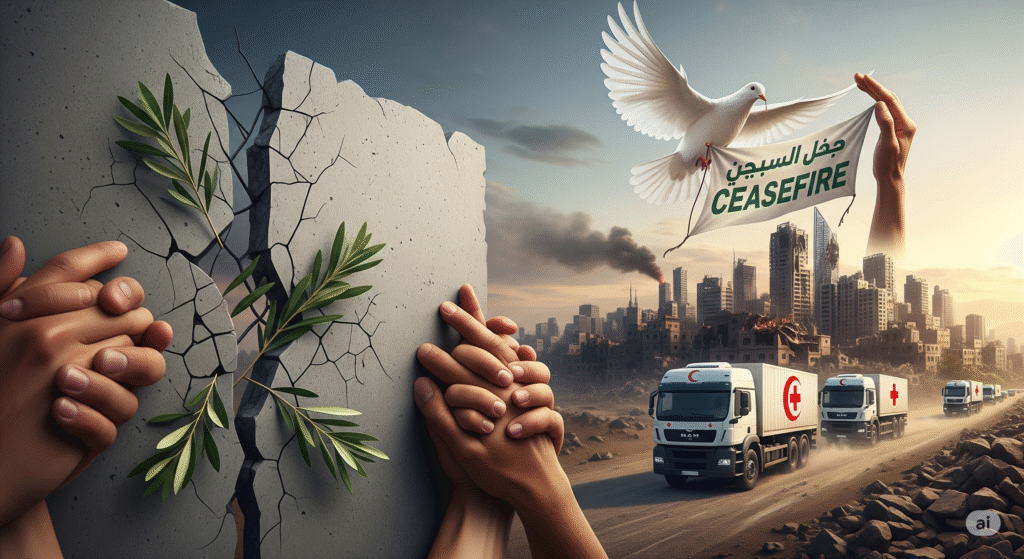
The Gaza conflict has once again reached a pivotal, yet profoundly precarious, moment. In a move that has ignited a mix of cautious optimism and deep skepticism, Hamas has reportedly accepted a ceasefire proposal, while Israel has signaled its intention to continue its military operations. This latest development unfolds against a backdrop of unimaginable human suffering, with the humanitarian crisis in the enclave spiraling into a full-blown catastrophe. The global community is watching with bated breath, but the chasm between the two sides’ objectives—Hamas’s demand for a permanent end to the war and Israel’s stated goal of “destroying” Hamas—threatens to unravel this fragile diplomatic thread before it can even be woven into a truce.
The reports of Hamas’s acceptance of the proposal, which was mediated by Egypt and Qatar with the backing of the United States, provide a glimmer of hope. According to sources, the deal would entail a 60-day pause in fighting, a prisoner exchange, and a significant increase in the flow of humanitarian aid. Hamas’s acceptance, described by some sources as “without requesting any amendments,” could be a strategic gambit to pressure Israel into a deal, or a genuine signal of its readiness to de-escalate. Regardless of the motive, it has put the onus on the Israeli government to respond.
Israel’s reaction, however, has been one of dismissal. Prime Minister Benjamin Netanyahu has reportedly stated that Hamas is under “immense pressure” and that Israel will move forward with its plan to take control of Gaza City. This stance is a reflection of the deep-seated belief within the Israeli leadership that only the complete and total defeat of Hamas can ensure the nation’s security and the return of all remaining hostages. Yet, this unwavering commitment to military victory comes at an increasingly steep price, both in terms of human lives and international standing. The planned expansion of military operations into densely populated areas of Gaza City has drawn sharp criticism and warnings of a humanitarian catastrophe from international bodies and governments alike.
This military-first approach is directly at odds with the escalating humanitarian crisis on the ground. The United Nations has repeatedly warned of a “man-made famine” unfolding in Gaza, with the Integrated Food Security Phase Classification (IPC) platform reporting that famine thresholds have been surpassed in Gaza City. Aid groups and medical professionals are reporting an alarming rise in severe malnutrition, particularly among children. The situation is so dire that the UN World Food Programme has described it as “unlike anything we have seen in this century,” and has issued a “call to action” rather than a mere warning. The World Health Organization estimates that thousands of critically ill and injured patients remain in Gaza, unable to receive life-saving medical care abroad due to the closure of crossings.
Adding to the gravity of the situation, human rights organizations have been vocal in their condemnation of Israel’s actions. Amnesty International has gone so far as to accuse Israel of “deliberately starving” Palestinians as a “deliberate policy” and part of its “ongoing genocide against Palestinians in Gaza.” The organization’s report, based on new testimonies from displaced civilians and medical staff, alleges that the suffering is not merely a byproduct of the war, but a calculated outcome of Israel’s policies. While Israel has rejected these claims, its restrictions on humanitarian aid, coupled with the targeting of aid convoys and infrastructure, have made it nearly impossible for aid to reach the most vulnerable populations. The UN has reported a record number of aid worker deaths in Gaza in the past year, further highlighting the extreme dangers and obstacles to delivering life-saving assistance.
The juxtaposition of diplomatic overtures and continued military escalation creates a climate of extreme uncertainty and despair. While a temporary ceasefire may alleviate some immediate suffering, the underlying issues remain unresolved. The international community, led by mediators like Egypt, Qatar, and the U.S., is scrambling to find a pathway to a more comprehensive solution. However, as long as one side views the conflict as a zero-sum game, the cycle of violence and suffering is likely to persist. The current moment is not just a test of diplomacy, but a profound moral challenge to the world to prevent a man-made humanitarian disaster from reaching its most tragic conclusion.
21 Bullet Points on the Gaza Conflict – August 19, 2025
- August 18, 2025: Hamas reportedly accepted a ceasefire proposal, signaling a potential diplomatic breakthrough.
- August 18, 2025: The proposal was mediated by Egypt and Qatar with the support of the United States.
- August 19, 2025: An unnamed Hamas source stated that the group accepted the deal “without requesting any amendments.”
- August 19, 2025: Israel has not formally responded to Hamas’s acceptance but has indicated its intention to continue the war.
- August 19, 2025: Israeli Prime Minister Benjamin Netanyahu reportedly dismissed Hamas’s acceptance as a sign of pressure.
- August 19, 2025: Israel’s security cabinet approved plans to expand military operations into Gaza City.
- August 19, 2025: The UN has issued stark warnings that a “man-made famine” is unfolding in Gaza.
- August 19, 2025: The Integrated Food Security Phase Classification (IPC) reported that famine thresholds have been surpassed in parts of Gaza.
- August 19, 2025: The UN World Food Programme described the situation as a “call to action” and “unlike anything we have seen in this century.”
- August 19, 2025: Amnesty International accused Israel of “deliberately starving” Palestinians as a “deliberate policy.”
- August 19, 2025: Amnesty’s report, based on new testimonies, links the starvation to Israel’s policies and blockade.
- August 19, 2025: The report alleges that the starvation is part of Israel’s “ongoing genocide against Palestinians in Gaza.”
- August 19, 2025: The Gaza Health Ministry reports that the Palestinian death toll from the war has exceeded 62,000.
- August 19, 2025: Reports suggest the ceasefire deal would include a 60-day truce and a phased release of hostages and prisoners.
- August 19, 2025: The proposal envisions the release of 10 living Israeli hostages in a first phase.
- August 19, 2025: In return, Israel would release a number of Palestinian prisoners, including those serving life sentences.
- August 19, 2025: The UN has reported a record 383 aid worker deaths globally in the past year, with nearly half occurring in Gaza.
- August 19, 2025: Access to humanitarian aid is severely restricted, with some organizations reporting they are unable to bring in supplies.
- August 19, 2025: Medical professionals in Gaza report a rising number of children with severe malnutrition.
- August 19, 2025: The closure of the Rafah crossing has prevented thousands of injured and critically ill patients from leaving Gaza for treatment.
- August 19, 2025: The conflict has also resulted in the displacement of over 1 million people within the Gaza Strip.
When, Where, Why, and Who
- When: This latest development in the conflict emerged on August 18-19, 2025, with Hamas’s reported acceptance of the ceasefire proposal and Israel’s subsequent indications of continued military action. The humanitarian crisis has been a continuous and escalating issue throughout the entire conflict, which began on October 7, 2023.
- Where: The events are centered on the Gaza Strip, a besieged Palestinian territory. The diplomatic talks and mediation efforts have primarily taken place in Cairo, Egypt, and Doha, Qatar, with the involvement of the United States. The humanitarian crisis is most acute in the northern and central parts of Gaza, including Gaza City, where military operations and aid restrictions have been most severe.
- Why: The conflict is a result of a complex and decades-long history, with the current escalation triggered by the October 7, 2023, attack on Israel. Hamas is seeking a permanent end to the war, a full Israeli withdrawal from Gaza, and the release of Palestinian prisoners. Israel’s stated objective is to dismantle Hamas’s military and governing capabilities, secure the return of all hostages, and ensure its long-term security. The ongoing humanitarian crisis is a direct consequence of the war and Israel’s blockade and military actions, which have severely restricted the flow of essential goods, food, and medicine into the enclave.
- Who: The key players are:
- Hamas: The Palestinian militant group and governing authority in Gaza, which reportedly accepted the ceasefire proposal.
- Israel: The state of Israel, led by Prime Minister Benjamin Netanyahu, which has signaled its intention to continue the war.
- Mediators: Egypt and Qatar, who have been instrumental in brokering the ceasefire talks.
- United States: A key diplomatic player and Israel’s primary ally, which has been involved in the mediation efforts.
- United Nations (UN) and various aid agencies: International bodies and humanitarian organizations, including the World Food Programme and UNRWA, that are on the ground providing aid and warning of the dire humanitarian situation.
- Amnesty International: A human rights organization that has accused Israel of “deliberately starving” Palestinians.
- Civilians: The more than two million Palestinian residents of Gaza, who are enduring the devastating consequences of the war and humanitarian crisis, as well as the Israeli hostages still held in the enclave.