





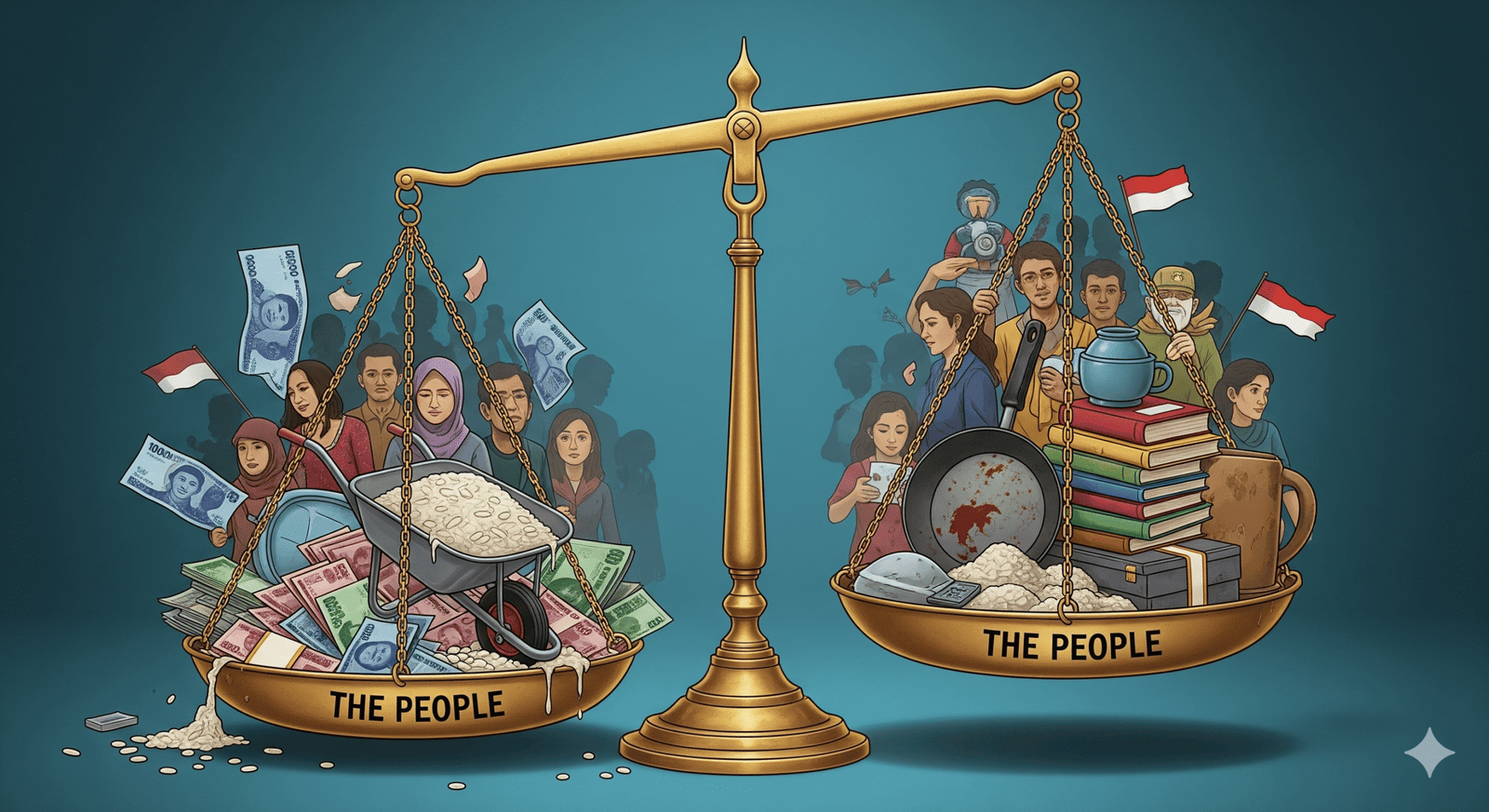
In a powerful and rare concession to mounting public fury, Indonesia’s newly-elected President Prabowo Subianto has announced a major policy reversal, scrapping lucrative financial perks for the nation’s lawmakers.1 The move, made in a televised address on Sunday, August 31, 2025, came as the government grappled with widespread and violent protests that have rocked major cities across the archipelago.2 This decision, which targets controversial benefits like housing allowances and overseas travel, represents a direct attempt to calm tensions and restore public trust in a political elite seen as detached from the struggles of ordinary citizens.3
The nationwide unrest was initially sparked by revelations that Indonesia’s 580 lawmakers were set to receive a monthly housing allowance of 50 million rupiah ($3,075 USD).4 This figure, as protesters and activists quickly pointed out, is nearly 10 times the minimum wage in Jakarta, the capital.5 At a time when many Indonesians are grappling with the rising costs of living, a new austerity drive, and stagnant wages, the allowance was seen as a blatant display of insensitivity and corruption by the nation’s political elite. The protests, which began as peaceful demonstrations on August 25, quickly gained momentum and turned violent after the tragic death of a 21-year-old motorcycle taxi driver, Affan Kurniawan, who was reportedly run over by a police vehicle during a rally in Jakarta.6
The death of the young driver served as a catalyst, transforming the protests from a localized issue into a furious national outcry against government corruption and a police force increasingly seen as heavy-handed. The demonstrations spread to cities like Yogyakarta, Bandung, Palembang, and Makassar, where they escalated into riots, looting, and arson.7 Several government buildings and the homes of political figures were set ablaze, leaving a trail of destruction and at least seven people dead.8 The looting of the home of Finance Minister Sri Mulyani Indrawati further underscored the protestors’ deep-seated rage. In response, President Prabowo, a former general who has been in office for less than a year, was forced to act.9
In a press conference flanked by leaders from eight political parties, Prabowo announced that the parties had agreed to “revoke a number of parliament policies, including the size of allowances for members of parliament and a moratorium on overseas work trips.”10 He also made it clear that while his government would respect the right to peaceful assembly, it would not tolerate violence, looting, or actions that “lean towards treason and terrorism.” This dual approach—a rare concession combined with a stern warning—is a risky political maneuver. While the move to scrap the perks directly addresses the protestors’ core demand, the president’s strong rhetoric and orders for a security crackdown could further antagonize those who feel the government is simply paying lip service to their grievances.
The full impact of this decision remains to be seen. Student groups and activists have stated that the move, while a step in the right direction, does not go far enough. They argue that the issue is not just about a single allowance but about a systemic problem of corruption, a lack of transparency, and the growing role of the military in civilian life. For now, however, the government has offered a temporary solution to a deeply rooted problem. The decision to strip lawmakers of their perks is a public acknowledgement of a growing disconnect between the rulers and the ruled. It’s a move aimed at dousing a fire before it spreads, a recognition that the outrage on the streets of Indonesia is too powerful to ignore.
21 Bullet Points on the Lawmaker Perks Controversy (September 1, 2025)
- Indonesia’s President Prabowo Subianto announced the scrapping of lawmakers’ perks.11
- The announcement was made in Jakarta on Sunday, August 31, 2025.12
- The decision was in direct response to nationwide anti-government protests.13
- The protests began a week earlier, on August 25, over controversial lawmaker benefits.14
- The primary benefit at issue was a monthly housing allowance of $3,075.15
- This allowance is nearly 10 times the minimum wage in Jakarta.16
- The protests escalated into violence after the death of a motorcycle taxi driver, Affan Kurniawan.17
- The driver was reportedly run over by a police vehicle during a protest.18
- At least seven people have been killed in the ensuing unrest.19
- Protests and rioting have spread to major cities, including Yogyakarta and Makassar.20
- Protesters engaged in looting and arson, targeting government buildings and private homes.21
- The home of Finance Minister Sri Mulyani Indrawati was among those looted.22
- President Prabowo has also imposed a moratorium on lawmakers’ overseas trips.23
- The decision was a rare concession to public anger from the new administration.
- Prabowo was flanked by leaders of eight political parties during the announcement.24
- The president has also issued a stern warning against further violence and looting.25
- He called for security forces to take “firm action” against rioters.26
- Student groups and other protesters have stated the measures do not go far enough.
- They argue the issue is a systemic one of corruption and a lack of transparency.
- The move to scrap perks is seen as a way to restore public trust in the government.
- The unrest is seen as one of the most significant challenges to Prabowo’s young presidency.
<br>
Separate Answer: When, Where, Why, and Who
When
The President’s announcement was made on Sunday, August 31, 2025.27 The protests that led to it began a week earlier on August 25.
Where
The announcement was made in Jakarta, the capital of Indonesia.28 The protests took place across major cities throughout the country.29
Why
President Prabowo Subianto scrapped lawmakers’ perks in a bid to calm mounting public anger and violent protests that had spread nationwide.30 The protests were fueled by outrage over a controversial housing allowance for lawmakers that was deemed excessive and insensitive amid a difficult economic period for many Indonesians. The death of a protester further escalated the unrest, forcing the government to act.31
Who
- The Announcer: Prabowo Subianto, the President of Indonesia.
- The Recipients of Perks: Indonesian lawmakers (members of the House of Representatives).
- The Protesters: A broad coalition of students, workers, and activists.
- The Victims: At least seven people were killed in the clashes, including a young motorcycle taxi driver whose death helped fuel the protests.32