





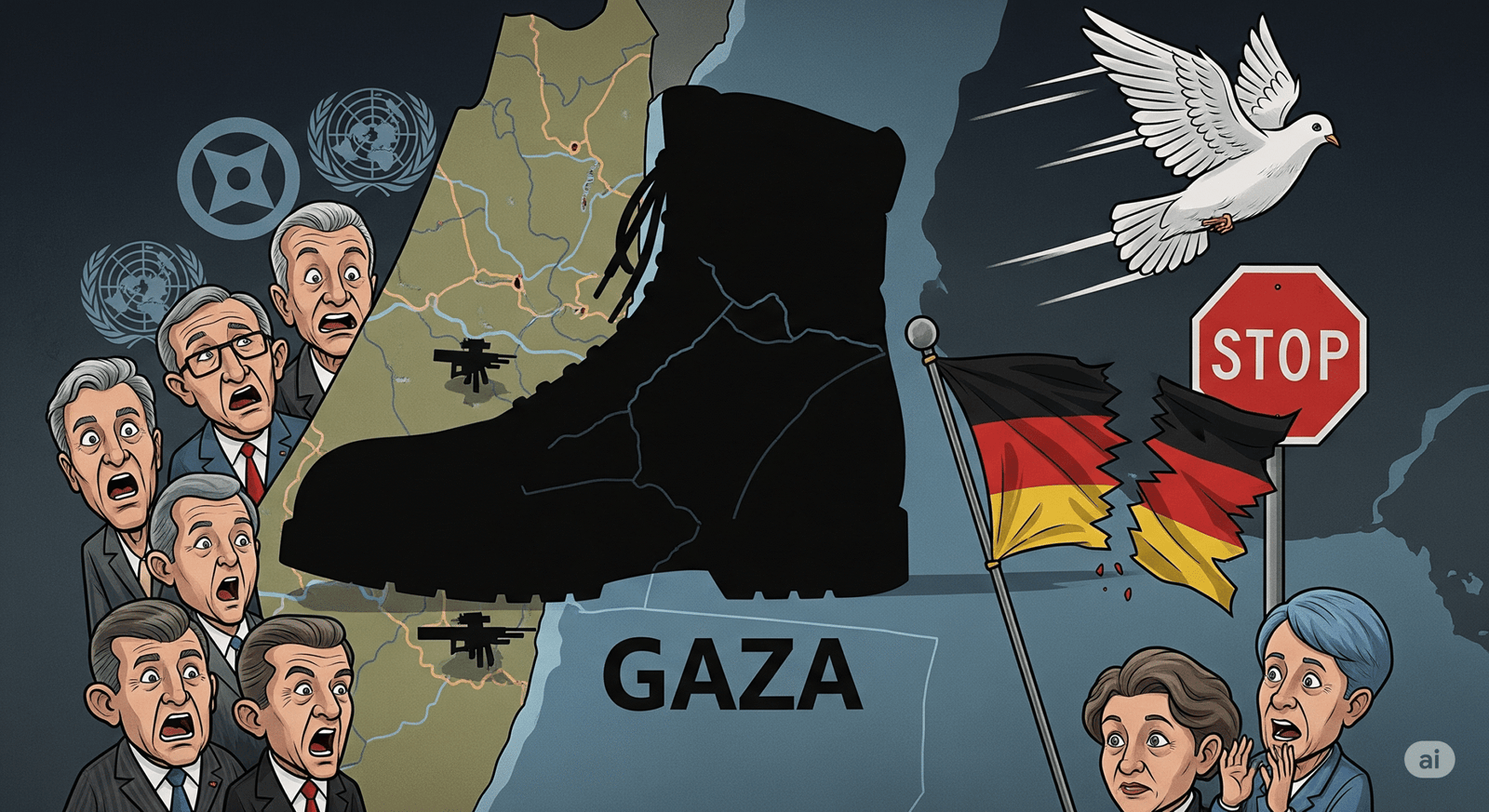
In a dramatic and alarming turn of events, Israel’s Security Cabinet has approved a plan to “take control of Gaza City,” signaling a major escalation of its nearly two-year-long conflict with Hamas. This decision, announced in the face of mounting international pressure for a ceasefire, has been met with swift and widespread condemnation from global leaders and institutions. The reaction has been so severe that Germany, one of Israel’s staunchest allies and its second-largest arms supplier, has announced it will suspend all military exports that could be used in the Gaza Strip. This geopolitical ripple effect is not just a diplomatic setback for Israel; it represents a potential fracturing of its international support and a new low in the humanitarian crisis in Gaza.
The Israeli government, led by Prime Minister Benjamin Netanyahu, has justified the move as a necessary step to disarm Hamas and secure the release of the remaining hostages. However, this rationale has been questioned by critics both at home and abroad. Netanyahu’s office released a statement saying the military would “prepare for taking control of Gaza City while providing humanitarian aid to the civilian population outside the combat zones,” but this assurance has done little to quell the fears of a looming humanitarian catastrophe. With much of Gaza’s infrastructure already in ruins and a large portion of the population displaced, a full-scale military offensive on Gaza City could trigger a new wave of mass displacement, famine, and loss of life.
The international outcry has been led by the United Nations, with Secretary-General António Guterres branding the plan a “dangerous escalation” that risks deepening the “already catastrophic consequences for millions of Palestinians.” His concerns were echoed by the UN High Commissioner for Human Rights, Volker Türk, who called for an immediate halt to the plan, stating that it “runs contrary to international law” and the ruling of the International Court of Justice. The alarm has also spread across Europe, with France, the UK, and other nations joining the chorus of condemnation. EU Council President Antonio Costa went a step further, warning that the decision “must have consequences for EU-Israel relations,” a clear signal that diplomatic and economic repercussions are being considered.
The most significant and surprising development, however, came from Berlin. German Chancellor Friedrich Merz announced that his government would not approve any military exports to Israel that could be used in Gaza “until further notice.” This is a seismic shift in policy for Germany, a country that has long felt a special responsibility to Israel due to its historical legacy. Merz articulated the German government’s concern that Israel’s intensified military action makes it “increasingly difficult to see how these goals [disarming Hamas and freeing hostages] can be achieved.” This move, while not a full arms embargo, is a powerful statement of disapproval and a testament to the level of international discomfort with Israel’s current strategy. It indicates that even Israel’s most loyal partners are finding it difficult to defend actions that are perceived as reckless and detrimental to a peaceful resolution.
The implications of this diplomatic and military escalation are far-reaching. The internal criticism within Israel is also growing, with opposition figures and even former Prime Minister Ehud Olmert voicing strong disapproval. The families of the hostages, a powerful and vocal group, have warned that the plan could “sacrifice” their loved ones. This confluence of domestic and international opposition leaves Netanyahu in an increasingly isolated position. The path forward is fraught with danger, and the coming days will be critical in determining whether the international community’s pressure can force a change of course, or if Israel will proceed with an operation that many fear could lead to a point of no return for peace in the region.
Here are 21 key points about the latest developments regarding Israel’s plan for Gaza City:
- Date: August 9, 2025.
- Israel’s Security Cabinet has approved a plan to “take control of Gaza City.”
- The decision is a significant escalation of the 22-month-long war with Hamas.
- The UN Secretary-General, António Guterres, called the plan a “dangerous escalation.”
- The UN High Commissioner for Human Rights, Volker Türk, demanded the plan be “immediately halted.”
- Germany, a key ally of Israel and its second-largest arms supplier, has announced it will suspend military exports to Israel.
- The German government’s decision specifically targets equipment that could be used in the Gaza Strip.
- German Chancellor Friedrich Merz stated it is “increasingly difficult to see how” Israel’s goals can be achieved through this plan.
- Other global leaders and nations, including France, the UK, China, and Arab states, have condemned the Israeli plan.
- The UN Security Council will hold a rare weekend session to discuss the situation.
- EU Council President Antonio Costa said the decision “must have consequences for EU-Israel relations.”
- Israel’s Prime Minister Benjamin Netanyahu has reportedly said the goal is not to permanently occupy Gaza but to establish a “security perimeter.”
- Netanyahu’s office stated that the IDF will prepare to take control of Gaza City while providing humanitarian aid to civilians outside combat zones.
- Hamas has warned that the expanded military operation would “sacrifice” the remaining hostages.
- Families of the Israeli hostages have also voiced opposition, fearing for the lives of their loved ones.
- Former Israeli Prime Minister Ehud Olmert has publicly criticized the plan, stating it will endanger hostages and soldiers.
- The plan has also been met with fierce domestic criticism from within Israel’s military and opposition.
- The expanded operation is expected to worsen the already dire humanitarian crisis in Gaza.
- The number of Palestinian casualties, as reported by the Gaza Health Ministry, has surpassed 61,000 since the war began.
- The German decision marks a major shift in Berlin’s long-standing policy of steadfast support for Israel.
- This latest development comes after a reported breakdown in ceasefire negotiations.
When, Where, Why, and Who
- When: The Israeli Security Cabinet approved the plan overnight on Thursday, August 7, 2025. The international reactions, including Germany’s decision, began to emerge on Friday, August 8, and continued into Saturday, August 9, 2025.
- Where: The plan was approved in Israel. The international condemnation has come from leaders and organizations around the world, including the United Nations in New York, the German government in Berlin, and other European capitals.
- Why: The decision by Israel to “take control of Gaza City” is a major escalation of the conflict. It was made amid a total breakdown of ceasefire negotiations and growing internal and external pressure. The international community, including Germany, is concerned that this move will lead to further humanitarian catastrophe, increased civilian casualties, and may be a violation of international law. Germany’s specific move to halt military exports is a direct response to these concerns.
- Who: The key figures involved are Israeli Prime Minister Benjamin Netanyahu and the Israeli Security Cabinet, who approved the plan. The international opposition includes U.N. Secretary-General António Guterres, German Chancellor Friedrich Merz, EU Council President Antonio Costa, and leaders from France, the UK, and several Arab nations. Hamas has also weighed in, warning of the consequences for hostages.