
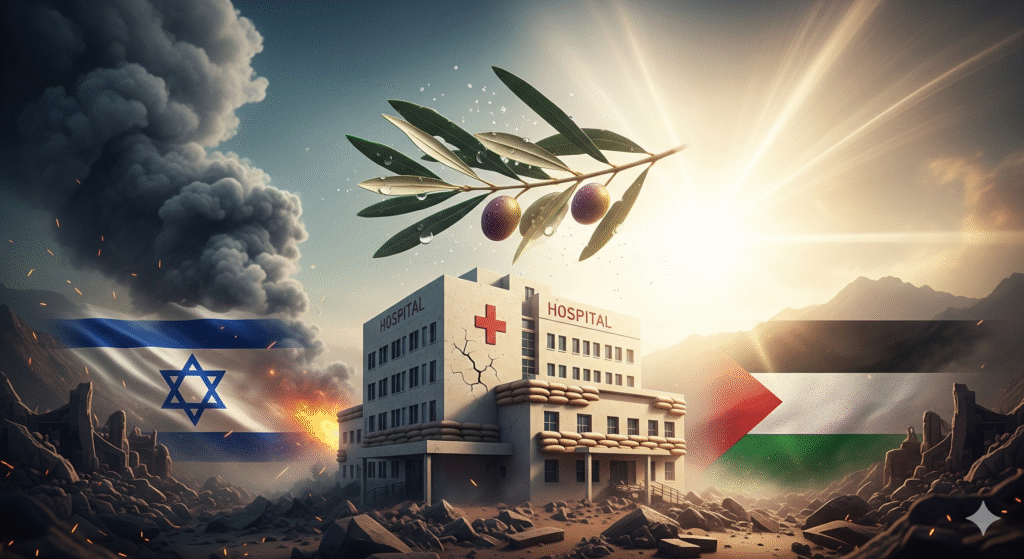
In a region defined by its volatility, the latest news from the Israel-Gaza conflict serves as a stark reminder of the brutal realities on the ground and the complex web of diplomatic efforts to find a resolution. According to statements from the Israeli military and confirmed by the U.S. envoy to the United Nations, a recent strike on a hospital in Gaza resulted in the death of six Hamas members. This tragic event, which has also been reported to have killed dozens of other people, including journalists and medical staff, has reignited international outrage and put a spotlight on the a fragile path to peace.
The Israeli military has stated that the strike, which occurred on August 25, 2025, on the Nasser Hospital in Khan Yunis, was a deliberate targeting of a Hamas surveillance camera. According to the Israeli Defense Forces (IDF), the camera was being used to monitor IDF troop movements and direct terrorist attacks. The IDF claims that its forces identified the threat and acted to remove it. The U.S. envoy to the UN, Dorothy Shea, backed this assessment in a statement to the Security Council, asserting that the IDF concluded that six Hamas members were killed in the strike, one of whom had participated in the October 7th, 2023 attacks. This narrative is, however, vehemently disputed by Hamas, which claims that none of its fighters were killed in the attack and that two of the six named by the IDF were killed at other times and locations.
The strike on the Nasser Hospital was particularly controversial as it was a “double-tap” strike, with a second missile hitting the same location minutes after the first. According to reports from Al Jazeera and Al-Masri, the second strike targeted rescue workers and journalists who had rushed to the scene to assist the wounded. The attack has drawn widespread international condemnation, with countries like the UK, France, and various UN officials labeling it as “indefensible” and calling for a thorough investigation. The attack is a microcosm of the larger conflict, where the use of civilian infrastructure by militants is a major challenge for the Israeli military, while the high civilian casualties and destruction of essential services have led to accusations of war crimes.
Amidst this devastating violence, there are reports of intensifying diplomatic efforts to find a resolution. U.S. President Donald Trump has suggested that a “conclusive ending” to the conflict could be achieved within the coming weeks. While details of these efforts are not publicly available, they are likely being conducted through backchannels involving mediators like Qatar, Egypt, and Turkey. The goal is to broker a lasting ceasefire, secure the release of hostages, and lay the groundwork for a future political solution. However, the path to peace is riddled with immense challenges, including the fundamental disagreement over the two-state solution and the future governance of Gaza.
The humanitarian crisis in Gaza continues to worsen. A recent UN report stated that famine is expanding and has already caused the deaths of at least ten more children. The UN has also warned that a planned Israeli offensive on Gaza City could be catastrophic and that a failure to act would have irreversible consequences. The international community, with the exception of the U.S., has largely called for an immediate and permanent ceasefire, but these calls have gone unheeded. The ongoing military operations and strikes on civilian infrastructure, including hospitals, suggest that a peaceful resolution is still a long way off. The strike on the Nasser Hospital is a grim reminder that in this conflict, even places of healing are not safe, and the line between military and civilian targets is often blurred, with devastating consequences.
21 Bullet Points on the Latest News
- Date: August 28, 2025
- An Israeli military strike hit a hospital in Gaza.
- The strike took place at Nasser Hospital in Khan Yunis.
- Israel’s military stated that six Hamas members were killed in the strike.
- The U.S. envoy to the UN, Dorothy Shea, confirmed the assessment.
- The IDF claimed the strike targeted a Hamas surveillance camera.
- The camera was allegedly used to monitor Israeli troop movements.
- Hamas has denied that any of its fighters were killed in the attack.
- Hamas claims that two of the six named were killed at other locations.
- The attack was a “double-tap” strike with a second missile hitting after the first.
- The second strike reportedly killed rescue workers and journalists.
- At least 20 people, including 5 journalists, were killed in the strike.
- The journalists were from Reuters, Al Jazeera, and the Associated Press.
- The Israeli Prime Minister’s office called the strike a “tragic mishap.”
- The UN has stated that there needs to be “justice” for the attack.
- UK Prime Minister Keir Starmer called the attack “completely indefensible.”
- Ongoing military operations continue in Gaza City.
- There are intensifying diplomatic efforts to find a resolution.
- U.S. President Donald Trump has suggested a “conclusive ending” in the coming weeks.
- The humanitarian crisis in Gaza is deepening, with a spreading famine.
- A recent UN report warns of a planned Israeli offensive on Gaza City.
- The International Criminal Court has issued arrest warrants for Israeli and Hamas leaders.
When, Where, Why, and Who
When?
- When did the strike happen? The Israeli military strike on the Nasser Hospital took place on Monday, August 25, 2025.
- When did the U.S. envoy confirm the assessment? The U.S. envoy to the UN, Dorothy Shea, confirmed the assessment to the Security Council on Wednesday, August 27, 2025.
Where?
- Where did the strike occur? The strike occurred at Nasser Hospital in Khan Yunis, in the southern Gaza Strip.
- Where did the U.S. envoy make the confirmation? The U.S. envoy made the confirmation at the UN Security Council in New York.
Why?
- Why did the strike happen? According to the Israeli military, the strike was to destroy a Hamas surveillance camera positioned near the hospital to monitor IDF activity. The IDF’s goal was to eliminate what it assessed as an operational risk. The IDF also claims that six Hamas members were killed in the strike, including one who participated in the October 7th attack.
- Why did the U.S. envoy confirm the assessment? The U.S. envoy confirmed the assessment to the UN Security Council as a way to defend Israel’s actions and condemn Hamas’s use of civilian infrastructure for military purposes.
Who?
- Who carried out the strike? The Israeli military (IDF) carried out the strike.
- Who was killed in the strike? According to the IDF, six Hamas members were killed. However, Hamas denies this. Dozens of others were also killed, including at least five journalists and four health workers.
- Who confirmed the Israeli assessment? Acting U.S. Ambassador to the UN, Dorothy Shea, confirmed the assessment.
- Who are the key parties in the conflict? Israel and Hamas are the main parties, with the United States acting as a key ally to Israel, and the United Nations and other international bodies attempting to mediate and address the humanitarian crisis.