





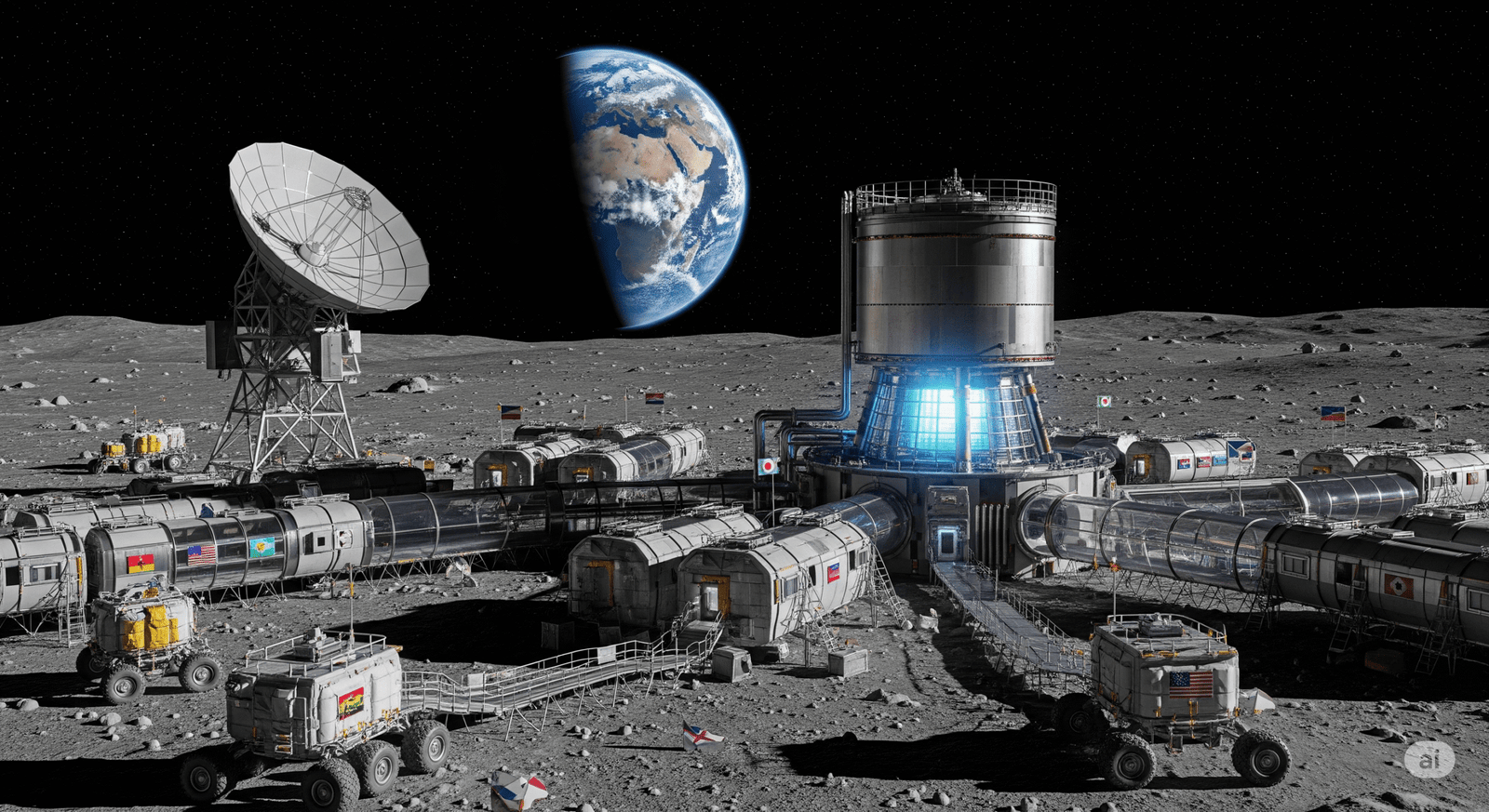
In a move that harks back to the Cold War-era space race, the United States, under the leadership of NASA, has made a decisive and bold pivot in its lunar strategy: a fast-tracked plan to deploy a nuclear reactor on the Moon by 2030. This ambitious project, announced in a new directive from Acting NASA Administrator Sean Duffy, is a clear and direct response to the burgeoning lunar ambitions of geopolitical rivals, China and Russia. The goal is not just scientific exploration, but the establishment of a strategic, long-term presence that could solidify U.S. leadership in space for decades to come.
For years, the dream of a permanent human presence on the Moon has been stymied by a fundamental challenge: power. The lunar environment is unforgiving, with two-week-long nights during which solar panels, the traditional workhorse of space energy, are rendered useless. This new initiative aims to solve that problem with a 100-kilowatt nuclear fission surface power system. This powerful reactor, which would be able to continuously generate electricity regardless of sunlight or lunar dust, would be a game-changer. It is designed to support multiple habitats, life-support systems, scientific laboratories, and the heavy-duty equipment needed for “in-situ resource utilization” – the process of converting lunar materials into usable resources like oxygen, water, and rocket fuel. This capability would be the key to making a lunar base truly self-sufficient and independent of expensive, risky resupply missions from Earth.
However, this is not just a scientific endeavor; it is a geopolitical one. The directive explicitly warns that the first nation to deploy such a reactor could “declare a keep-out zone,” a move that would effectively grant them de facto control over a strategic area, such as the resource-rich lunar south pole. With China and Russia actively collaborating on their own lunar base, also with a nuclear power element, the pressure on the U.S. to win this “Space Race 2.0” is immense. The accelerated 2030 timeline is a direct effort to get there first, not just with astronauts, but with the critical infrastructure needed to sustain them.
The plan, while praised for its vision, is not without its critics and challenges. Scaling up the power system from a previously planned 40-kilowatt design to a much larger 100-kilowatt system in such a short time is a monumental engineering feat. The cost is also a significant hurdle, with estimates suggesting a multi-billion-dollar price tag. There are concerns that accelerating this project could divert much-needed funding from other vital NASA missions, including earth science and climate observation programs. Furthermore, the safety of launching and deploying a nuclear reactor is a major consideration. While proponents argue that the fuel is not radioactive at launch and the reactor would only be activated once it is in a “nuclear safe orbit,” the historical track record of space-based nuclear technology has led to calls for caution and rigorous oversight.
To meet the ambitious deadline, NASA is shifting its approach, moving away from purely government-led projects towards a public-private partnership model. The directive mandates a 60-day window for industry proposals, signaling an intent to leverage the innovation and speed of the private sector, with companies like Axiom Space and Blue Origin potentially in the running. The hope is that this collaboration will not only meet the technical demands but also create a new commercial ecosystem for the lunar economy.
As the U.S. and its rivals race to a new frontier, the stakes are higher than ever. The success of this project could establish a new era of space exploration, laying the foundation for Mars missions and beyond. But its failure, or a misstep along the way, could prove to be a costly gamble with geopolitical and scientific consequences that extend far beyond the lunar surface. The coming years will determine whether NASA’s bold plan is a triumph of engineering and vision or a cautionary tale of a space race pushed to its limits.
Note: The following is a news summary based on the latest available information as of Friday, August 8, 2025.
Here are 21 key points regarding NASA’s plan for a lunar nuclear reactor:
- NASA is accelerating a plan to deploy a nuclear reactor on the Moon’s surface.
- The target date for the reactor to be operational on the Moon is 2030.
- The project is part of a “Space Race 2.0,” driven by competition from China and Russia.
- China and Russia have announced their own plans for a joint lunar base with nuclear power, targeting the early 2030s.
- The U.S. believes being the first to establish a reactor could prevent rivals from creating “keep-out zones.”
- The new plan calls for a 100-kilowatt fission surface power system.
- This is a significant increase from a previous 40-kilowatt design concept.
- A 100-kilowatt system is powerful enough to support multiple lunar habitats and industrial-scale facilities.
- The primary purpose of the reactor is to provide continuous, reliable power for future lunar bases.
- Solar power is insufficient for long-term lunar habitation due to the Moon’s two-week-long nights.
- The reactor would also power resource extraction, such as converting lunar regolith into oxygen and water.
- This technology is considered crucial for making lunar bases self-sufficient and reducing reliance on Earth resupply missions.
- The plan involves a new directive from Acting NASA Administrator Sean Duffy.
- The directive sets a 60-day window for NASA to gather input and proposals from private space and energy companies.
- The project marks a shift in NASA’s policy towards infrastructure-led, hard-power technologies.
- Challenges include the high cost, with some estimates reaching $3 billion over five years.
- Another major challenge is heat management, as the Moon lacks an atmosphere for cooling.
- The safety of transporting nuclear fuel to the Moon is a key concern, though safety protocols are in place to ensure the reactor is not active until it reaches a safe orbit.
- The project could serve as a blueprint for future missions to Mars and other deep-space explorations.
- Some critics have raised concerns that the accelerated timeline and high cost could siphon funds from other essential NASA science programs.
- The 1967 Outer Space Treaty and 1992 UN guidelines permit the peaceful use of nuclear power in space but emphasize cooperation and safety.
When, Where, Why, and Who
- When: The plan was accelerated in a new directive issued by Acting NASA Administrator Sean Duffy in July 2025. Public announcements and media reports on the project became widespread on Thursday, August 7, 2025. The reactor is targeted to be on the Moon by 2030.
- Where: The nuclear reactor is planned for deployment on the Moon’s surface. The U.S. aims to establish a presence in strategic, resource-rich areas, such as the south pole.
- Why: The primary reason is to provide a continuous and reliable power source for long-term human presence and scientific exploration on the Moon. This is necessary because solar power is not viable during the two-week lunar night. Additionally, the project is a strategic response to the emerging “Space Race 2.0” with geopolitical rivals China and Russia, who are also developing similar technology.
- Who: The plan is being led by NASA, specifically under the direction of Acting Administrator Sean Duffy. The project will involve significant collaboration with private space and energy companies to design and build the reactor. The global context includes China and Russia, whose own lunar ambitions are a major driving force behind the U.S. effort.