



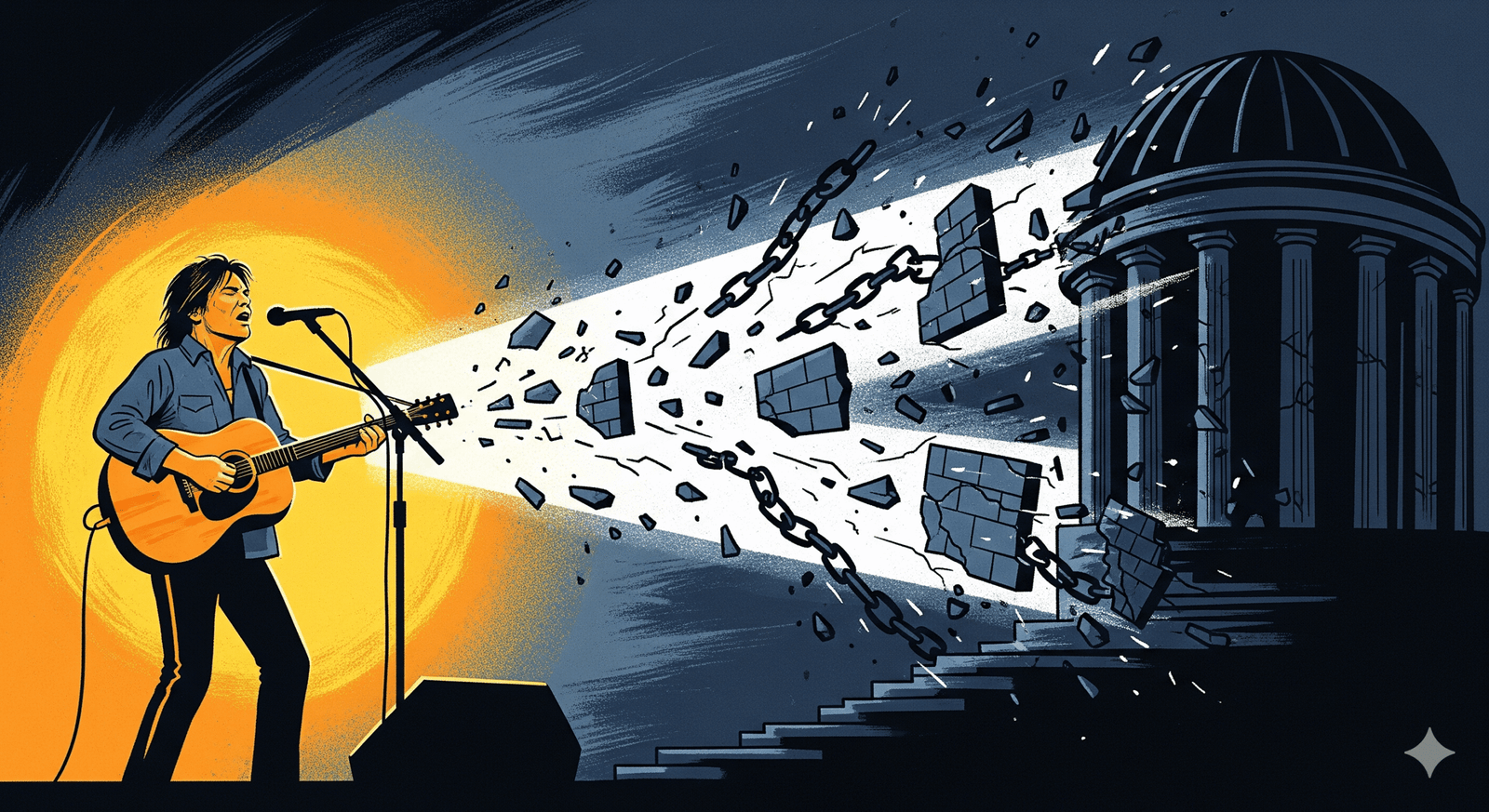
In a powerful and unapologetic return to his protest roots, legendary rocker Neil Young has debuted a new song, “Big Crime,” which serves as a searing and direct condemnation of the current political climate. The song, which first aired during a live performance in Chicago on August 27, 2025, and was later officially released on his website and YouTube channel, marks another chapter in Young’s long and often confrontational history of speaking truth to power. With lyrics that leave no room for ambiguity, Young, an artist whose career is synonymous with challenging the establishment, is once again using his music as a weapon for dissent.
The song’s message is a visceral and unvarnished reaction to what Young views as a betrayal of democratic ideals. The chorus is a repeated, hammering indictment: “There’s big crime in D.C. at the White House.” He goes on to declare, “Don’t need no fascist rules / Don’t want no fascist schools,” and in a pointed reference to a recent policy, “Don’t want soldiers on our streets.” The lyrics, which also include the line, “Got to get the fascists out / got to clean the White House out,” are a direct and explicit critique of the current U.S. administration. The song also flips the “Make America Great Again” slogan on its head, with Young repeatedly and defiantly chanting, “No more great again.”
This is not the first time Young has used his platform to confront the president. The two have a long-standing, contentious relationship that dates back to 2015 when Young sued the Trump campaign for using his music without permission. He has repeatedly called the president “a disgrace to my country,” and in an open letter on his website, he once wrote, “Your mindless destruction of our shared natural resources, our environment, and our relationships with friends around the world is unforgivable.” The release of “Big Crime” comes just a few months after Young expressed concerns that his outspoken criticism, as a dual Canadian-American citizen, could lead to him being barred from re-entering the United States, a chilling prospect he described as a symptom of a crumbling democracy.
“Big Crime” is more than just a political statement; it is a protest anthem in its purest form. It is a song born of frustration and a deep sense of national betrayal. It evokes the spirit of his 1970 song “Ohio,” a response to the Kent State shootings, which also used music to capture the rage and despair of a nation. Unlike the more poetic or nuanced protest songs of the past, “Big Crime” is a raw, blunt-force instrument. It is designed to be a call and response, a chant for a disillusioned public. In a world of fleeting news cycles and social media noise, Young has chosen clarity over subtlety. His lyrics are punchy, direct, and unforgettable, serving as a rallying cry for those who feel that the country’s core values are under threat. For his fans and fellow critics, the song is a powerful affirmation that in these uncertain times, the voice of protest is as vital and necessary as ever.
21 Bullet Points on Neil Young’s “Big Crime” (August 27, 2025)
- Neil Young released a new protest song titled “Big Crime.”
- The song was first performed live in Chicago on Wednesday, August 27, 2025.
- It was later released as an official audio track on his Neil Young Archives website and YouTube channel.
- The song is a direct and explicit protest against the current U.S. administration.
- The main chorus of the song is, “There’s big crime in D.C. at the White House.”
- The lyrics also include, “Don’t need no fascist rules, don’t want no fascist schools.”
- Young criticizes the deployment of the military, singing, “Don’t want soldiers on our streets.”
- He repeatedly chants “No more great again” as a reversal of a campaign slogan.
- The song urges listeners to “get the fascists out, got to clean the White House out.”
- The track was recorded with his backing band, The Chrome Hearts.
- The recording was a sound check from his Chicago concert at the Huntington Bank Pavilion.
- The release comes a few months after Young expressed concerns about being barred from the U.S.
- Young, a Canadian-American dual citizen, has been a vocal critic of the U.S. president for years.
- He previously sued the Trump campaign for unauthorized use of his music.
- The new song is seen as a return to his protest-era songwriting, similar to his 1970 song “Ohio.”
- The song is described as a raw, unfiltered critique of the political climate.
- It is also seen as a public affirmation of his political stance.
- The lyrics are designed to be a clear and direct message, not a subtle one.
- The White House has not yet officially commented on the song.
- The song also criticizes “the billionaire fascists” who receive money.
- It is described by some as a modern protest anthem for a new generation.
<br>
Separate Answer: When, Where, Why, and Who
When
The song was debuted on Wednesday, August 27, 2025, during a live performance. It was officially released on Friday, August 29, 2025.
Where
The song was performed live at the Huntington Bank Pavilion in Chicago, Illinois. The official audio was later released on Neil Young’s website and YouTube.
Why
Neil Young released “Big Crime” as a protest song to express his deep criticism of what he perceives as a “fascist” turn in the U.S. government. The lyrics directly challenge the current administration’s policies, including the use of soldiers in U.S. cities and its rhetoric, which Young sees as anti-democratic. The song is a continuation of his long history of using music as a tool for political dissent.
Who
- The Artist: Neil Young, a Canadian-American singer-songwriter.
- The Band: The Chrome Hearts, his backing band on the track.
- The Protest: The song protests the policies and actions of the current U.S. administration, specifically the president.