
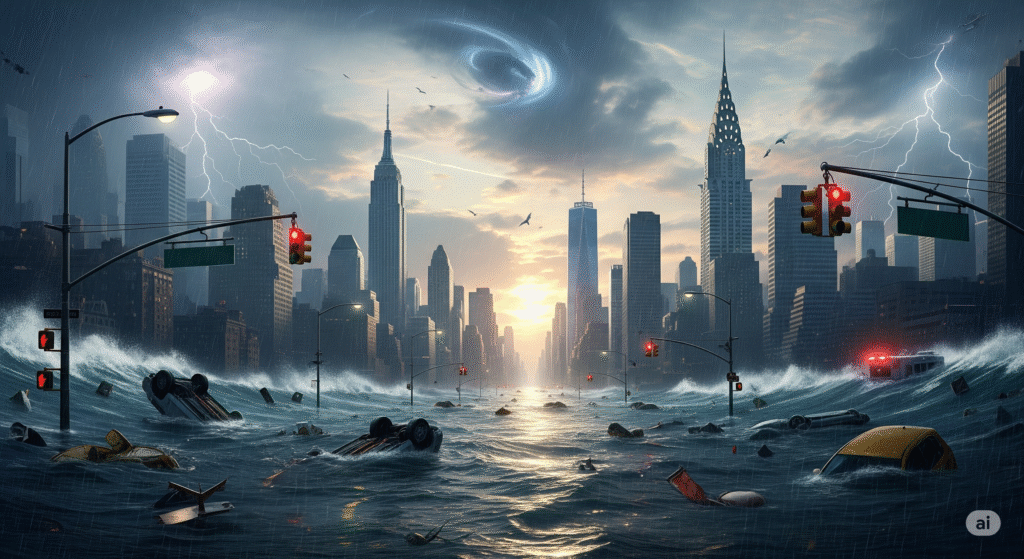
In a city defined by its ceaseless motion and unyielding rhythm, something brought New York to a halt. It wasn’t a holiday, a planned protest, or a subway strike. It was water—a torrent of it, cascading down subway stairs, bubbling up from manholes, and turning the city’s iconic streets into murky, impassable rivers. On a day that began like any other, New York was once again a city submerged, a dramatic and terrifying scene that underscored a stark reality: the city’s aging infrastructure is no match for the new, brutal world of extreme weather.
The chaos began on July 31, 2025, when a slow-moving storm system settled over the Northeast. The National Weather Service described it as carrying an “unusual amount of moisture,” and the result was catastrophic. In just a few hours, some parts of Queens received more than six inches of rain, an amount that would be manageable in a rural area but was devastating in a dense metropolis. The city’s century-old drainage systems, a marvel of engineering in their time, were simply overwhelmed.
The heart of the city’s paralysis was its world-famous subway system. Videos that quickly went viral captured scenes of chaos and terror: water gushing down stairs at Grand Central Terminal, turning a bustling hub into a cascading waterfall. In a Brooklyn station, passengers were seen climbing walls and gripping handrails, desperate to escape the rising floodwaters that had turned platforms into shallow pools. Major highways, the lifeblood of the city’s traffic, became deathtraps. The Clearview Expressway was closed in both directions, trapping cars and a tractor-trailer in waist-high water. At one point, a Long Island Rail Road train was so immobilized by floodwaters that passengers had to be evacuated by emergency crews with ladders.
The response was swift but challenged. New York City Mayor Eric Adams and Governor Kathy Hochul both declared a state of emergency, urging residents to stay home and avoid all unnecessary travel. For those living in the city’s many basement apartments, a travel advisory became an emergency plea to seek higher ground. While emergency services worked heroically to rescue stranded commuters and restore a semblance of order, the sheer scale of the event made it clear that the city was not prepared. This was the second such flooding event in weeks, a pattern that is becoming a terrifying new normal.
The financial and logistical impacts are immense. The MTA is now facing the daunting task of assessing and repairing damage to its subway and rail systems, which will likely cost hundreds of millions of dollars and cause ongoing service disruptions. Businesses across the city were brought to a standstill, and residents are being urged to report flood damage to a new city portal to help officials determine if they can seek federal disaster relief.
More importantly, the flooding has brought a renewed and urgent focus on the role of climate change and the city’s ability to adapt. For years, scientists and urban planners have warned that the kind of extreme rainfall events once considered rare are now becoming more common and more intense. New York City, with its coastal location and aging infrastructure, is particularly vulnerable. The city has long had plans for climate resilience, but critics argue that these projects have been either underfunded or delayed. This latest crisis has turned those theoretical debates into a concrete, and costly, reality.
This isn’t just a New York problem; it’s a global one. The flooding in the city is part of a larger pattern of extreme weather events—from unprecedented heatwaves in Europe to devastating floods in Asia—that are challenging the foundations of our modern world. The image of a flooded New York City, a symbol of human ambition and power, is a sobering reminder that the greatest threat we face is not from an external enemy, but from a rapidly changing planet. The question is no longer whether we can withstand these events, but how quickly we can adapt to a future where they are no longer the exception, but the rule.
The Latest on the New York City Flooding
- July 31, 2025: Torrential rainfall and flash flooding brought New York City to a standstill, marking the second major flood event in a matter of weeks.
- July 31, 2025: Mayor Eric Adams declared a local state of emergency for New York City, effective through the morning of August 1st.
- July 31, 2025: Governor Kathy Hochul also declared a state of emergency for several New York counties, including New York City.
- July 31, 2025: The National Weather Service issued a Flash Flood Emergency for the city, a rare and severe warning.
- July 31, 2025: Parts of Queens, specifically Oakland Gardens and Bayside, recorded over 6 inches of rainfall, overwhelming the city’s drainage systems.
- July 31, 2025: Subway services were severely disrupted, with floodwaters turning station stairways into waterfalls and platforms into rivers.
- July 31, 2025: Viral videos showed passengers in subway stations climbing walls and clinging to poles to escape the rising floodwaters.
- July 31, 2025: Major highways, including the Clearview Expressway and the Long Island Expressway, were submerged, with cars and even a tractor-trailer becoming stranded.
- July 31, 2025: A Long Island Rail Road train was also brought to a halt, with emergency crews using ladders to help evacuate trapped passengers.
- July 31, 2025: Hundreds of flights were canceled or delayed at major airports, including JFK, LaGuardia, and Newark, due to the storm.
- July 31, 2025: A state of emergency was also declared in neighboring New Jersey, which was also hit by severe weather.
- July 31, 2025: City officials urged residents, especially those in basement apartments, to move to higher ground and avoid all unnecessary travel.
- August 1, 2025: The city’s Emergency Management is urging citizens to report flood damage via its reporting portal to help the city assess the full scope of the storm’s impact.
- August 1, 2025: The information gathered from damage reports may support a request for federal disaster assistance.
- August 1, 2025: Clean-up crews worked overnight to clear debris, pump water from tunnels, and assess damage to signaling systems.
- August 1, 2025: While most subway lines resumed partial service, delays persisted well into the day.
- August 2, 2025: A 13-year-old boy tragically died in Maryland after being swept into a storm drain during the severe weather.
- July 31, 2025: This extreme weather event has raised renewed concerns about New York City’s aging infrastructure and its ability to handle increasingly common climate-driven storms.
- August 1, 2025: The National Weather Service called this one of the most intense rain events of 2025 so far.
- August 1, 2025: Officials noted that a slow-moving cold front carrying an unusual amount of moisture was the cause of the intense rainfall.
- August 2, 2025: The storm, which also hit other East Coast cities like Washington D.C. and Philadelphia, follows a similar event that occurred in the region just two weeks prior.
Analysis of the New York City Flooding
Who: The key people involved are New York City Mayor Eric Adams and New York Governor Kathy Hochul, who both declared a state of emergency. The storm affected countless residents, commuters, and businesses across the city’s five boroughs. Emergency personnel from the FDNY, NYPD, and the MTA were the primary responders, assisting stranded residents and working to restore service.
When: The most severe flooding occurred on Thursday, July 31, 2025. States of emergency were declared on the same day, and the city continues to deal with the aftermath as of August 2, 2025, with cleanup and recovery efforts underway.
Where: The flooding was most severe in New York City, with the boroughs of Queens, Brooklyn, and Manhattan experiencing the most significant impacts. Neighboring New Jersey was also hit hard, with its acting governor also declaring a state of emergency. The storm system’s effects were felt across the entire Northeast U.S. East Coast, including parts of Washington D.C. and Philadelphia.
Why: The immediate cause of the flooding was a powerful, slow-moving storm system that dropped an immense amount of rain in a very short period. The National Weather Service described it as carrying an “unusual amount of moisture,” leading to rainfall rates of up to 2-3 inches per hour in some areas. The underlying reason for the severe impact is the city’s aging infrastructure, which was simply overwhelmed. The subway system, in particular, was not built to handle this volume of water. This event is also being framed by officials as part of a larger trend of extreme weather events linked to climate change, which are becoming more frequent and intense. This latest flooding has amplified calls for greater investment in climate resiliency and infrastructure upgrades.