





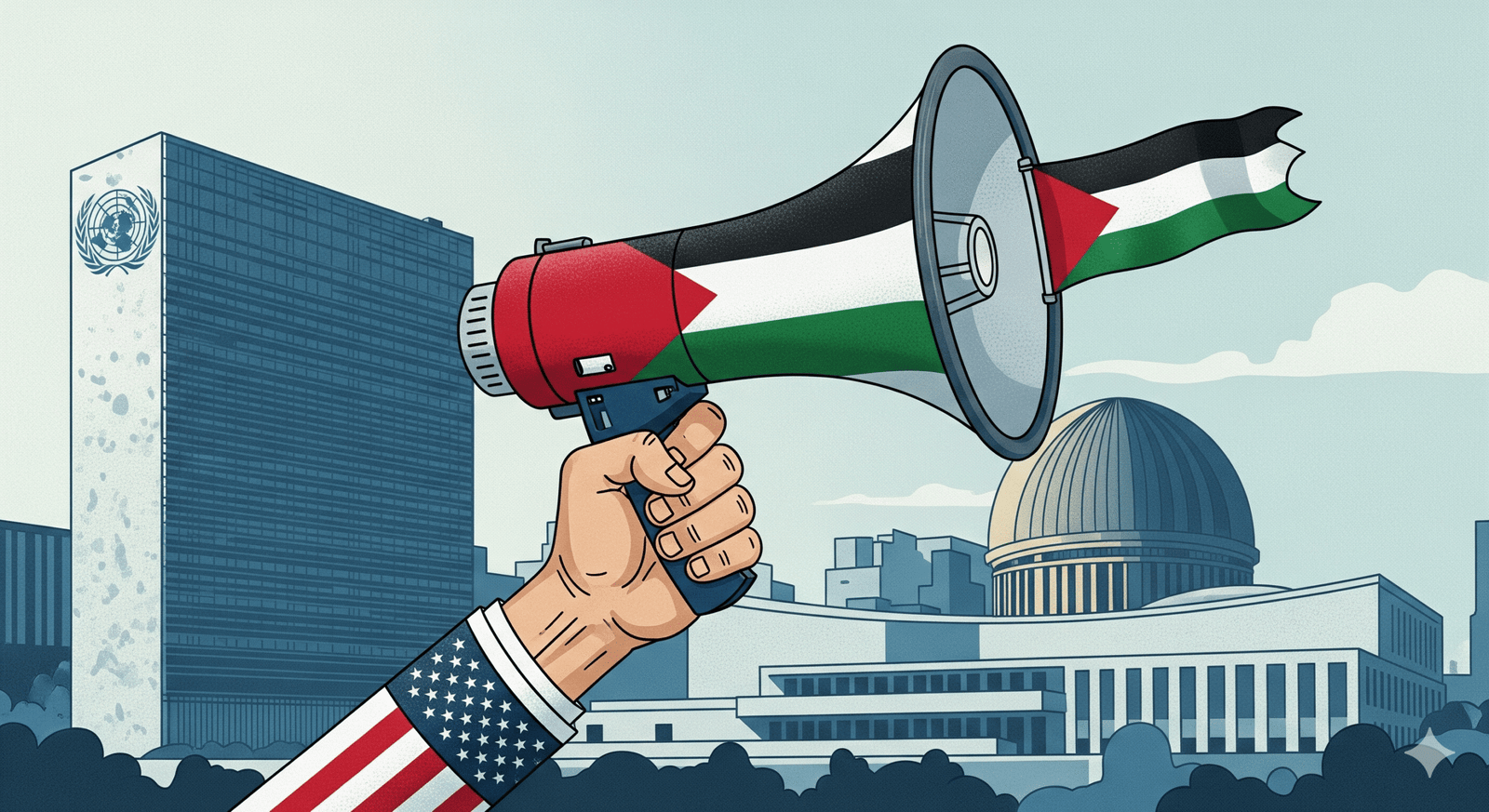
In a move that has been widely condemned as a direct attempt to silence a national voice on the global stage, the United States has denied visas to Palestinian officials, including President Mahmoud Abbas, who were scheduled to attend the upcoming United Nations General Assembly (UNGA). This decision, announced by the State Department on August 29, 2025, has been described by Palestinian journalist Daoud Kuttab as “yet another move to silence Palestinians.” The timing of the visa denials is particularly poignant, as it comes just as several Western countries, including France and Canada, have announced their intention to recognize a Palestinian state during the UNGA session, a diplomatic push that the U.S. and Israel staunchly oppose.
The justification for the visa denial, according to the U.S. State Department, is that the Palestinian Authority (PA) has “not compli[ed] with their commitments, and… [is] undermining the prospects for peace.” This is a claim the Palestinians and their supporters find absurd, arguing that the PA has consistently renounced armed struggle and has engaged in U.S.-led peace initiatives for years. The decision is seen as a direct retaliation for the Palestinians’ recent moves to seek redress at international bodies like the International Criminal Court (ICC) and the International Court of Justice (ICJ), a form of legal action the U.S. has derisively labeled “lawfare.” The visa denial is, therefore, seen by many as a clear signal that the U.S. will punish Palestinians not only for violence but also for non-violent diplomatic and legal actions.
This unprecedented step is a significant departure from diplomatic norms. Under the 1947 UN Headquarters Agreement, the host country, in this case, the U.S., is generally obligated to grant visas to officials from all member and observer states attending UN meetings. The U.N. itself has voiced its concern, with spokesman Stephane Dujarric stating that it is “important” for all parties to be represented. The visa denial has drawn swift and sharp condemnation from several European countries, with France, Spain, and others arguing that the move is an “unjust revocation” that contravenes international law.
The U.S. government’s decision is deeply aligned with the policies of the Israeli government. Israeli Foreign Minister Gideon Sa’ar has publicly thanked the Trump administration for the “bold step” of “standing by Israel once again.” The move is seen as a way to deny the Palestinians a platform to speak about the ongoing atrocities in Gaza and to celebrate the anticipated recognition of their statehood by new allies. The article by Kuttab also points to a broader pattern of the U.S. and Israel working to silence Palestinian voices, including the targeting of journalists, citing the recent death of five Palestinian journalists in a hospital bombing and the long-ago killing of journalist Shireen Abu Aqleh.
The visa denial has brought into sharp focus the precarious position of Palestinians in the international community. It raises a fundamental question: If even a compliant body like the PA, which has renounced armed resistance, is denied a voice, who is allowed to speak for the Palestinian people? This action, framed as an issue of national security, is viewed by critics as a clear attempt to erase Palestinian self-determination and to support efforts to remove a people from their homeland. For now, the future of the Palestinian delegation’s attendance remains uncertain, with the U.N. hoping for a swift resolution.
21 Bullet Points on U.S. Visa Denials to Palestinian Officials (September 1, 2025)
- The U.S. State Department has denied visas to Palestinian officials for the UN General Assembly.
- Palestinian President Mahmoud Abbas is included in the visa ban.
- The announcement was made on Friday, August 29, 2025.
- The U.S. claims the Palestinian Authority (PA) is “undermining the prospects for peace.”
- The visa denials are a response to Palestinian legal actions at the International Criminal Court.
- The U.S. has labeled the Palestinian legal moves as “lawfare.”
- The decision contravenes the 1947 UN Headquarters Agreement.
- The UN has stated it is “important” for all states to be represented.
- The Palestinian Authority has called for a reversal of the decision.
- The Palestinian ambassador to the UN, Riyad Mansour, said his mission was seeking clarification.
- The U.S. has allowed representatives permanently assigned to the Palestinian UN mission to keep their visas.
- The move is seen as a strong show of alignment with the Israeli government.
- Israel’s Foreign Minister Gideon Sa’ar thanked the Trump administration for the step.
- The visa denials come as several Western countries plan to recognize a Palestinian state.
- France, Canada, and Britain are among the countries that have pledged to recognize a Palestinian state.
- Critics say the U.S. policy punishes Palestinians for both violence and non-violence.
- The article by Daoud Kuttab argues the visa denial is an effort to silence Palestinians.
- Kuttab’s article also mentions a pattern of violence against Palestinian journalists.
- The UN General Assembly (UNGA) is set to begin in New York in September 2025.
- This is not the first time the U.S. has denied a visa to a Palestinian leader; Yasser Arafat was denied in 1988.
- European nations, including Spain and France, have condemned the U.S. decision.
Separate Answer: When, Where, Why, and Who
When
The U.S. State Department announced the visa denials on Friday, August 29, 2025. The UN General Assembly is scheduled to begin in September 2025.
Where
The visa denials were announced by the U.S. State Department in Washington, D.C. The Palestinian officials were scheduled to attend the UN General Assembly in New York City.
Why
According to the U.S. State Department, the visas were denied because the Palestinian Authority is “undermining the prospects for peace” by pursuing legal action against Israel in international courts. According to Daoud Kuttab and other critics, the move is intended to silence the Palestinian voice and prevent them from gaining international support, particularly as several nations plan to recognize a Palestinian state.
Who
- The Denier: The U.S. government, specifically the State Department under Secretary of State Marco Rubio.
- The Denied: Palestinian officials, including President Mahmoud Abbas and approximately 80 other members of the Palestine Liberation Organization (PLO) and the Palestinian Authority (PA).
- The Analyst: Daoud Kuttab, a Palestinian journalist who authored the opinion piece on the matter.