



The War in the Skies: A Dangerous Escalation as Russia and Ukraine Intensify Aerial Barrages
The brutal conflict between Russia and Ukraine has entered a new and alarming phase, characterized by a relentless escalation of aerial attacks. The past few days, particularly the night of Friday, July 25, into Saturday, July 26, 2025, have witnessed a surge in drone and missile strikes deep within each other’s territories, tragically claiming lives and causing extensive damage on both sides of the border. This intensified aerial warfare underscores the grim reality that neither side is willing to cede ground, opting instead to inflict maximum pressure and disrupt the adversary’s capacity to wage war.
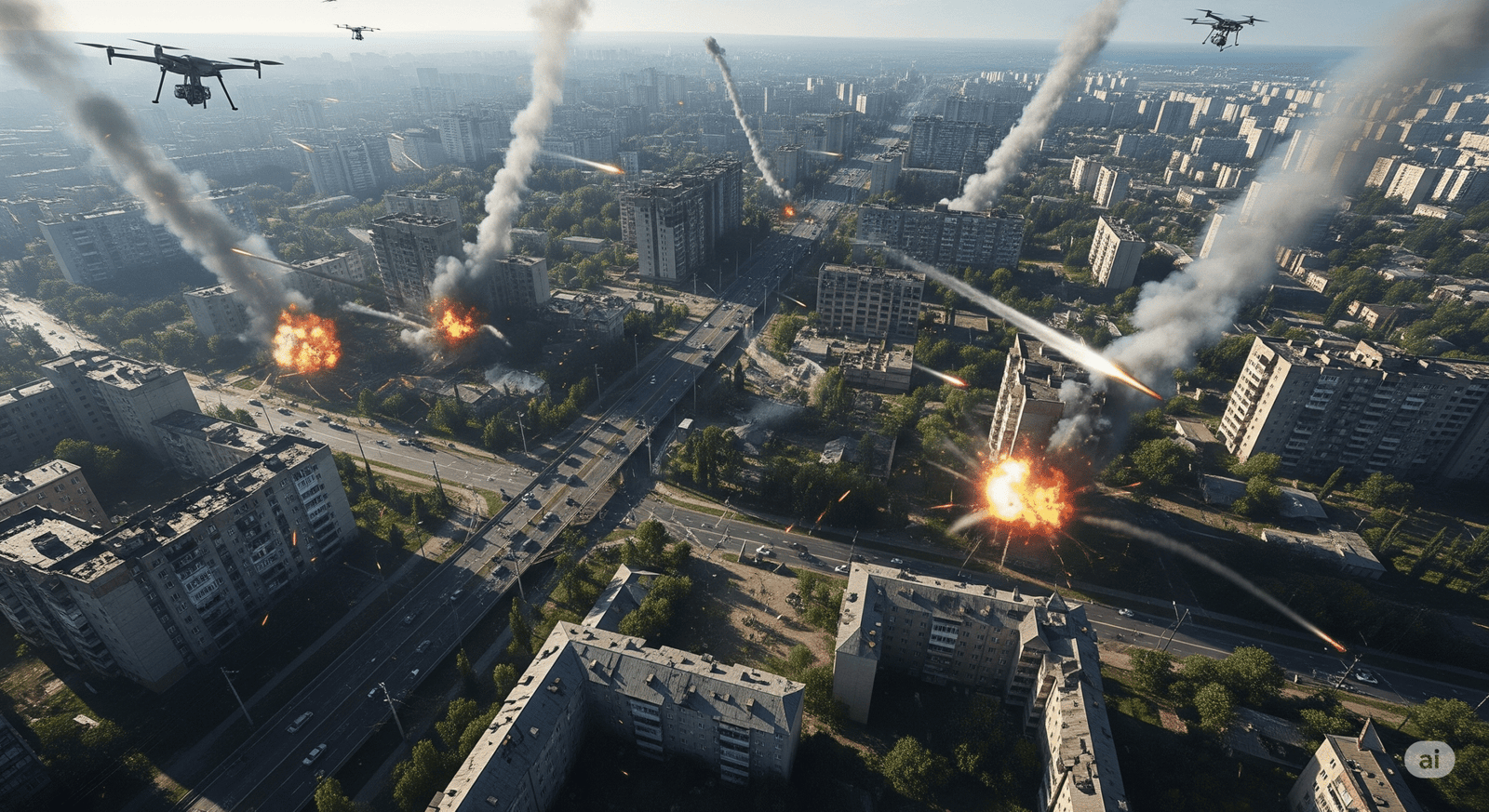
The human cost of this escalation is stark. Latest reports confirm that four lives were lost – two in Ukraine’s Dnipro region and two in Russia’s Rostov region – with many more injured. In Ukraine, the southern Dnipro region, including the city of Dnipro, bore the brunt of a combined rocket and drone attack. Multi-story buildings were damaged, businesses were hit, and a shopping center was engulfed in flames, painting a picture of civilian life under siege. Simultaneously, Kharkiv, Ukraine’s second-largest city, endured a punishing three-hour aerial bombardment involving guided aerial bombs, ballistic missiles, and numerous drones. The city’s mayor reported widespread damage to residential buildings, infrastructure, and businesses, and critically, five individuals were injured, including three dedicated rescue workers who fell victim to a “double tap” strike, a heinous tactic designed to maximize casualties among emergency responders.
Ukrainian officials detailed the scale of the Russian assault, reporting that a staggering 208 drones and 27 missiles were launched across Ukraine overnight. While Ukraine’s air defense systems valiantly intercepted a significant portion – 183 drones and 17 missiles – the sheer volume of the barrage meant that 10 missiles and 25 drones still managed to hit their targets in at least nine different locations. This relentless saturation strategy by Russia aims to overwhelm Ukraine’s increasingly strained air defense capabilities, forcing them to expend precious interceptors and exposing critical infrastructure.
However, Ukraine is not merely a passive recipient of these attacks. Its own long-range drone program has matured significantly, allowing Kyiv to strike deep into Russian territory. On the same night, Ukrainian drones targeted multiple regions within Russia, including the Rostov region, where two civilian fatalities were reported. An industrial facility in the Stavropol region was hit, sparking a fire, while drones were also reported over Moscow and an industrial facility in the Penza region. Russian authorities confirmed interceptions over Bryansk, annexed Crimea, and the Azov and Black Seas, highlighting the expansive reach of Ukraine’s retaliatory strikes. The disruption caused was evident, with cellular internet services restricted in parts of Stavropol and brief halts in flight operations at several Russian airports.
Ukrainian President Volodymyr Zelenskyy minced no words in his response, asserting that such attacks cannot go unanswered and vowing that Ukrainian long-range drones would ensure a decisive response. His statement, emphasizing that Russian military enterprises, logistics, and airfields “must see that Russia’s own war is now hitting them back with real consequences,” underscores a clear strategic intent: to raise the cost of aggression for Moscow and demonstrate that Russia itself is not immune to the devastating effects of the conflict it initiated.
This escalation is not isolated; it builds upon a trend observed throughout July 2025. UN officials recently conveyed to the Security Council on July 25, 2025, that civilian casualties in Ukraine had reached a three-year high in June, with thousands killed or injured in the first half of the year alone. Reports from the Institute for the Study of War indicate that Russia has been increasingly integrating missiles into its overnight strike packages, moving beyond a primary reliance on drones seen earlier in the spring and summer. This points to an enhanced Russian missile and drone production capability, enabling a higher volume and more complex series of attacks.
Analysts suggest that Russia’s intensified targeting of densely populated urban areas is a deliberate part of a “cognitive warfare” effort. The aim is to sow fear, undermine public morale, and ultimately erode Ukrainian resolve to resist. By making daily life a constant gamble under the threat of aerial assault, Moscow hopes to break the spirit of the nation. For Ukraine, the continued and expanded aerial campaign deep into Russia serves a dual purpose: to disrupt Russia’s war machine and to keep the urgency of their need for more sophisticated Western air defense systems and military aid firmly on the international agenda.
As the conflict stretches into its third year, the skies over both nations have become fiercely contested battlegrounds. The escalating aerial attacks, characterized by a devastating exchange of drones and missiles, mark a dangerous intensification of the war. With civilian casualties mounting and critical infrastructure under constant threat, the path to peace appears more fraught than ever. The world watches, hoping for an end to the violence, even as the aerial barrages continue to underscore the brutal and unyielding nature of this protracted conflict.
The war in Ukraine continues to escalate, with aerial attacks by both Russia and Ukraine reaching new levels of intensity. The latest reports indicate a significant increase in drone and missile strikes deep within each other’s territories, leading to casualties and widespread damage.
Here are 21 bullet points on the latest news of intensified aerial attacks between Russia and Ukraine.
- July 26, 2025: Both Russia and Ukraine conducted extensive aerial attacks overnight, resulting in casualties and widespread damage.
- July 26, 2025: Two people were killed in Ukraine’s Dnipro region, and two more in Russia’s Rostov region, bringing the total reported fatalities from these overnight strikes to four.
- July 26, 2025: Multiple injuries were reported across both nations, including in Ukraine’s Sumy and Kharkiv regions.
- July 26, 2025: In the city of Dnipro, a multi-story building and a business were damaged, and a shopping center caught fire.
- July 26, 2025: Kharkiv, Ukraine’s second-largest city, sustained an intense bombardment with four guided aerial bombs, two ballistic missiles, and 15 drones over a three-hour period.
- July 26, 2025: Kharkiv’s mayor reported damage to high-rise residential buildings, local businesses, roads, and communication networks.
- July 26, 2025: At least five people were injured in Kharkiv, including three rescue workers wounded in a “double tap” strike, which targets emergency responders.
- July 26, 2025: According to Ukraine’s Air Force report, Russia launched a total of 208 drones and 27 missiles overnight across Ukraine.
- July 26, 2025: Ukrainian air defense systems reportedly intercepted 183 drones and 17 missiles, but hits were recorded in nine locations from 10 missiles and 25 drones.
- July 26, 2025: In Russia, Ukrainian drones targeted multiple regions overnight, including Rostov, Stavropol, Moscow, and Penza.
- July 26, 2025: An industrial facility in Russia’s Stavropol region was hit by drones, sparking a brief fire, but no casualties were reported there.
- July 26, 2025: Russian officials also reported that drones were shot down over Bryansk, annexed Crimea, and the Azov and Black Seas.
- July 26, 2025: Cellphone internet services in some parts of the Stavropol region were restricted following the attacks, a measure authorities often take.
- July 26, 2025: Russian civil aviation agency Rosaviatsia briefly halted flights in and out of airports serving Kaluga, Vladikavkaz, and Grozny due to drone activity.
- July 26, 2025: Ukrainian President Volodymyr Zelenskyy commented that such strikes cannot be left unanswered, vowing that Ukrainian long-range drones would ensure a response.
- July 26, 2025: He emphasized that Russian military enterprises, logistics, and airfields must face “real consequences” from Russia’s own war.
- July 25, 2025: UN officials warned the Security Council that civilian casualties reached a three-year high in June 2025, with 6,754 civilians killed or injured in the first half of the year.
- July 2025: Russia has reportedly intensified its missile and drone production capabilities, integrating more missiles into overnight strike packages.
- July 2025: Analysts note that Russia is increasingly targeting densely populated cities, potentially as a “cognitive warfare” effort to weaken Ukrainian resolve.
- July 2025: Ukraine’s Western partners continue to provide critical air defense and military assistance to counter these intensified attacks.
- July 2025: The escalation highlights the ongoing humanitarian toll and the disruption to daily life in both Ukraine and Russia.
When, Where, Why, and Who
- When: The most recent wave of intensified aerial attacks, leading to the reported casualties, occurred on the night of Friday, July 25, into Saturday, July 26, 2025. The broader escalation of drone and missile strikes has been a continuous trend throughout July 2025.
- Where:
- In Ukraine: Major targets included the Dnipro region (specifically Dnipro city and Kamianske), where a multi-story building, a shopping center, and other businesses were damaged, and casualties reported. Kharkiv suffered extensive bombardment, hitting residential areas and infrastructure. Sumy region also came under attack. Other reported hits were across various “nine locations” in Ukraine.
- In Russia: Ukrainian drones targeted deep into Russian territory. Key locations included the Rostov region (where two people were killed), the Stavropol region (hitting an industrial facility), Moscow, and the Penza region (hitting an industrial facility). Drones were also reportedly intercepted over Bryansk, annexed Crimea, and the Azov and Black Seas. Flight operations were briefly halted at airports serving Kaluga, Vladikavkaz, and Grozny.
- Why:
- Russia’s motivations: Russia’s intensified aerial attacks are primarily aimed at degrading Ukraine’s military and energy infrastructure, exerting psychological pressure on the civilian population to weaken their resolve, and exhausting Ukraine’s air defense resources. Reports suggest Russia is increasing its missile and drone production to sustain these high-volume attacks, potentially as part of a “cognitive warfare” strategy.
- Ukraine’s motivations: Ukraine’s retaliatory strikes deep into Russian territory are intended to disrupt Russian military logistics and production capabilities, demonstrate Ukraine’s ability to strike back, and exert pressure on Russia by bringing the realities of the war closer to its population. Ukrainian President Zelenskyy explicitly stated that Russian military enterprises, logistics, and airfields must face “real consequences.” These strikes also serve to maintain pressure on Western allies for continued military aid, especially advanced air defense systems.
- Who:
- On the Russian side:
- Russian Armed Forces: Responsible for launching missiles and drones against Ukrainian territory.
- Russian Defence Ministry: Provides official reports on Ukrainian drone interceptions and damage within Russia.
- Local Russian officials: Such as acting governor Yuri Slyusar of Rostov region, Governor Vladimir Vladimirov of Stavropol region, Mayor Sergei Sobyanin of Moscow, and Governor Oleg Melnichenko of Penza region, who report on impacts within their respective areas.
- On the Ukrainian side:
- Ukrainian Armed Forces (including Air Force): Responsible for air defense operations and launching drone/missile strikes into Russia.
- Ukrainian Security Service (SBU) and Main Directorate of Intelligence (HUR): Credited with conducting some of the deep strikes into Russia.
- Ukrainian President Volodymyr Zelenskyy: The supreme commander, who issues statements and sets the strategic direction for responses.
- Local Ukrainian officials: Such as Serhii Lysak (Head of Dnipro Regional Administration) and Ihor Terekhov (Kharkiv Mayor), who provide updates on Russian strikes and casualties in their regions.
- Ukrainian civilians and emergency services: The direct victims and first responders to the attacks.
- International Bodies:
- United Nations (UN): Officials, like those from the Department of Political and Peacebuilding Affairs and the Office for the Coordination of Humanitarian Affairs, continue to monitor and report on the human toll of the conflict.
- Western Allies/Partners: Countries providing military and humanitarian aid to Ukraine, whose ongoing support is crucial for Ukraine’s defense.
- On the Russian side: