
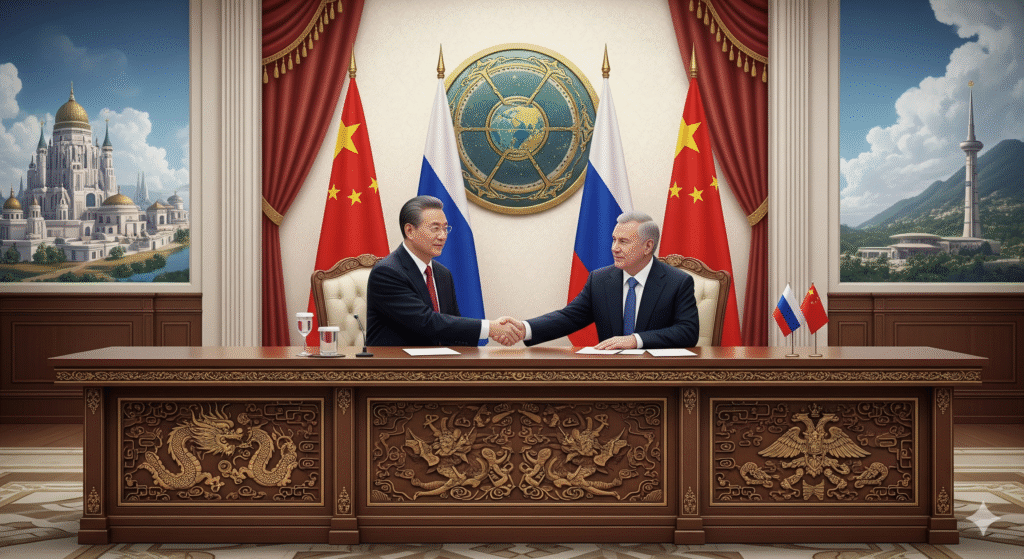
In a powerful display of geopolitical alignment, China’s President Xi Jinping and Russia’s President Vladimir Putin used a high-profile summit in China to launch a direct and coordinated critique of Western policies, signaling a deepening of their partnership and a shared vision for a new, multipolar world order.1 The Shanghai Cooperation Organization (SCO) Summit, held in Tianjin on September 1, 2025, served as a potent platform for the two leaders to project an image of unity and to articulate their shared grievances against what they see as a Western-dominated international system.2
President Xi, speaking to a gathering of leaders from across Eurasia, offered a veiled but unmistakable condemnation of the United States.3 He urged the member states of the SCO to “oppose cold war mentality, bloc confrontation, and bullying behavior.”4 This language, a consistent feature of Beijing’s diplomatic rhetoric, is widely interpreted as a direct jab at Washington’s use of economic sanctions, trade tariffs, and military alliances to assert its global primacy. Xi also called for a new model of “true multilateralism,” one anchored not by Western institutions but by a collective of nations that value what he called “justice and fairness” over “hegemony and power politics.”5 He underscored this vision with a pledge of financial aid and loans, a clear signal that China is prepared to lead by example and with material support.6
Following Xi’s address, President Putin delivered his own confrontational message, offering a defiant defense of Russia’s war in Ukraine.7 Putin blamed the West for the war, rejecting the notion that Russia’s invasion was the cause of the conflict.8 Instead, he reiterated the Kremlin’s long-standing claim that the war was a direct result of a “coup d’état in Kyiv, which was supported and provoked by the West.”9 He also pointed to what he called the “constant attempts to drag Ukraine into NATO” as a key driver of the conflict, framing Russia’s actions as a necessary response to an existential threat.10 This narrative, while rejected by Western nations, found a receptive audience among the SCO members, many of whom share a history of friction with Western powers.
The optics of the summit were as significant as the words. President Putin and Indian Prime Minister Narendra Modi were seen in a series of highly symbolic meetings, including a private car ride and a warm handshake, signaling a deepening of India-Russia ties.11 This public display of friendship came at a time when the U.S. under President Donald Trump is imposing tariffs on Indian goods, creating a stark contrast and seemingly driving New Delhi closer to Beijing and Moscow.12 Experts have dubbed this strategic pivot a “Reverse Nixon,” a geopolitical maneuver in which Russia and China are strengthening their alliance, rather than being driven apart, as President Nixon famously did with China in the 1970s to isolate the Soviet Union.
This summit underscores a clear shift in global power dynamics. The SCO, once a largely ceremonial organization, is evolving into a more assertive bloc that is actively working to create an alternative to Western-led alliances like NATO and the G7.13 The speeches by Xi and Putin were not just about condemning past actions; they were about laying the foundation for a future international order where their influence and values are at the forefront. As the world becomes more fragmented, the Shanghai summit serves as a powerful reminder that the old unipolar order is fading, and a new, more complex, multipolar reality is rapidly taking its place.
21 Bullet Points on the Shanghai Summit (September 1, 2025)
- The Shanghai Cooperation Organization (SCO) Summit was held in Tianjin, China.14
- The summit took place on Sunday and Monday, August 31 and September 1, 2025.15
- China’s President Xi Jinping condemned “bullying behavior” by other countries.16
- The condemnation was widely seen as a veiled critique of the United States.17
- Russia’s President Vladimir Putin blamed the West for the war in Ukraine.18
- Putin claimed the war was a result of a “coup in Kyiv, which was supported and provoked by the West.”19
- He also cited Western attempts to “drag Ukraine into NATO” as a primary cause.20
- The SCO is being promoted as a non-Western alternative to organizations like NATO.21
- The summit highlighted a deepening strategic alignment between China and Russia.22
- The event was attended by leaders from across Eurasia, including India and Iran.23
- Indian Prime Minister Narendra Modi’s warm interactions with Putin and Xi were highly symbolic.24
- Analysts have called this a “Reverse Nixon,” as it strengthens the China-Russia alliance.
- Xi Jinping called on SCO members to oppose “cold war mentality” and “bloc confrontation.”25
- China pledged a significant financial package of aid and loans to SCO member states.26
- The leaders discussed a new “multipolar” world order.27
- The SCO is comprised of China, India, Russia, Pakistan, Iran, Kazakhstan, Kyrgyzstan, Tajikistan, Uzbekistan, and Belarus.28
- The speeches aimed to challenge the dominance of Western-led institutions.29
- The leaders also emphasized cooperation on issues of trade, security, and development.30
- The SCO’s joint declaration condemned a terrorist attack in Indian Kashmir.31
- Putin and Xi also praised India’s and China’s diplomatic efforts on the Ukraine conflict.32
- The summit underscored the growing influence of non-Western powers in global affairs.33
Separate Answer: When, Where, Why, and Who
When
The Shanghai Cooperation Organization (SCO) Summit took place on September 1, 2025.34
Where
The summit was held in the port city of Tianjin, China.35
Why
The leaders gathered to address shared security and development challenges and to promote the SCO as a more equitable, multipolar alternative to Western-led international organizations.36 Xi and Putin used the platform to publicly criticize what they perceive as Western “bullying” and hegemonic policies, with Putin specifically defending Russia’s actions in Ukraine and casting blame on the West.37
Who
- The Speakers: Xi Jinping, President of China, and Vladimir Putin, President of Russia.38
- The Audience: Leaders from the member states of the Shanghai Cooperation Organization (SCO), including India’s Prime Minister Narendra Modi and leaders from Central Asian nations.39
- The Subject of Criticism: The United States and other Western nations, particularly their policies on sanctions, trade, and military alliances.