
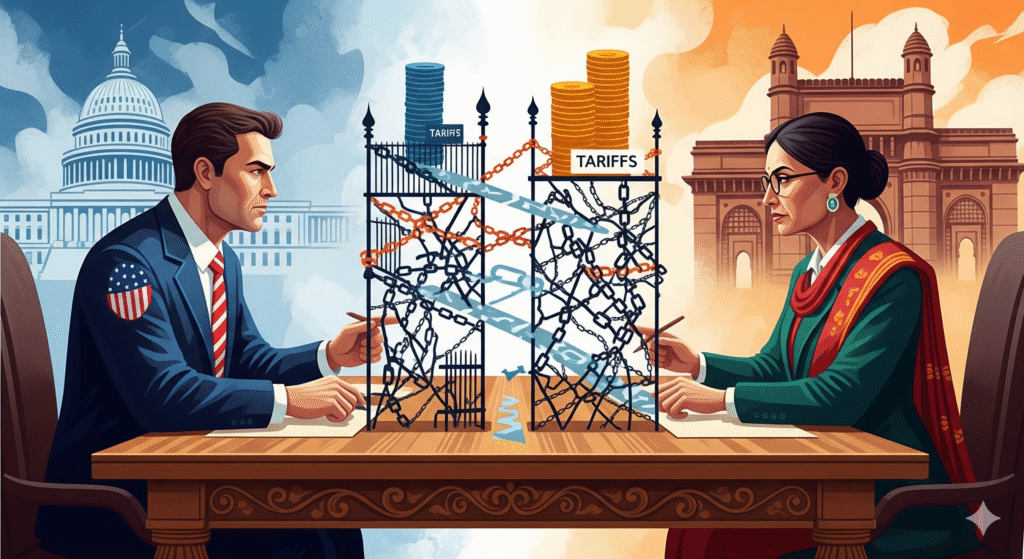
In a significant shift in the global economic landscape, a new U.S. tariff on Indian goods has taken effect, increasing the total duties on certain sectors to a staggering 50%. This move, implemented by the Trump administration, is a direct response to India’s continued and strategic purchase of discounted Russian oil. While the tariffs pose a serious challenge to India’s export-driven industries, New Delhi is not backing down. Instead, it is responding with a multi-pronged strategy focused on strengthening its domestic economy, diversifying its trade partnerships, and asserting its right to act in its national interest.
The tariffs, which came into effect on August 27, 2025, have sent a shockwave through India’s export-dependent sectors. Industries like textiles, gems and jewelry, shrimp, and leather goods are particularly vulnerable, as they rely heavily on the U.S. market. The new duties effectively price Indian products out of the U.S. market, creating a significant disadvantage compared to regional competitors like Bangladesh and Vietnam, which face much lower tariffs. This trade shock is expected to cause a significant drop in export volumes, potentially leading to job losses and a slowdown in economic growth.
However, India’s response is one of defiance, not desperation. The government, led by Prime Minister Narendra Modi, has made it clear that it will not compromise on its national interests. External Affairs Minister S. Jaishankar has robustly defended India’s decision to buy Russian oil, arguing that it is both in the national interest and contributes to global energy stability. He has pointed out the hypocrisy of the U.S., noting that other major importers of Russian oil, like China, have not been targeted with similar punitive tariffs.
India’s strategy to counter the impact of these tariffs is a testament to its growing economic resilience. The government is not considering retaliatory tariffs, which could escalate the situation and harm both economies. Instead, it is focusing on internal reforms and external diversification.
A key part of the government’s plan is to promote domestic consumption and production. This is being achieved through a push for the “Swadeshi” or “Make in India” movement, with a call from the Prime Minister to be “vocal for local” and for citizens and businesses to prioritize Indian-made products. The government is also considering significant changes to the Goods and Services Tax (GST) structure, with proposals for a simplified two-tier system and reduced tax rates on essential items. These reforms are expected to boost consumer spending and insulate the economy from external shocks.
On the international front, India is actively seeking new trade partnerships and accelerating negotiations with existing ones. The government is fast-tracking discussions for a comprehensive trade agreement with the UK and intensifying talks with the European Union. A trade deal with Oman is also nearing completion. Furthermore, a new “Export Promotion Mission” is being launched, which includes dedicated outreach programs in over 40 countries, including key markets in Europe, Asia, and Latin America. This initiative aims to diversify India’s export base and reduce its reliance on any single market.
While the tariffs present a significant challenge, they also serve as a catalyst for India to double down on structural reforms and fortify its economic foundation. The high tariffs may be a short-term blow, but by focusing on self-reliance, domestic demand, and a diversified trade strategy, India is positioning itself to emerge stronger and more resilient in the long run. The current trade dispute underscores the complex and evolving nature of the U.S.-India relationship, but also highlights India’s growing confidence and its unwavering commitment to charting its own course on the global stage.
21 Bullet Points on the Latest News
- Date: August 28, 2025
- The U.S. has imposed an additional 25% tariff on Indian goods, bringing the total tariff to 50% for certain sectors.
- This punitive measure is a response to India’s continued purchase of discounted Russian crude oil.
- The new tariffs came into effect on August 27, 2025.
- The tariffs are being implemented by the Trump administration.
- The U.S. alleges that India’s oil purchases are indirectly funding Russia’s war in Ukraine.
- The most affected sectors are labor-intensive industries such as textiles, gems and jewelry, shrimp, and leather goods.
- Exemptions to the tariffs have been made for key sectors like pharmaceuticals and smartphones.
- Indian officials have responded by promoting domestic production.
- Prime Minister Narendra Modi has called on citizens to be “vocal for local” to boost the domestic economy.
- The government is considering changes to the GST structure to boost consumer spending.
- India is not planning retaliatory tariffs against the U.S.
- The Indian government is seeking new trade partnerships to diversify its export markets.
- Negotiations for trade deals with the UK, EU, and Oman are being fast-tracked.
- A new “Export Promotion Mission” is being launched to push exports to 40 new countries.
- This move is an effort to reduce India’s reliance on any single market.
- The tariffs have been described as a “strategic shock” to India’s export-led growth.
- Some economists predict a potential decline in India’s GDP growth due to the tariffs.
- The tariffs place India at a significant disadvantage compared to other Asian competitors like Vietnam and Bangladesh.
- U.S. Treasury Secretary Scott Bessent has described the U.S.-India relationship as “very complicated.”
- Indian officials have stated that their foreign policy and trade decisions are guided by national interest and strategic autonomy.
When, Where, Why, and Who
When?
- When did the tariffs take effect? The additional 25% tariff on Indian goods officially took effect on August 27, 2025, at 12:01 AM Eastern Daylight Time (9:31 AM IST). This brought the total tariff to 50% for many sectors.
Where?
- Where are the tariffs being imposed? The tariffs are being imposed by the United States on Indian goods entering the U.S. market.
- Where is India’s response taking place? India’s response is being formulated and implemented by its government and various ministries in New Delhi, with a focus on domestic economic policies and diplomatic outreach to other countries.
Why?
- Why did the U.S. impose the tariffs? The U.S. imposed the tariffs as a direct response to India’s continued and large-scale purchase of discounted Russian oil. The U.S. government argues that these purchases are helping to fund Russia’s military actions in Ukraine. The tariffs are an attempt to pressure India to reduce its trade with Russia.
Who?
- Who imposed the tariffs? The tariffs were imposed by the U.S. administration, led by President Donald Trump.
- Who is affected by the tariffs?
- Directly Affected: Indian exporters, particularly those in the labor-intensive sectors of textiles, gems and jewelry, shrimp, and leather. The tariffs also threaten the livelihoods of millions of workers in these industries.
- Indirectly Affected: American consumers may face higher prices for certain goods previously imported from India. The Indian economy as a whole is also affected by the potential slowdown in exports and economic growth.
- Who is leading the response? The response is being led by the Indian government, under the leadership of Prime Minister Narendra Modi, with active roles played by the Ministry of Commerce and Industry and the Ministry of External Affairs.