




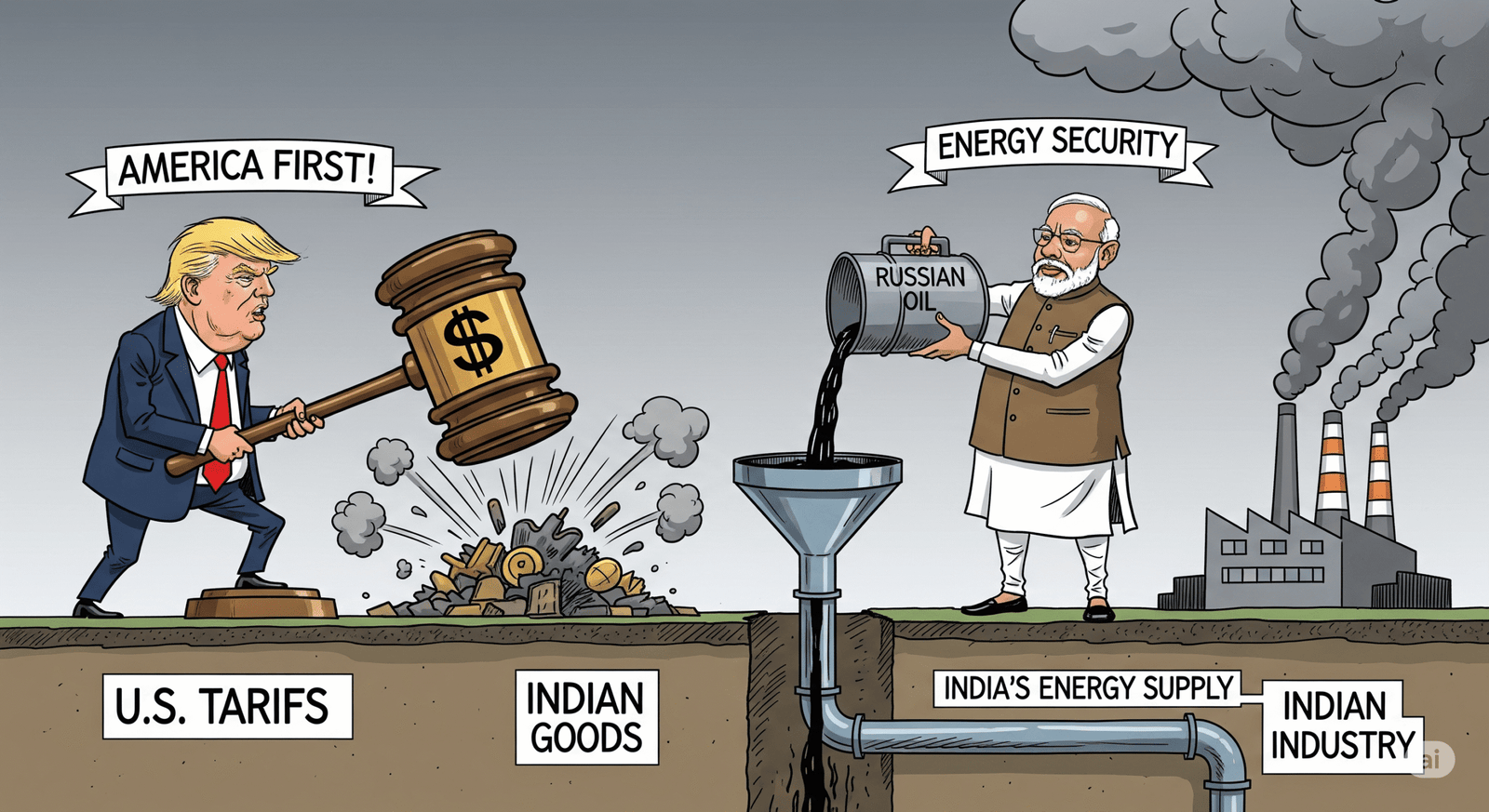
In a dramatic and unexpected turn of events, the United States has imposed a new, punitive tariff on Indian imports, signaling a major escalation in global trade relations and raising serious questions about the future of key strategic alliances.31 The decision, driven by the administration of President Donald Trump, specifically targets India’s continued purchase of discounted Russian oil, a move the White House has characterized as undermining U.S. sanctions against Russia and posing a “national security issue.”32
The new measure, an additional 25% tariff, comes on top of a separate 25% duty that had already taken effect.33 This brings the combined tariff rate on many Indian goods to a staggering 50%, placing India among the most heavily taxed exporters to the U.S. market.34 The move has been met with immediate and forceful pushback from New Delhi, with the Ministry of External Affairs denouncing the tariffs as “unfair, unjustified, and unreasonable.”35 Indian officials have firmly reiterated their position that the country’s oil imports are based on market factors and are crucial for meeting the energy needs of its 1.4 billion people.36 They have also pointed out the perceived hypocrisy of the U.S. singling out India when other nations, including some in Europe, have also continued to trade with Russia.37
The implications of this new tariff regime are far-reaching. Economically, the impact on India is projected to be significant. Moody’s Ratings, a global credit rating agency, has warned that the tariffs could slow India’s GDP growth by up to 0.3% and severely challenge the country’s “Make in India” manufacturing ambitions.38 Indian exporters, particularly in key sectors like textiles, chemicals, and pharmaceuticals, now face a steep competitive disadvantage.39 The Federation of Indian Export Organisations (FIEO) has warned that nearly 55% of India’s shipments to the U.S. market could be affected, leading to canceled orders and a search for alternative markets.
Beyond the economic fallout, the diplomatic repercussions are equally profound. The U.S. and India have spent two decades building a strategic partnership to counter China’s growing influence in the Indo-Pacific.40 This partnership, solidified in the “Quad” alliance with Japan and Australia, is now under immense strain.41 Analysts worry that the tariffs risk fracturing this alliance and could push India closer to its traditional partners like Russia, or even its rival, China, which has been the subject of its own trade tensions with the U.S. A senior fellow at the Carnegie Endowment for International Peace, Ashley Tellis, was quoted as saying that the U.S. “could be heading into a needless crisis that unravels a quarter century of hard-won gains with India.”
The U.S. has not stopped with India. President Trump has also hinted at the possibility of imposing similar “secondary sanctions” on China for its continued oil imports from Russia.42 While China has been granted a temporary pause on new tariffs, the threat remains and adds another layer of uncertainty to an already volatile global trade environment.
As the deadlines for these tariffs loom, the world watches to see if a diplomatic solution can be found. The Indian government has expressed its willingness to continue negotiations, but has also vowed to take all necessary measures to protect its national interests.43 This new chapter in U.S. trade policy is not just about tariffs and trade deficits; it is a high-stakes gamble that could reshape global alliances and trade flows for years to come, with India finding itself at the center of a new and dangerous geopolitical power play.
Note: The following is a news summary based on the latest available information as of Friday, August 8, 2025.
Here are 21 key points on the latest developments regarding U.S. tariffs and trade:
- The U.S. has imposed new tariffs on a range of countries as of August 7, 2025.1
- A specific, additional 25% tariff on imports from India has been announced.2
- This tariff is in response to India’s continued purchase and resale of Russian oil.3
- A White House trade adviser characterized India’s actions as a “national security issue.”4
- The new tariff on India is in addition to an existing 25% tariff, bringing the total to 50%.5
- The initial 25% tariff on India came into effect on August 7, 2025.6
- The new, additional 25% tariff is scheduled to take effect on August 27, 2025.7
- The new tariffs were implemented via an Executive Order signed by President Donald Trump.8
- India’s Ministry of External Affairs has called the tariffs “unfair, unjustified and unreasonable.”9
- India has stated it will continue to protect its national interests and its energy security.10
- Indian officials argue that the country’s oil imports are based on market factors.11
- Reports from Indian sources indicate that India has no intention of halting its purchases of Russian oil.12
- President Trump has also hinted at the possibility of imposing secondary sanctions on China.13
- China, like India, has also been a major purchaser of discounted Russian oil.14
- Trump’s administration had previously granted a tariff pause to China.15
- The White House has confirmed that a framework exists to assess other countries’ involvement in Russian oil and recommend similar actions.16
- The new tariffs are expected to significantly impact India’s exports to the U.S.17
- Analysts from Moody’s Ratings predict that India’s GDP growth could slow by 0.3% due to the tariffs.18
- The move has been criticized for potentially damaging the strategic partnership between the U.S. and India, particularly within the Quad alliance.19
- Some analysts suggest the tariffs are a pressure tactic to force India to make concessions in stalled trade negotiations.
- The Indian government has indicated that it may look for alternative export markets if the U.S. becomes too difficult to trade with.
When, Where, Why, and Who
- When: The new, additional 25% tariff on Indian imports was announced on Wednesday, August 6, 2025, and is set to take effect 21 days later, on August 27, 2025.20 The initial 25% tariff came into effect on Thursday, August 7, 2025.21
- Where: The tariffs were announced and imposed by the United States, targeting imports from India.22 The geopolitical context for these actions is the ongoing conflict in Ukraine and the global trade of Russian oil.23 The potential for similar actions against China also places the focus on trade relations in the Indo-Pacific region.24
- Why: The U.S. has imposed these tariffs on India to pressure the country into stopping its purchases of Russian oil.25 The White House and President Trump argue that these purchases are undermining U.S. sanctions and helping to fund Russia’s war effort in Ukraine, which they have labeled a “national security issue.”26 The tariffs are also seen by some as a tactic to gain leverage in broader trade negotiations with India.
- Who: The key figures are U.S. President Donald Trump and his administration, who signed the Executive Order.27 The actions directly target India and its government, led by Prime Minister Narendra Modi.28 Other countries like China are also directly impacted by the threat of similar sanctions.29 The tariffs will also affect Indian exporters and U.S. consumers and businesses that rely on imported Indian goods.30