
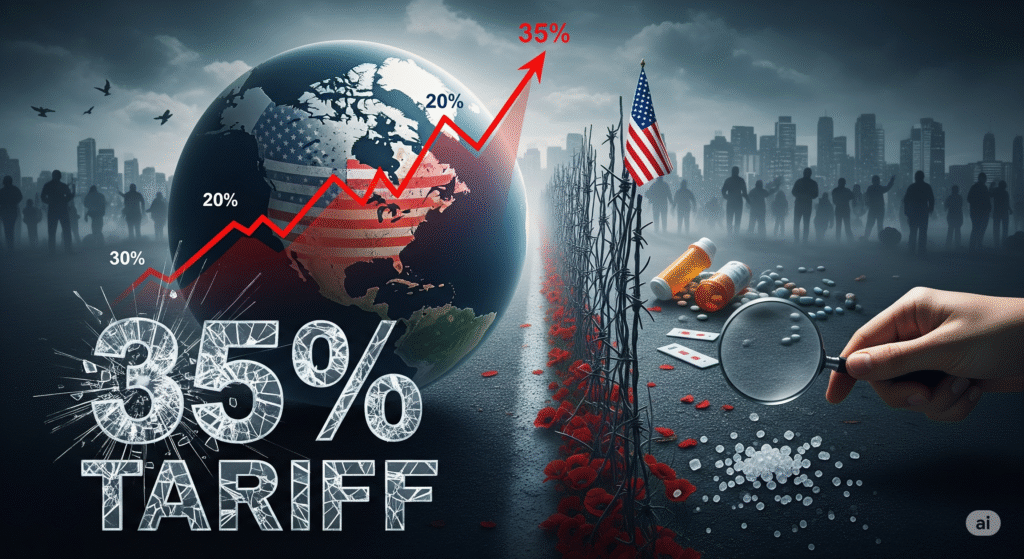
In a swift and impactful move, the U.S. administration has ratcheted up economic pressure on its northern neighbor, Canada, with a new executive order that increases tariffs on certain Canadian imports from 25% to 35%. The order, titled “Amendment to Duties to Address the Flow of Illicit Drugs Across our Northern Border,” went into effect on August 1, 2025, and signals a significant escalation in the ongoing trade dispute between the two nations. This action is framed as a critical response to a national emergency concerning the influx of illicit drugs, particularly deadly fentanyl, from Canada into the United States.
President Donald J. Trump’s administration has consistently tied its trade actions to national security and a perceived lack of cooperation from foreign governments. In this case, the White House has been explicit in its justification. According to a fact sheet released by the administration, the tariff increase is a direct result of Canada’s “continued inaction and retaliation” in the face of the growing opioid crisis. The U.S. government claims that Canada-based drug trafficking organizations are operating sophisticated “super labs” that produce massive quantities of fentanyl, and that seizures of the drug at the northern border have skyrocketed this fiscal year. This data, the administration argues, underscores Canada’s escalating role in a public health crisis that has already claimed countless American lives.
The Canadian government, led by Prime Minister Mark Carney, has pushed back against these claims. In a statement of disappointment, Carney highlighted that Canada accounts for only a small fraction of the fentanyl entering the U.S., with the vast majority originating from Mexico. He emphasized that Ottawa has been working intensively to curb the issue through enhanced law enforcement and border security measures. However, these arguments appear to have done little to change the White House’s course of action.
This tariff increase is not a standalone policy. It is an amendment to a series of tariffs first imposed in February 2025, following the declaration of a national emergency. At that time, a 25% tariff was placed on most Canadian imports, with some exemptions. This latest order raises that rate to 35%, while importantly maintaining a key distinction: goods that meet the rules of origin under the United States-Mexico-Canada Agreement (USMCA) will remain exempt. This suggests a strategic attempt to apply pressure without completely dismantling the core of the North American trade relationship.
For the Canadian economy, the impact of the new 35% duty is expected to be significant and far-reaching. Industries such as lumber, steel, and aluminum, which have long been integral to cross-border trade, are particularly vulnerable. The automotive sector, with its highly integrated supply chains that crisscross the border multiple times during production, also faces potential disruption. This economic pain is precisely the leverage the U.S. administration is seeking. The White House has made it clear that this is a punitive measure designed to force Canada to take more aggressive action on drug trafficking.
The political reaction in Canada has been swift and divided. While Prime Minister Carney has taken a measured tone, with his trade minister signaling a willingness to continue negotiations, other political figures have called for a more aggressive response. Ontario Premier Doug Ford, for instance, has advocated for a 50% counter-tariff on U.S. steel and aluminum, arguing that Canada should not “roll over” to U.S. demands. This internal debate reflects the difficult position Canada finds itself in: navigating a delicate balance between protecting its key industries and maintaining a functional relationship with its largest trading partner.
As the new tariff takes hold, American consumers may also feel the effects. Higher duties on imported Canadian goods could translate into increased prices for a range of products, from building materials to everyday consumer items. The order also includes a harsh penalty for transshipment, with a 40% tariff on goods found to be rerouted to avoid the duties. This is a clear signal that the administration is serious about enforcement and will not tolerate circumvention of its trade policies. Ultimately, this executive order is a stark reminder of how interconnected trade, national security, and domestic politics have become in the North American context. It is an action that prioritizes a tough stance on illicit drugs, using the powerful tool of economic leverage to reshape the bilateral relationship with Canada.
Amendment to Duties to Address the Flow of Illicit Drugs Across our Northern Border
Date: July 31, 2025
When, Where, Why, and Who
- When: The executive order was signed on July 31, 2025. The new tariff rate of 35% became effective at 12:01 a.m. EDT on August 1, 2025.
- Where: This order applies to certain goods imported into the United States from Canada, specifically those that do not qualify for duty-free treatment under the United States-Mexico-Canada Agreement (USMCA).
- Why: The order’s stated purpose is to address what the U.S. administration describes as a failure by Canada to adequately cooperate in stemming the flow of illicit drugs, particularly fentanyl, across the northern border. It is a continuation of a national emergency declared earlier in the year related to this issue. The tariff increase is intended to be a punitive measure to compel Canada to take more aggressive action.
- Who: The order was issued by President Donald J. Trump. The increased tariffs will primarily affect Canadian exporters and U.S. businesses and consumers who rely on imported goods from Canada. The implementation and enforcement of the order are delegated to the Department of Homeland Security and Customs and Border Protection (CBP).
Key Directives of the Executive Order
- Date of the Order: The executive order was signed on July 31, 2025.
- Effective Date: The new 35% tariff rate took effect on August 1, 2025.
- National Emergency: The order is justified under a pre-existing national emergency related to the flow of illicit drugs, especially fentanyl, across the northern border.
- Tariff Increase: The order amends a previous tariff, raising the rate on certain Canadian imports from 25% to 35%.
- Exemption for USMCA Goods: Products that meet the rules of origin under the United States-Mexico-Canada Agreement (USMCA) remain exempt from this tariff.
- Targeted Goods: The tariffs apply to a wide range of goods not covered by the USMCA, including some in industries like lumber, steel, aluminum, and automobiles.
- Transshipment Penalty: Goods that are found to have been transshipped to evade the 35% tariff will be hit with an even higher tariff of 40%.
- CBP Data: The White House cited a significant increase in fentanyl seizures at the northern border in the current fiscal year, stating that seizures have surpassed the total of the past three years combined.
- “Super Labs”: The administration claims that Canada-based drug trafficking organizations operate “super labs” capable of producing large quantities of fentanyl, primarily in rural areas of western Canada.
- Retaliatory Measures: The U.S. administration also cited Canada’s own retaliatory trade measures against earlier U.S. tariffs as a factor necessitating the increase.
- Canadian Prime Minister’s Reaction: Canadian Prime Minister Mark Carney expressed disappointment, stating that “Canada accounts for only 1% of U.S. fentanyl imports” and that Canada has been working to reduce these volumes.
- Industry Impact: Canadian industries such as lumber, steel, aluminum, and parts of the automotive sector are expected to be the most heavily impacted by the duties.
- U.S. Legal Authority: The order is based on the International Emergency Economic Powers Act (IEEPA).
- Preceding Actions: This order follows a series of previous tariff-related actions against Canada since February 2025, which included the initial 25% tariff.
- Canadian Response: The Canadian government has vowed to “act to protect Canadian jobs, invest in our industrial competitiveness, buy Canadian, and diversify our export markets.”
- No Talk with Carney: President Trump noted he had not spoken with Prime Minister Carney on the day the order was signed, despite the Prime Minister’s office reportedly reaching out.
- Ontario Premier’s View: Ontario Premier Doug Ford has called for a strong counter-response, including a 50% counter-tariff on U.S. steel and aluminum imports.
- Broader Context: This tariff increase is separate from the “reciprocal” tariffs imposed on dozens of other countries, which are set to take effect on a later date.
- Consumer Impact: The tariffs are expected to lead to higher prices for certain imported goods in the U.S. and potentially disrupt cross-border supply chains.
- Ongoing Negotiations: Despite the tariff hike, Canadian Trade Minister Dominic LeBlanc has indicated that trade talks with the U.S. are ongoing and that Canada remains prepared to continue working toward a new trade agreement.
- Potential for a New Deal: The order, in part, serves as a negotiating tool, with the possibility of future modifications to the tariffs if a new trade agreement is reached.