
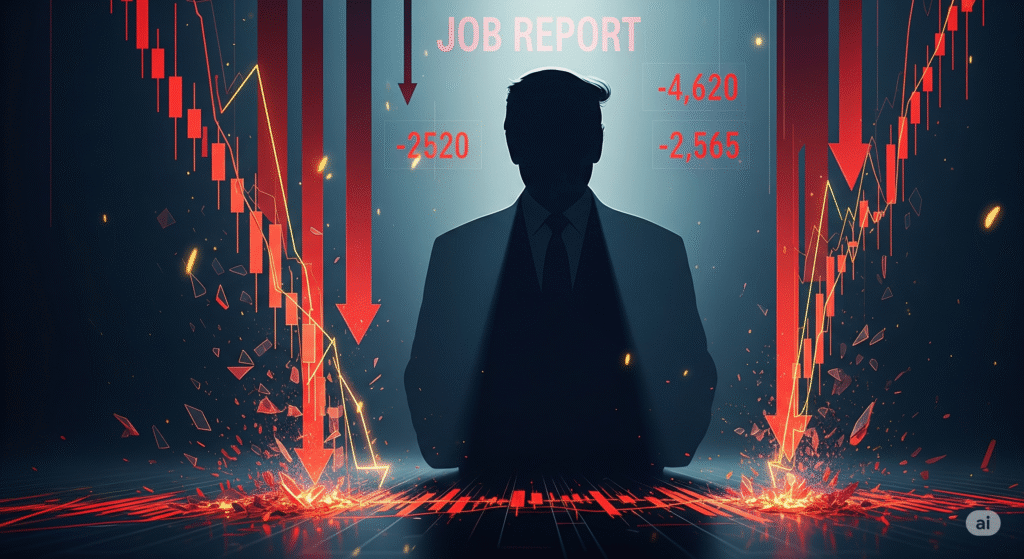
Friday, August 1, 2025, will be remembered on Wall Street as the day a long-simmering sense of uncertainty finally boiled over. A potent combination of disappointing economic data and renewed fears over President Trump’s aggressive tariff policy sent U.S. stock markets into a tailspin, with the S&P 500 suffering its steepest single-day decline since June. This market downturn was not a random fluctuation; it was a stark and direct reaction to a precarious global economic environment where data and political rhetoric are now intertwined with devastating consequences.
The first domino to fall was the U.S. jobs report for July, released by the Bureau of Labor Statistics. The report, which is one of the most closely watched indicators of economic health, showed weaker-than-expected job creation. Instead of the robust numbers analysts had predicted, the economy added far fewer jobs than anticipated, and the unemployment rate unexpectedly inched upward. This data was a heavy blow to market confidence, which had been buoyed in recent weeks by a belief that the U.S. economy was resilient and on a steady growth path. The weak numbers immediately raised a red flag, casting doubt on the economic outlook for the latter half of 2025. For investors, it was a clear signal that the economic engine might be sputtering, and it immediately fueled speculation that the Federal Reserve might be pressured to consider interest rate cuts sooner rather than later to stimulate growth.
If the jobs report was the first strike, President Trump’s tariffs were the second. Just as markets were reeling from the economic data, the specter of the administration’s new tariff regime loomed large once again. The tariffs, which are the most aggressive in nearly a century, have been widely criticized for their potential to disrupt global supply chains, increase costs for U.S. consumers, and ultimately, slow down global economic growth. The uncertainty surrounding their full impact and the potential for retaliatory measures from other countries, including key trading partners like the European Union and China, created a significant headwind for the market. Investors, already spooked by the jobs report, saw the tariffs as a compounding risk factor that could push the economy closer to a recession.
The resulting sell-off was a textbook example of a “risk-off” environment. Capital flowed out of stocks and into safer assets like government bonds. Technology and consumer discretionary sectors, which are particularly sensitive to economic fluctuations and consumer spending, were hit especially hard. The market’s reaction was a clear message to policymakers: the current mix of disappointing economic data and protectionist trade policy is a recipe for instability.
For the Federal Reserve, the jobs report presents a significant new challenge. The Fed had recently stated that its future interest rate decisions would be “data-dependent.” Now, with the data clearly pointing to a slowing labor market, the central bank is under immense pressure to re-evaluate its monetary policy. The market is now looking ahead to the next Fed meeting, hoping for some guidance on how the central bank plans to navigate this complex and uncertain economic landscape.
Ultimately, the market downturn on Friday was a culmination of a difficult week. It demonstrated the fragility of the current economic environment and the profound impact that both economic data and political policy can have on global markets. It was a perfect storm, where a single piece of disappointing news combined with a pervasive sense of geopolitical risk to send a powerful warning signal to investors, businesses, and policymakers around the world. The week ended with a question mark hanging over the global economy, and the coming days will be a crucial test of its resilience.
Based on the latest reports from Friday, August 1, 2025, here are 21 bullet points on the recent downturn in global markets.
- Date: August 1, 2025
- Market Performance: U.S. stock markets experienced a significant downturn.
- S&P 500: The S&P 500 saw its steepest single-day decline since June 2025.
- Cause 1 (Jobs Data): The downturn was primarily triggered by disappointing U.S. job data.
- Jobs Report: The Bureau of Labor Statistics released a report showing weaker-than-expected job creation in July.
- Unemployment Rate: The unemployment rate unexpectedly ticked up.
- Fed Implications: The weak jobs data led to speculation that the Federal Reserve might be forced to consider interest rate cuts sooner than previously anticipated.
- Cause 2 (Tariffs): Renewed uncertainty over President Trump’s new tariffs also contributed to the market sell-off.
- Tariff Impact: The tariffs have created significant concerns about their potential to disrupt global supply chains and slow economic growth.
- Global Reaction: The U.S. market downturn had a ripple effect, causing global markets to follow suit.
- European Markets: Major European indices, including the DAX and FTSE 100, closed lower.
- Asian Markets: Asian markets are expected to open in the red on Monday.
- Investor Sentiment: The data and tariff news created a “risk-off” environment, with investors moving away from stocks and into safer assets like government bonds.
- Economic Forecast: The jobs report cast doubt on the strength of the U.S. economic outlook for the second half of 2025.
- Sector Performance: Technology and consumer discretionary stocks were among the hardest hit sectors in the market sell-off.
- Federal Reserve’s Stance: The Federal Reserve had recently indicated that its next moves on interest rates would be “data-dependent,” making the jobs report particularly impactful.
- Corporate Earnings: The market uncertainty overshadowed what had been a mixed but generally positive corporate earnings season.
- President Trump’s Role: President Trump has repeatedly defended his tariff policies, arguing they are necessary to protect American industries.
- Analyst Commentary: Market analysts described the day as a confluence of negative factors, with one expert calling it a “perfect storm.”
- Previous Highs: The downturn wiped out some of the gains seen in previous weeks, which were driven by a short-lived surge in confidence.
- Looking Ahead: Market participants are now focused on the Federal Reserve’s next policy meeting and the ongoing international trade negotiations.
When, Where, Why, and Who
- When: The stock market downturn occurred on Friday, August 1, 2025. The jobs data was released on the same day.
- Where: The main events took place on U.S. stock markets, including Wall Street, but their effects were felt in global markets.
- Why: The downturn was a direct result of two key factors: weaker-than-expected U.S. job creation data, which fueled concerns about economic growth, and renewed uncertainty surrounding the broad and aggressive tariffs implemented by the Trump administration, which threaten to disrupt the global economy.
- Who: The key actors are the investors who reacted to the news; President Trump, whose tariff policies are a central point of concern; the U.S. Federal Reserve, which will now have to consider the data in its future interest rate decisions; and the U.S. Bureau of Labor Statistics, which released the disappointing jobs report.