




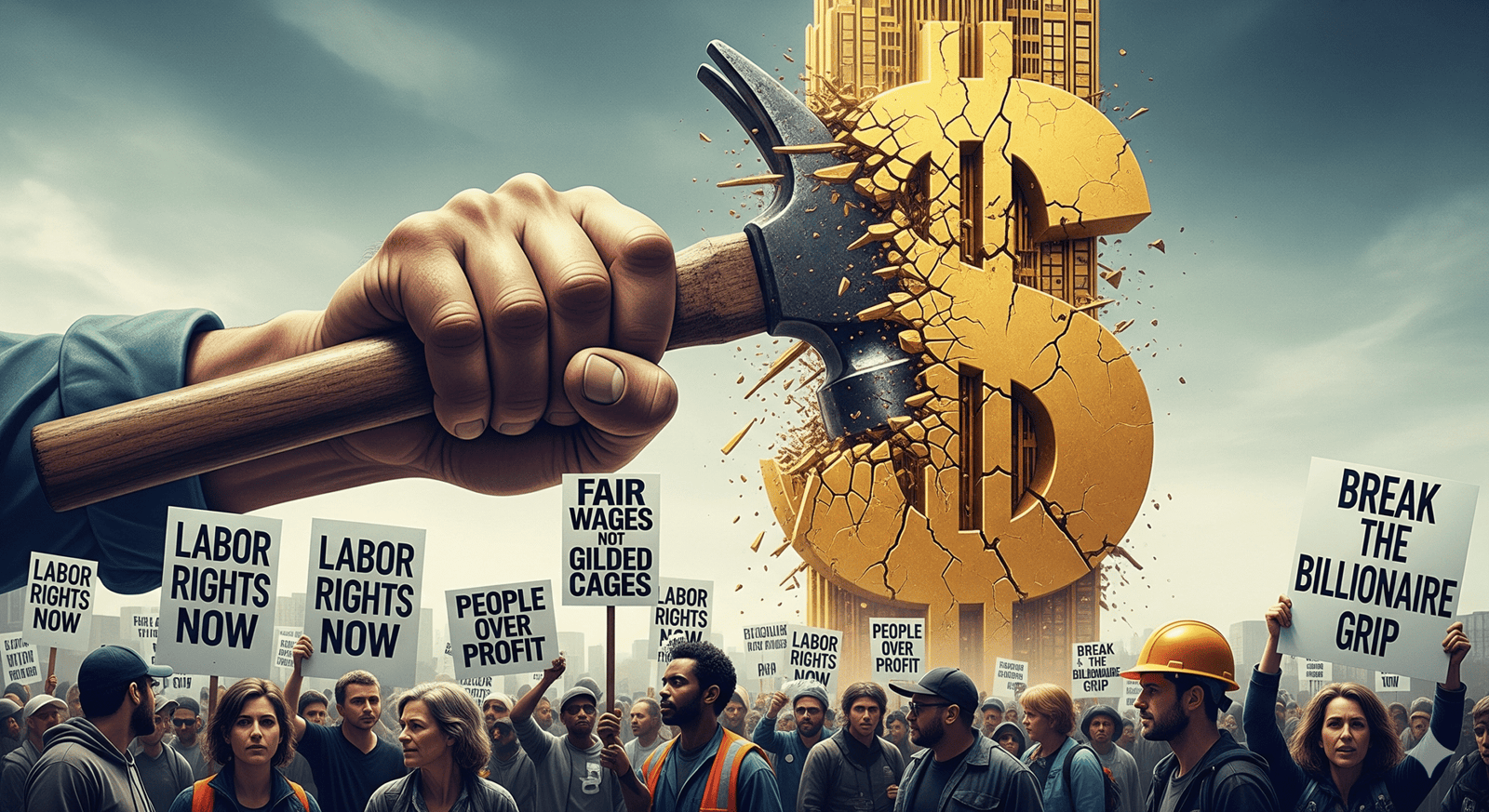
On September 1, 2025, Labor Day in the United States was transformed from a traditional holiday of picnics and parades into a powerful day of protest and political mobilization.1 Hundreds of “Workers Over Billionaires” rallies took place across all 50 states, drawing tens of thousands of people to the streets to voice their grievances against a range of policies from the Trump administration.2 This unprecedented, nationwide action marked a significant moment of public dissent, as workers and their allies sought to reclaim the holiday’s original purpose: a day to celebrate the contributions of labor and to demand economic justice.
The protests, organized by a coalition of labor unions and advocacy groups, including the May Day Strong coalition and the AFL-CIO, were fueled by a deep-seated frustration with an economy and a political system that many believe is rigged in favor of the wealthy elite.3 The “Workers Over Billionaires” banner succinctly encapsulated a widespread sentiment that the current administration’s policies, from tax cuts for corporations to attacks on unions and social safety nets, were actively widening the chasm between the ultra-rich and the working class. The rallies were not just a reaction to one or two policies but a collective outcry against a perceived “billionaire takeover” of the federal government and the erosion of worker power.
In cities large and small, from New York to Los Angeles and from Chicago to a 17-mile human chain in California, protesters carried signs and chanted slogans that highlighted their diverse yet interconnected concerns.4 In New York, crowds gathered outside Trump Tower, calling for a living wage and universal healthcare.5 In Chicago, Mayor Brandon Johnson, a former teacher and union organizer, led a rally that specifically protested the Trump administration’s threat to deploy federal troops to the city as part of a crackdown on immigration and crime.6 The fear of federal overreach and the protection of marginalized communities were recurring themes, intertwining economic issues with civil liberties.7
The broad scope of the protests reflected a coalition that extended far beyond traditional labor unions.8 Advocacy groups for tax fairness, immigrant rights, and racial justice joined forces, creating a powerful, united front. This collaboration demonstrates a growing understanding that economic injustice is deeply linked to other forms of social inequality. The rally’s organizers, like the May Day Strong coalition, emphasized that the actions were not limited to a single day but were part of a sustained effort to build a bigger and stronger movement that could challenge the concentration of wealth and power.9
While the Trump administration responded to the day with a social media post of the president shaking hands with workers, the contrast between the government’s message and the protestors’ actions was stark. The widespread dissent on Labor Day serves as a powerful indicator of the political climate. It signals that a significant portion of the American populace feels that their economic and political futures are slipping out of their control. The rallies were a visible and vocal demand for a country that prioritizes public schools, affordable housing, healthcare, and a living wage—a country that puts workers over billionaires.
21 Bullet Points on “Workers Over Billionaires” Rallies (September 1, 2025)
- Hundreds of “Workers Over Billionaires” rallies took place across the U.S. on Labor Day.10
- The protests were held on Monday, September 1, 2025.11
- The rallies were organized in all 50 states, with an estimated 865 to over 1,000 events.12
- The protests were aimed at the Trump administration’s policies and what organizers called a “billionaire takeover.”13
- Tens of thousands of people participated in the demonstrations.14
- The events were a joint effort by labor unions and various advocacy groups.15
- The May Day Strong coalition, AFL-CIO, and others were key organizers.16
- Protesters demanded stronger worker protections and economic justice.17
- The rallies called for fully funded schools, universal healthcare, and affordable housing.18
- Many demonstrations focused on specific grievances, such as the minimum wage.19
- In Chicago, protesters rallied against the threat of federal troop deployment.20
- Chicago Mayor Brandon Johnson spoke at the rally, vowing to resist federal overreach.21
- In New York City, a large protest gathered outside the Trump Tower.22
- Protesters in New York chanted for a living wage and an end to the sub-minimum wage for tipped workers.23
- The protests highlighted shared concerns about the rising cost of living and basic goods.24
- A human chain was formed for 17 miles in California as part of the protests.25
- The movement seeks to build on momentum from earlier protests on May Day.
- The demonstrations were intended to be a mass action, not just a single event.
- Participants included a wide range of people, from union members to community activists.26
- The “Workers Over Billionaires” slogan reflects a central theme of economic inequality.27
- The rallies were a direct response to what organizers see as policies that benefit the wealthy at the expense of working families.
Separate Answer: When, Where, Why, and Who
When
The rallies took place on Labor Day, Monday, September 1, 2025.28
Where
The “Workers Over Billionaires” rallies took place across the entire United States, with events held in cities large and small in all 50 states.29 Key locations for major demonstrations included New York City, Chicago, Los Angeles, and Washington, D.C.30
Why
The protests were organized to express widespread opposition to the Trump administration’s policies, which organizers and participants believe favor billionaires and corporations at the expense of working-class families.31 Key issues included the demand for a living wage, universal healthcare, protection of social safety nets like Social Security and Medicaid, and an end to perceived attacks on unions and marginalized communities.32
Who
- The Protesters: Tens of thousands of people from a diverse array of backgrounds, including union members, community organizers, teachers, restaurant workers, and other concerned citizens.33
- The Organizers: A coalition of labor unions and advocacy groups, including the May Day Strong coalition, the AFL-CIO, the American Federation of Teachers, and groups like Americans for Tax Fairness and Indivisible.34
- The Subject of Protest: The Trump administration and its policies.
- Prominent Figures: Mayor Brandon Johnson of Chicago and Senator Bernie Sanders were among the political figures who spoke at the rallies.35