





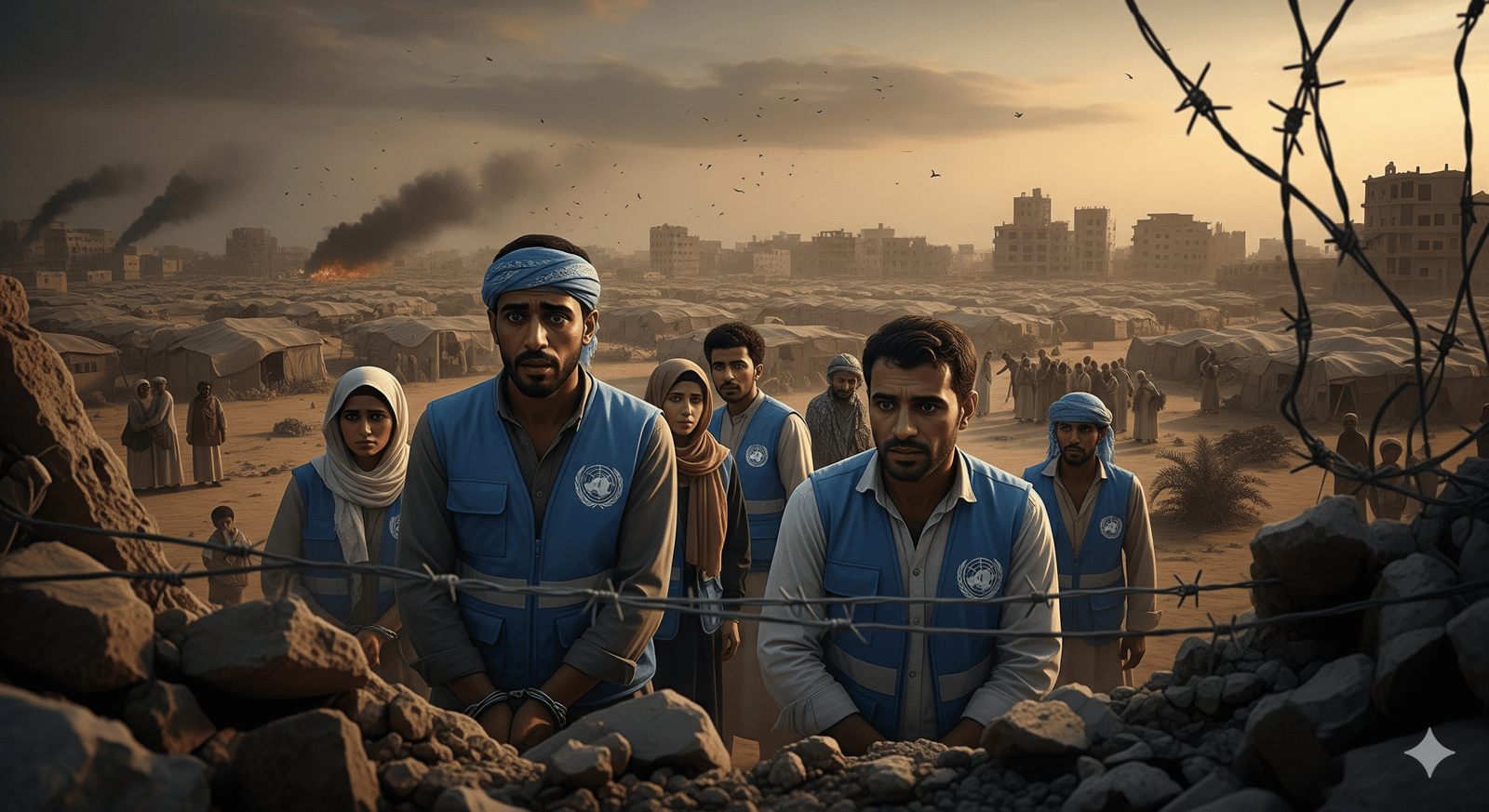
The already dire humanitarian crisis in Yemen has taken a sharp and alarming turn with the news that Houthi authorities in Sana’a have detained at least 11 United Nations workers. These arrests, which occurred on or around August 31, 2025, are more than just a political maneuver; they are a direct assault on the lifeline that keeps millions of Yemenis from starvation and disease. The raids on the offices of the UN’s food, health, and children’s agencies—the World Food Programme (WFP), the World Health Organization (WHO), and UNICEF—are a clear violation of international law and a flagrant disregard for the safety of aid workers who operate in one of the most dangerous and complex conflict zones on earth.
This latest crackdown is a chilling escalation in a long-running pattern of interference by the Houthis against international organizations. The UN Special Envoy for Yemen, Hans Grundberg, revealed that this new wave of arrests adds to a pre-existing number of detained UN personnel, some of whom have been held since 2021. The systematic targeting of aid workers, civil society members, and even former diplomatic staff shows a deliberate strategy to control the flow of information and aid, and to silence any voices that do not align with the Houthi narrative. The allegations of “spying for Israel,” which have been used as a pretext for these detentions, have been vehemently rejected by the UN and international bodies. They are baseless and serve only to justify a power grab that threatens to plunge the country into an even deeper abyss of suffering.
The timing of these detentions is particularly telling. They follow an Israeli strike that killed the Houthi-appointed prime minister and several other high-ranking officials. The Houthis, who have launched attacks on Israel and shipping in the Red Sea in response to the war in Gaza, are now using the UN as a proxy target for their rage and a way to exert pressure on the international community. This tit-for-tat violence, however, is a zero-sum game with the Yemeni people as the ultimate losers. The ability of humanitarian organizations to operate effectively is now severely compromised. Aid delivery, which more than half of Yemen’s population relies on, is at risk of being halted or dramatically scaled back. This could lead to a catastrophic increase in famine and a surge in preventable diseases, all while the world’s attention is fixated on other conflicts.
UN Secretary-General António Guterres has strongly condemned the detentions and called for the immediate and unconditional release of all personnel. His statement underscores the fundamental principle that humanitarian workers and their premises must be protected at all times. The international community faces a difficult choice: to stand firm in its condemnation and risk further escalation, or to negotiate a delicate path that secures the release of the workers while also ensuring that aid can continue to flow. There is no easy answer, and the consequences of either choice are immense.
Ultimately, the detention of these UN workers is a stark reminder of the human cost of a broader geopolitical conflict. It highlights how local conflicts are inextricably linked to regional and global tensions, and how the most vulnerable populations are always the first to pay the price. The global community cannot afford to look away. The lives of millions of Yemenis depend on the continued, unhindered efforts of humanitarian workers. Their freedom is not just a matter of justice for them; it is a matter of life and death for the Yemeni people.
21 Bullet Points on the Detention of UN Workers in Yemen (September 2, 2025)
- At least 11 United Nations workers were detained by Houthi authorities in Yemen.
- The raids and detentions took place on Sunday, August 31, 2025.
- The targeted UN premises were in the Houthi-controlled capital of Sana’a.
- Raids were conducted on the offices of the World Food Programme (WFP), UNICEF, and the World Health Organization (WHO).
- The Houthi authorities reportedly also seized UN property during the raids.
- The UN Secretary-General, António Guterres, strongly condemned the “arbitrary detentions.”
- The UN is demanding the immediate and unconditional release of all personnel.
- The latest detentions bring the total number of UN staff held by Houthis to a higher number, with some held since 2021.
- A security source stated that seven WFP and three UNICEF workers were among those arrested.
- The detentions came shortly after an Israeli airstrike killed the Houthi prime minister.
- The Houthi-run government has accused the UN workers of “collaborating with Israel.”
- The UN has vehemently rejected these allegations of espionage.
- The UN Special Envoy for Yemen expressed “great concern” over the detentions and the recent escalation.
- The arrests are seen as a form of retaliation by the Houthis for the Israeli strike.
- The targeting of humanitarian workers violates international law.
- The detentions severely hinder the delivery of life-saving aid in Yemen.
- Over half of Yemen’s population relies on humanitarian aid to survive.
- The incident threatens to worsen Yemen’s already catastrophic humanitarian crisis.
- The raids are part of a long-standing crackdown by the Houthis on international organizations.
- The UN’s ability to operate in Houthi-controlled areas is now at a critical juncture.
- The international community is urging for de-escalation to prevent Yemen from becoming a broader geopolitical battleground.
Separate Answer: When, Where, Why, and Who
When
The detentions of at least 11 UN workers took place on Sunday, August 31, 2025.
Where
The raids and arrests occurred in Sana’a, the Houthi-controlled capital of Yemen. The premises of several UN agencies, including the World Food Programme, UNICEF, and the World Health Organization, were targeted.
Why
The Houthi authorities have not provided a specific official reason for the detentions, but a security source stated they are on “suspicion of collaborating with Israel.” These raids are widely seen as an act of retaliation following an Israeli airstrike that killed the Houthi prime minister and other high-ranking officials just a few days earlier. The detentions are part of a broader, long-running pattern of Houthi harassment and control over humanitarian aid operations in their territory, often using unsubstantiated allegations of espionage to justify their actions.
Who
The people involved include:
- The Detained: At least 11 personnel from the United Nations, including staff from the World Food Programme (WFP), UNICEF, and the World Health Organization (WHO).
- The Detainers: Houthi authorities, also known as Ansar Allah, who control a large part of Yemen, including the capital Sana’a.
- The UN: Secretary-General António Guterres and the Special Envoy for Yemen, Hans Grundberg, have strongly condemned the actions and demanded the release of their staff.
- The Broader Community: The Yemeni people, who are reliant on the aid that is now at risk, and the international community, which is attempting to navigate the complex political and humanitarian landscape.