



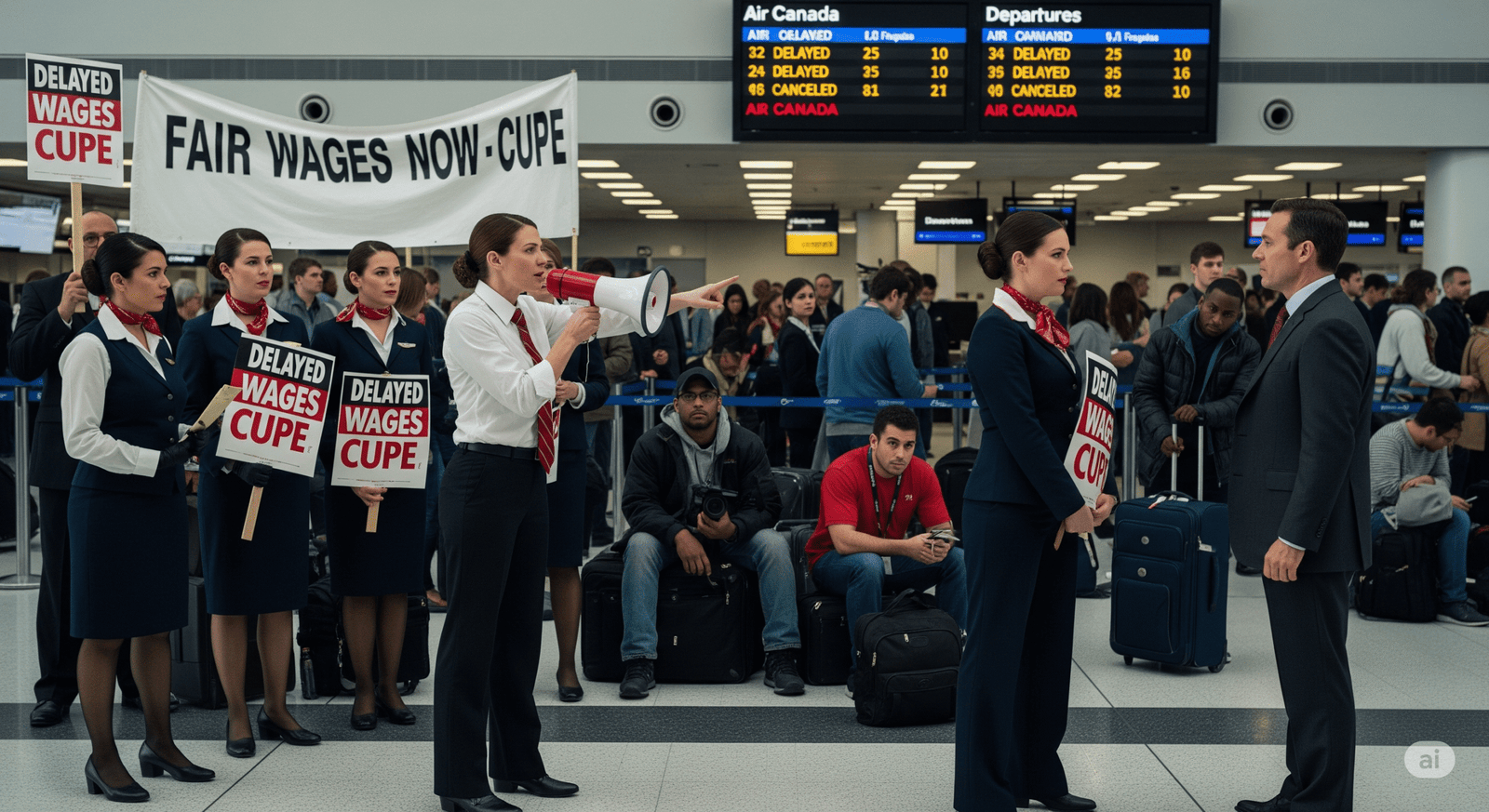
In a dramatic escalation of an already bitter labor dispute, Air Canada has suspended all operations after its flight attendants’ union, the Canadian Union of Public Employees (CUPE), defiantly refused a government order to return to work.1 This unprecedented act of defiance has not only plunged the country’s largest airline into chaos during the peak summer travel season but also highlighted a deep-seated frustration within the airline’s workforce.2 The strike, which has grounded hundreds of flights and stranded over 130,000 travelers per day, is more than a simple wage dispute; it is a battle for the fundamental rights of workers and a direct challenge to the authority of government intervention in labor conflicts.3
The strike, which began on Saturday, was the culmination of over eight months of stalled negotiations between Air Canada and CUPE.4 The central point of contention, and the issue that has galvanized the union’s members, is the demand for compensation for “groundwork”—the hours flight attendants spend on safety checks, preparing the cabin, and assisting passengers with boarding and deplaning.5 While it is a common industry practice to only pay flight attendants for the time a plane is in the air, the union argues that this amounts to “unpaid work” and is a core issue of fairness.6 They point out that a significant portion of their duties, often over two hours per flight, goes uncompensated, making their true hourly wage far less than what is advertised.7
In a move that many saw as a direct response to the strike, the Canadian government quickly intervened, with the Minister of Jobs directing the Canada Industrial Relations Board (CIRB) to impose binding arbitration and issue a back-to-work order.8 Air Canada, which had sought government intervention from the start, announced plans to resume flights, believing the strike would be short-lived.9 However, the union’s response was swift and resolute.10 CUPE leadership, backed by an overwhelming 99.7% strike vote from its members, called the government order “blatantly unconstitutional” and vowed to continue the strike.11 This defiance is rare and signals a profound level of anger and a belief that their right to collective bargaining has been violated.
The union has accused the government of a “disgraceful misuse of power” and a “blatant betrayal” of workers’ rights, claiming the government is siding with a “wildly profitable employer.”12 They also point to what they perceive as a gender-based disparity, noting that the largely female flight attendant workforce is being offered what they call a “below inflation” wage increase, while a largely male pilot workforce received a much more significant hike in their last contract.13 This adds a powerful layer of social justice to an already complex labor dispute.
For the Canadian economy, the strike is proving to be a costly affair. The Business Council of Canada has warned of “immediate and extensive harm,” with the disruption of passenger and cargo services at the height of the summer travel season.14 Stranded travelers are facing a nightmare scenario, with full flights on other airlines and soaring rebooking costs.15 The strike’s continuation, despite the government’s order, presents a difficult dilemma for the government. It is unclear what further actions they can take if the union continues to defy the order, raising questions about the future of government intervention in labor disputes.16 The standoff between Air Canada, its flight attendants, and the government is more than a fleeting news story; it is a test of labor rights, corporate power, and the role of the state in a modern economy.
21 Key Bullet Points on the Air Canada Strike (August 18, 2025)
- Date: August 18, 202517
- Event: Air Canada flight attendants’ strike.18
- Union: The Canadian Union of Public Employees (CUPE), representing over 10,000 flight attendants.19
- Strike Reason: The main issue is a demand for compensation for “unpaid groundwork” and a new contract with higher wages.20
- Unpaid Work: Flight attendants are not paid for duties performed before takeoff and after landing, which the union says amounts to hours of uncompensated labor.21
- Start of Strike: The strike began on Saturday, August 16, 2025.22
- Overwhelming Mandate: 99.7% of union members voted in favor of the strike.23
- Airline Response: Air Canada has suspended all operations of its mainline and low-cost carrier, Air Canada Rouge.24
- Impact on Travelers: Approximately 130,000 passengers are being affected per day during the peak summer travel season.25
- Government Intervention: The federal government, through the Minister of Jobs, directed the Canada Industrial Relations Board (CIRB) to end the strike.26
- Government Order: The CIRB issued a back-to-work order, ordering flight attendants back to duty by Sunday afternoon.27
- Union Defiance: CUPE has defied the back-to-work order, calling it “unconstitutional” and a violation of their charter rights.28
- Contention Over Wages: The union rejected Air Canada’s offer of a 38% pay increase over four years, calling it “below inflation” and a misrepresentation of the true value.29
- Gender-Based Disparity: The union has raised concerns about a perceived gender bias, noting that the largely female workforce’s pay is not keeping pace with what was offered to the largely male pilot workforce.30
- Economic Impact: The Business Council of Canada has warned of “immediate and extensive harm” to the Canadian economy.31
- Passenger Frustration: Stranded travelers are facing a travel nightmare, with limited alternative flights and high rebooking costs.32
- Government Stance: The government has justified its intervention by citing the need to protect the economy and prevent widespread travel disruption.33
- Legal Challenge: The union has stated its intention to challenge the government’s back-to-work order in court.34
- Airline’s Stance: Air Canada maintains that the union’s defiance is “illegal” and has suspended its plans to resume flights.35
- Solidarity: Other unions have reportedly joined the flight attendants on the picket lines in a show of solidarity.36
- First Strike in Decades: This is the first strike by Air Canada flight attendants since 1985.37
The Four W’s: When, Where, Why, and Who
- When: The strike began on Saturday, August 16, 2025, after months of failed negotiations.38 The government’s back-to-work order was issued shortly after, but the union defied it on Sunday, August 17, 2025.39 The news of the defiance and continued strike is being reported today, Monday, August 18, 2025.
- Where: The strike is primarily affecting Canada, with the central conflict taking place between Air Canada and its union.40 The disruptions, however, have a global reach due to Air Canada’s international routes, affecting travelers at airports worldwide.41
- Why: The strike is happening due to a breakdown in contract negotiations.42 The main points of disagreement are:
- Compensation for Unpaid Work: The union is demanding to be paid for all hours worked, including the time spent on the ground before and after a flight.43
- Wages: The union argues that Air Canada’s latest pay offer is not sufficient and falls below inflation, while the airline maintains it is a generous offer.44
- Defiance of Government Order: The strike has continued because the union views the government’s intervention as an unconstitutional infringement on its right to strike and a betrayal of workers’ rights.45
- Who: The key parties involved are:
- The Canadian Union of Public Employees (CUPE): The union representing the striking flight attendants.46
- Air Canada: The airline whose operations have been suspended.47
- The Canadian Government: The entity that has intervened in the dispute with a back-to-work order and a directive for binding arbitration.48
- Tens of thousands of Travelers: The passengers who are stranded or have had their travel plans disrupted by the strike.49
- Airline Industry Analysts: Experts who are assessing the economic impact and the future implications of the strike.