
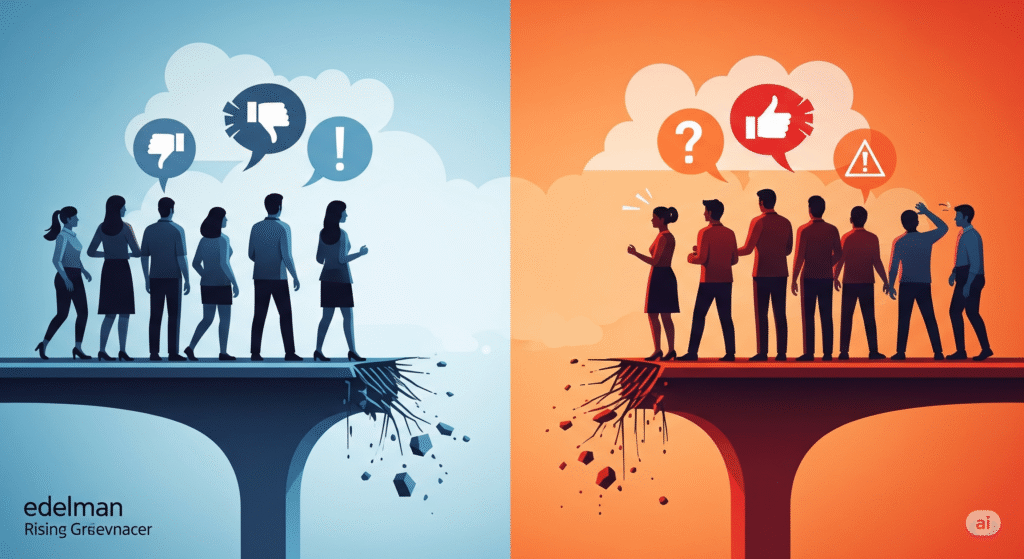
Edelman, a global leader in public relations and government affairs, has once again positioned itself at the forefront of understanding the complex relationship between institutions and the public. Its annual Edelman Trust Barometer, now in its 25th year, has become a key instrument for gauging the pulse of global trust in business, government, media, and NGOs. The 2025 report, “Trust and the Crisis of Grievance,” reveals a profound and concerning trend: a widespread sense of grievance that is fueling political polarization and a new acceptance of aggressive action. The findings underscore the critical role that firms like Edelman play in helping clients navigate these turbulent waters.
The core finding of the 2025 Trust Barometer is that economic fears have morphed into a deep-seated grievance. Six out of 10 respondents reported a moderate to high sense of grievance, defined as a belief that government and business serve narrow, wealthy interests while leaving ordinary people behind. This is a significant shift from mere distrust to a more active, zero-sum mindset where gains for one group are perceived as a direct loss for another. This sense of grievance has led to a surge in fear of discrimination and a lack of optimism for the next generation, with only 36% of respondents globally believing that things will be better for their children.
This “crisis of grievance” has direct and pressing implications for government relations and corporate reputation. For businesses, the report highlights a new set of guardrails for their involvement in societal issues. The public is more willing to accept corporate action on societal problems only if the business contributed to the problem, can make a significant impact, and if its actions also improve business performance. This is a clear signal that brand trust has shifted from societal purpose to personal relevance. Consumers are looking for brands that provide stability, optimism, and a sense of possibility in their own lives.
Edelman’s expertise in public and government affairs is more crucial than ever in this environment. The firm’s work now focuses on helping organizations not only engage with policymakers but also build stakeholder support and manage a heightened level of regulatory risk. With elections failing to improve trust in government, the onus is increasingly on businesses to act as a stabilizing force. The 2025 Trust Barometer indicates a trust gap of 30 points between those with high and low grievance, a chasm that can only be bridged by a cross-institutional effort. This involves businesses, governments, media, and NGOs working together to address the root causes of grievance, such as information integrity, affordability, and the future of AI.
The firm’s approach to public affairs and government relations in 2025 is predicated on a shift from traditional, relationship-based engagement to one that is research-based and evidence-driven. Edelman’s teams, comprising a diverse range of experts from domain experts to lawyers, are focused on developing long-term strategies that use compelling content to nurture relationships with a vast and complex stakeholder universe. This approach is designed to help clients not only anticipate issues but also plan for and respond to emerging challenges at the national, state, and local levels.
Furthermore, Edelman is also grappling with the evolving nature of crisis communications. With crises spreading twice as fast due to AI-driven misinformation and deepfakes, the firm emphasizes the need for a robust and transparent communication plan. The Trust Barometer’s findings show that brands that communicate openly during a crisis are more likely to retain customer trust. This necessitates a proactive approach that includes identifying potential risks, assembling a crisis team, and preparing holding statements in advance. As the world becomes more interconnected and volatile, the ability to build trust and navigate uncertainty becomes a key business imperative.
In summary, the 2025 Edelman Trust Barometer paints a sobering picture of a world divided by grievance and distrust. For a firm like Edelman, this presents both a challenge and an opportunity to leverage its expertise in corporate reputation, public affairs, and crisis communications to help its clients adapt and lead in this new reality. The shift from a “we” to a “me” brand trust model, coupled with the need for cross-institutional collaboration, will define the future of government relations and public affairs.
21 Bullet Points on the Latest News
- Date: August 17, 2025
- The 2025 Edelman Trust Barometer is titled “Trust and the Crisis of Grievance.”
- Six in 10 respondents report a moderate to high sense of grievance.
- Grievance is defined by a belief that government and business serve the wealthy.
- This mindset has led to an acceptance of aggressive action.
- Fear of discrimination has surged to a record high of 63%.
- Only 36% of respondents believe things will be better for the next generation.
- There is a 30-point trust gap between high and low grievance individuals.
- Brand trust has shifted from societal purpose to personal relevance.
- Consumers seek brands that provide optimism and stability.
- Businesses face new “guardrails” for their involvement in societal issues.
- Their actions must make a major impact and improve business performance.
- Edelman’s public affairs work is now research-based and evidence-driven.
- This approach replaces older, relationship-based models.
- Firms must build long-term relationships with a complex stakeholder universe.
- Crisis communications are now more critical due to AI-driven misinformation.
- Crises can spread twice as fast with AI-driven misinformation.
- Transparent communication during a crisis helps brands retain customer trust.
- The report urges a cross-institutional effort to address the roots of grievance.
- Trust remains highest in developing nations like China, Indonesia, and India.
- “My employer” remains the most trusted institution, despite a drop.
The Four W’s: When, Where, Why, and Who
- When: The findings are from the 2025 Edelman Trust Barometer, which was officially launched in January 2025. The special reports on specific topics have been released throughout the year, with a special report on Brand Trust released in June 2025.
- Where: The survey research for the Edelman Trust Barometer was conducted in 28 countries globally, with findings applicable to the U.S. and Europe, as well as developing nations. The insights from the report are discussed and utilized by professionals in public relations and government affairs worldwide.
- Why: The report was produced to measure the public’s level of trust in key institutions and to identify the key drivers of trust and distrust in the current global environment. The findings are used by Edelman to provide strategic advice to its clients on corporate reputation, public affairs, and crisis communications to help them navigate an increasingly polarized and grievance-filled world.
- Who: The key actors are Edelman, the global communications firm that produced the report; the 33,000 respondents from 28 countries who participated in the survey; and the various institutions (business, government, media, and NGOs) that are the subject of the survey’s findings. The insights are particularly relevant to businesses and government officials who need to build and maintain public trust.