




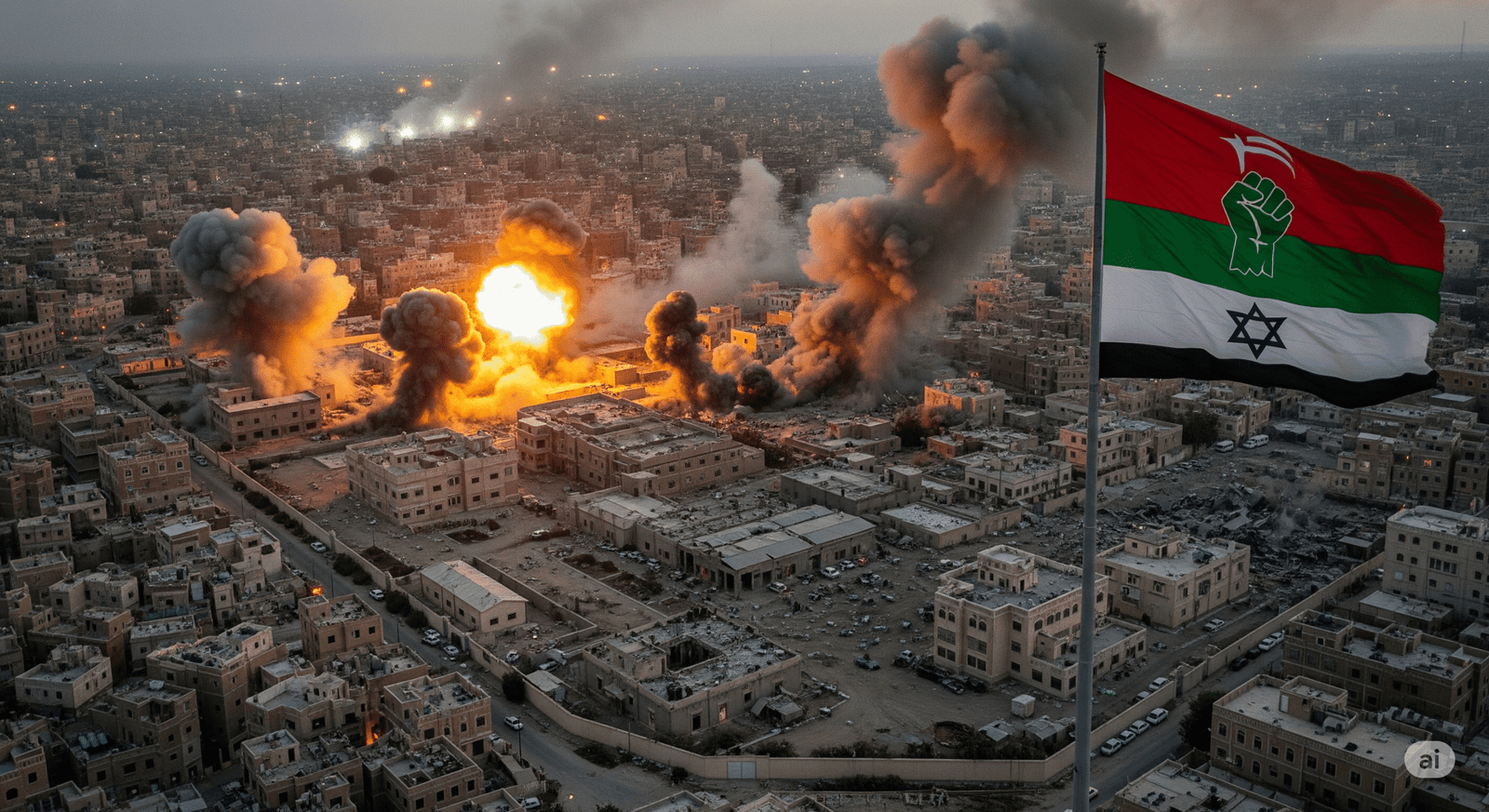
The volatile situation in the Middle East has once again demonstrated its capacity to spiral outward, with the conflict’s front lines now extending far beyond Gaza. In a dramatic escalation, Israeli airstrikes have targeted Yemen’s capital, Sana’a, in what the Israeli government has called a retaliation for repeated missile and drone attacks by the Iran-backed Houthi rebels.1 The strikes, which reportedly killed at least six people and injured dozens, represent a significant broadening of the conflict, directly engaging two non-contiguous states in a deadly exchange.2 This marks a new and perilous chapter, where the war is no longer a localized struggle but a regional fire, with multiple actors and a complex web of allegiances.
The Houthi movement, which controls a significant portion of Yemen, has been launching attacks against Israel and Red Sea shipping for months in what they claim is an act of solidarity with the Palestinian people in Gaza.3 Their actions, while largely intercepted by Israeli defenses, have nonetheless been a persistent and provocative challenge.4 The recent Israeli strikes in Sana’a, hitting military compounds, power plants, and a fuel depot, are a clear message that Israel will not tolerate these attacks and is willing to project its military power across the Arabian Peninsula.5 The Houthis, for their part, have vowed to continue their campaign, ensuring a cycle of retaliation and a dangerous expansion of the war. This situation underscores the fragility of the region, where a single conflict can quickly draw in a multitude of parties, each with their own interests and agendas.
Adding to the complexity is Israeli Prime Minister Benjamin Netanyahu’s statement regarding a potential withdrawal from Lebanon.6 Netanyahu has said that Israel could reduce its military presence in southern Lebanon and eventually withdraw entirely, but only on the condition that Hezbollah, the powerful Iran-backed group, is disarmed.7 The statement comes in the wake of a recent decision by the Lebanese government to work towards disarming Hezbollah, a move that the Israeli Prime Minister has welcomed as “momentous.”8 However, this is a path fraught with immense difficulty.
Hezbollah, which is both a political party and a heavily armed militant organization, has rejected the idea of disarmament, arguing that its weapons are essential for defending Lebanon against Israeli aggression.9 The group has publicly stated it will not disarm until Israel withdraws from the five contested hills inside Lebanon and ceases its airstrikes, which have continued even after the US-brokered ceasefire.10 This creates a deeply entrenched and seemingly intractable stalemate. The Lebanese government, under immense US pressure, has taken a step towards disarming the group, but Hezbollah’s leadership has publicly vowed to resist any such effort.11 Netanyahu’s offer, while seemingly a step towards de-escalation, is a conditional one that hinges on an outcome that Hezbollah has already rejected.
The situation in Lebanon is a microcosm of the broader regional tensions. The presence of powerful, non-state actors like Hezbollah and the Houthis, who are aligned with Iran, creates a permanent state of instability. These groups act as proxies, allowing Iran to project its influence and challenge Israel without a direct, state-on-state confrontation. Israel’s response, which is increasingly direct and uninhibited by international borders, risks further entrenching these conflicts and igniting a multi-front war. The recent events—the strikes on Sana’a and the conditional offer regarding Lebanon—highlight a dangerous shift. The conflict is no longer a series of isolated battles but a single, interconnected web of violence that threatens to engulf the entire region, with each new strike and political maneuver bringing the region closer to a full-scale conflagration. The stakes have never been higher, and the path to peace has never seemed more elusive.
21 Bullet Points on Middle East Tensions
- Date: Tuesday, August 26, 2025
- Israeli airstrikes have hit Yemen’s capital, Sana’a.12
- The strikes were in retaliation for recent attacks by Houthi rebels.13
- The Houthi rebels have been targeting Israel with missiles and drones.14
- The strikes killed at least six people and injured dozens.15
- The Israeli military confirmed hitting Houthi military sites, including the presidential palace, power plants, and a fuel depot.16
- The Houthis stated that the attacks would not deter their support for Palestinians in Gaza.17
- This exchange marks a significant broadening of the conflict beyond the Israeli-Gaza border.
- Israeli Prime Minister Benjamin Netanyahu has stated a condition for withdrawing from Lebanon.18
- The condition is the complete disarmament of Hezbollah.
- This statement follows a decision by the Lebanese government to work toward disarming the group.19
- Netanyahu called the Lebanese government’s decision “momentous” and offered “reciprocal measures.”20
- Hezbollah, the Iran-backed group, has publicly rejected the idea of disarmament.21
- Hezbollah’s leadership insists it will not disarm until Israel withdraws from five hills it occupies in Lebanon.22
- Hezbollah also demands an end to Israeli airstrikes inside Lebanon.23
- The conflict between Israel and Hezbollah has been ongoing, even after a US-brokered ceasefire in November 2024.
- Israel accuses Hezbollah of violating the ceasefire by rebuilding its military capabilities.24
- The two events highlight the interconnected nature of the conflicts in the Middle East.
- Powerful, non-state actors like the Houthis and Hezbollah are central to these tensions.
- The situation risks igniting a multi-front war across the region.
- The latest actions by all parties indicate a deepening cycle of violence and retaliation.25
Separate Answer: The Latest Middle East Tensions
When?
The Israeli strikes on Yemen’s capital, Sana’a, occurred on Sunday, August 24, 2025.26 Prime Minister Netanyahu’s statement regarding Lebanon was made on Monday, August 25, 2025.27
Where?
The airstrikes were in Sana’a, Yemen, the capital city controlled by Houthi rebels.28 Netanyahu’s statement was made in Israel, likely from Jerusalem or Tel Aviv. The events concern the conflict between Israel and two powerful groups, the Houthis in Yemen and Hezbollah in Lebanon.
Why?
The Israeli strikes on Sana’a were a direct retaliation for missile and drone attacks launched by Houthi rebels toward Israel.29 The action is intended to deter further Houthi attacks and to demonstrate Israel’s capacity to strike its enemies across the region.30 Netanyahu’s statement on Lebanon is a response to the Lebanese government’s recent decision to work toward disarming Hezbollah.31 The statement outlines Israel’s condition for withdrawal, which aims to secure its northern border and neutralize a major threat.
Who?
The Israeli military carried out the strikes on Yemen.32 The targets were Houthi rebels and their infrastructure.33 The victims of the strikes were Yemeni civilians and military personnel. On the political front, the key figures are Israeli Prime Minister Benjamin Netanyahu, leaders of Hezbollah in Lebanon, and officials of the Lebanese government. The Houthis are the other key actor in the conflict, operating from Yemen.34